This story is from an installment of The Oeno Files, our weekly insider newsletter to the world of fine wine. Sign up here.
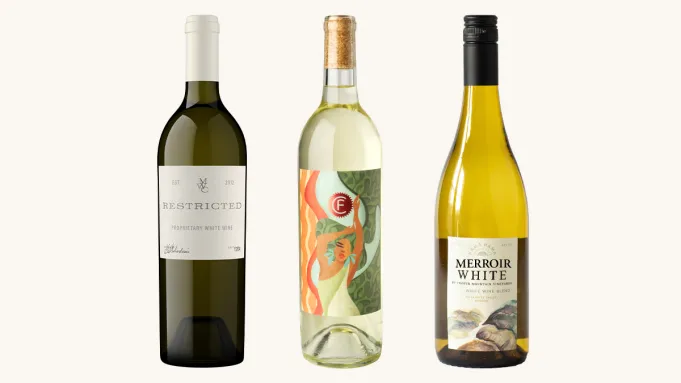
Old-World purists, avert your eyes. While most of the familiar multi-variety white cuvées are traditional blend styles from regions like Rhône Valley, Rioja, Tuscany, or Bordeaux, a handful around the globe—and especially from the New World—combine varieties that would infuriate traditionalists. Examples include California’s Restricted Proprietary White Blend, made with Chenin Blanc, Pinot Blanc, Roussanne, Albariño, Sémillon, and Sauvignon Blanc, and Clif Family x Reyna Noriega White Wine, a 50-50 blend of Chardonnay and Viognier. While many would argue that these do not even belong in the same region, let alone the same bottle, the result of these carefully thought-out blends is a delicious and complex glass of wine that demonstrates the advantages of creativity in the winemaking process.
In many cases, the wines are the result of successful planting experiments that caused winemakers to look for non-traditional combinations of the grapes they had growing in their vineyards. “We’ve planted a handful of less common varieties at this site, driven by curiosity and a desire to see how they translate in a different environment,” winemaker Gianna Ghilarducci says about the Russian River Valley Marsanne in her Restricted Proprietary White Blend. “In this case, the cooler conditions shape Marsanne into something restrained, lower in alcohol, and defined by a leaner structure with a beautiful textural layer. It brings a quiet depth to the blend while also offering an ageing potential that may surprise people.”
A fan of aromatic whites, Ghilarducci says Pinot Blanc serves as the backbone of the blend, bringing a clean line of mouthwatering acidity, while Albariño lifts the aromatics with delicate florals and a subtle coastal salinity. Meanwhile, Marsanne adds weight and texture through the mid-palate, and Chenin Blanc contributes vibrancy and a bright, zesty finish. While Pinot Blanc, Marsanne, and Chenin Blanc are all French varieties native to Burgundy and the Rhône and Loire valleys, respectively, pouring a glass of this delicious and age-worthy wine would certainly elicit a finger wag and cry of “mon dieu!” from a Frenchman, especially with the addition of Albariño, which hails from the border of western Spain and northern Portugal.

Massican
Grapes from Burgundy and the Rhône also come together in winemaker Laura Barrett’s Clif Family x Reyna Noriega White Wine, a wine and art collaboration that brings together Clif Family’s organically farmed wines with the bold artistry of Miami visual artist Reyna Noriega. Clif Family had been purchasing both Chardonnay and Viognier grapes from growers in the Oak Knoll District to make single-varietal bottles, but when they acquired their property in 2018 the team planted these two varieties along with nine others. While Rhône Viognier often emphasizes elegance, minerality, and texture, Barrett says in California it tends to bring out aromatics, richness, and fruit expression. “This contrast is why Viognier can work so well in a blend with Chardonnay in California,” she says. And although it is drinking beautifully now, as it ages, the fruit will soften, and it will become more layered and complex with a potential to drink beautifully for another five or six years.
Farther north, in Oregon’s Willamette Valley, Cooper Mountain Vineyards produces a wine called Merroir White from Tocai Friulano, Pinot Gris, and Gewürztraminer, a blend that is common in northern Italy but very unusual in the United States, as it is rare to find the three varieties planted in proximity to one another here. In partnership with Hama Hama Oysters, Cooper Mountain crafted a wine to complement the flavor profile of native Pacific bivalves. “The proportions of the blend were carefully selected to enhance the oysters’ natural sweet and briny character,” explains Cooper Mountain co-owner Barbara Gross. Winemaker Gilles de Domingo says while Pinot Gris is a well-established variety in the Willamette Valley, the Tocai Friulano was planted in 2004 as a varietal exploration and ongoing experiment and that the Gewürztraminer followed in 2008 to be used as a blending component offering aromatic lift and texture. “The result is not an imitation of Northern Italy but rather a distinctly Oregon interpretation shaped by its own soils, climate, and identity,” he explains.
The primary grape in these cuvées is often one that is almost unknown outside its home region. Case in point: Massican 2023 Maryam + Company, a blend of 90 percent Loureiro with 5 percent each Cortese and Falanghina. The Loureiro, a Portuguese native that is a primary ingredient in Vinho Verde, is from a vineyard in Clarksburg, Calif., whose owner discovered it on vacation and wanted to experiment with it back home; the two Italian varieties are planted in the same location. Massican founder and winemaker Dan Petroski made it with Napa Valley wine strategist Maryam Ahmed in honor of a conference she runs called Field Blends. While Massican’s prime inspiration is white wines of the Mediterranean, especially Italy, Petroski says he has never felt constrained by traditional regional rules. “Loureiro brings an herbaceous, green snap to the wine, the Cortese brings a hint of texture and mid-palate, while the Falanghina acts like a squeeze of fresh lemon on the finish,” he tell us.
Another grape that’s rarely seen in the United States is Santorini native Assyrtiko, which winemaker Kristina Shideler used as the main variety in Stonestreet Winery 2025 White Blend alongside 13 percent Sémillon. “In 2020, we planted an area of our mountain estate to various white varieties to explore drought resistance on soils that were otherwise too weak for Bordeaux varieties,” she says. “It was very clear early on that Assyrtiko was the shining star with its aromatic intensity, laser-like acidity, and ability to build gorgeous texture in the winemaking.” Although as wine drinkers we are accustomed to tried-and-true formulas, especially among traditional blends, as Shideler points out, “It’s easy to put your reservations aside when something is undeniably delicious.”
Do you want access to rare and outstanding reds from Napa Valley? Join the Robb Report 672 Wine Club today.
Authors
-
Mike DeSimone and Jeff Jenssen

-
Coastal Coin Necklace
$34.00 -
Resort Palmtree Necklace
$64.00 -

Oceanside Sparkle Studs
$38.00 -

Coin Necklace
$34.00