For Isabella Franco, founder of Lupettatelier, the idea of a home by the sea had been quietly forming for decades. The Milan-based architect and her husband, Riccardo Proni, spent years traveling across Italy with their two sons, now 25 and 22, exploring coastlines, small towns, and rural stretches in both Europe and the U.S. Yet despite the breadth of their travels, one destination resurfaced again and again in their conversations: Pantelleria, the volcanic island set between Sicily and North Africa, where they felt the strongest sense of connection. “We have loved this island for a long time,” Franco says.
Both in their late 50s, Franco and Proni had known Pantelleria long before they arrived at the house that would eventually become theirs. Proni, who works as a V.P. of R&D for a software company focusing on fashion and retail markets, first visited in the early 1970s with his uncle, a journalist who bought a home on the island in the late ’60s after researching the Sicilian archipelago for an article. Franco began traveling to the island in the late 1990s. Over the years, they returned for long weekends and summer trips, feeling increasingly drawn to the island’s rhythm and isolation. “We started going there occasionally from 1997,” Franco says. “Then in 2020 we began dreaming of having our own dammuso.”

From left: A sealed door was transformed into a window overlooking the terrace; a painting by local Pantelleria artist Maria Collavini resting on the floor of the primary bedroom just behind a vintage rocking chair.
Photography by Beppe Brancato/Styling by Giulia Taglialatela
Pantelleria differs sharply from many Mediterranean islands. Instead of sandy beaches, its dark volcanic cliffs drop abruptly into the sea. Inland, ancient lava flows form jagged ridges of black stone, while steady winds sweep across terraces, vineyards, and low dry-stone walls. These conditions shaped how people built and farmed on the rugged landscape for centuries. Traditional dammusi, the dome-roofed stone dwellings scattered across the island, emerged directly from the challenging terrain and its scarcity of resources. Their massive exterior walls—often more than 20 inches thick—are constructed entirely from volcanic rock.
Ironically, the same molten lava that once devastated the island has both built it back up and kept these dwellings cool. The dense stone serves as a sort of natural insulation that keeps interior temperatures cool in summer and warm in winter. The design is so effective that Franco and Proni rarely need air-conditioning, even when summer temperatures climb past 104 degrees Fahrenheit. The dammuso stays temperate thanks to its 19-to-23-inch-thick stone walls, which slowly absorb heat during the day and release it at night, and its domes—more than 13-feet tall—that allow rising heat to dissipate above the living spaces.
Water management remains equally central to daily life on Pantelleria. Although the island now has a desalination plant that provides supplemental water, rainwater collection is still essential. The domed roofs divert precipitation into underground cisterns, sustaining life on the arid island just as they have for generations. Rather than being fully coated in lime-based mortar, as many dammusi are, the domed roofs here are traced with thin seams of the impermeable material. From afar, the white lines appear decorative; up close, they reveal themselves to be functional channels that seal cracks and direct water flow. Living with the system requires restraint: quick showers, no waste. Even after returning to Milan, the couple find themselves more mindful of conservation.

From left: A view of the dramatic cliffs formed by ancient volcanic lava; the scenic landscape beyond the house and a neighboring dammuso.
Photography by Beppe Brancato/Styling by Giulia Taglialatela
It was this deep respect for the traditional architecture that guided Franco and Proni’s search for a home of their own. The couple was clear about what they did not want: Managing a major construction project from Milan sounded exhausting. They hoped to find a house that still held its authenticity—original materials, solid bones, and the potential to make thoughtful updates rather than undertake a complete rebuild. “We were looking for something that wouldn’t require a full renovation,” Franco says.
They finally found a place that felt right in May 2023. Built in the early 1900s, the traditional peasant house sat on terraced land and consisted of several connected dammusi. The main residence stood on the upper level, while a smaller dépendance, or outbuilding, was partially carved into the lower terrain. The previous owner, a well-known local restaurateur, had preserved many original features. They made an offer two months after their first visit.

Thin seams of lime-based mortar snake across the top of the dammuso to seal cracks and direct water flow.
Photography by Beppe Brancato/Styling by Giulia Taglialatela
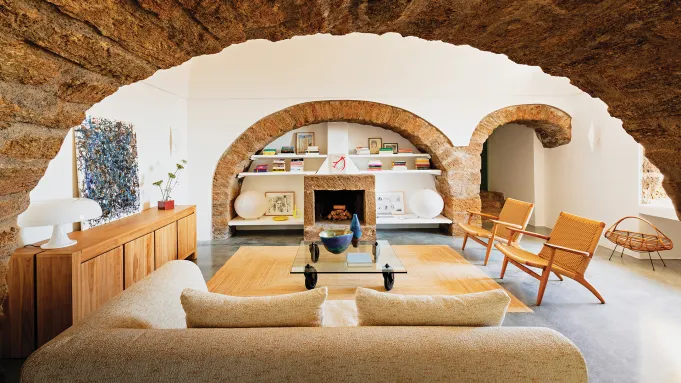
Inside their main house, vaulted ceilings rise more than 14 feet. Old cementina tiles in soft reds, greens, and creams pattern the floors, while stone arches connect rooms and thick stucco walls curve seamlessly into the domed ceilings above. The layout includes a generous living area with an open kitchen, two bedrooms, and two bathrooms. The dépendance, once a small storeroom with an oven, had already been converted into a guest unit with its own kitchen, bedroom, and bathroom, offering privacy for visiting friends and family.
The land itself tells an even older story. Near the pool, shallow stone hollows mark where Zibibbo grapes were once laid out to dry for Passito di Pantelleria, the island’s renowned sweet wine. They remain untouched, now reading as sculptural reminders of the land’s former use. Millstones in the garden suggest that grain was once processed on the property long ago. Inside, the vaulted room that now serves as the living area was once a milling space. “A donkey would turn the wheel,” Franco says. These traces of self-sufficiency only strengthened the couple’s determination to preserve the site’s history.

Milanese architect Isabella Franco.
Photography by Beppe Brancato/Styling by Giulia Taglialatela
One element made the decision even easier: the pool. On Pantelleria, where nearly the entire island is a protected national park, obtaining a permit for new pools is nearly impossible. This house already had one. Renovations lasted about six months and were intentionally subtle. The electrical system was updated, the kitchen structurally reworked so they could install modern appliances, and a few new openings were added to increase natural light. A sealed door in the living room, for example, became a window overlooking the terrace and surrounding vegetation. Where original cementina tiles were missing, Franco opted for smooth resin flooring that would be easy to maintain.
Island artisans shaped much of the transformation, handling everything from masonry repairs to custom windows to cabinetry and furniture, working with a level of care that respected the building’s age and character. The interiors blend original features with contemporary furnishings and pieces designed by Franco herself. In the living room, a custom sofa upholstered in Rubelli fabric sits beside the fireplace, while a glass FontanaArte table by Gae Aulenti anchors the room. Ceramics and paintings by Pantelleria-based artists—including Sebastiano Fischer, Maria Collavini, and Andrea Chiaravalli—bring color, texture, and a sense of place.

Original cementina accent tiles leading to the alcove.
Photography by Beppe Brancato/Styling by Giulia Taglialatela
The bedrooms retain the traditional alcova layout, a shallow, arched niche historically used for sleeping. In the main bedroom, Franco placed the bed within the alcova and built wardrobes with open shelving. “One thing I definitely didn’t want was to create closed wooden wardrobes in the bedrooms, as over time they tend to trap humidity,” she explains. “So I decided to build masonry wardrobes with shelves and hanging space, which I intentionally left open.”
The adjoining bathroom maintains its original cementina floor tiles and is finished in a pink concrete-resin playing off the existing terra-cotta tones. At its center, a barrel-vaulted dome—one of the home’s most striking architectural features—extends across the entire space. The curved form, also coated in pink concrete resin, echoes the hues of the floor tiles and mirrors the geometry of traditional dammusi.

The guesthouse shower’s vaulted ceiling and locally sourced stone tiles.
Photography by Beppe Brancato/Styling by Giulia Taglialatela
In the second bedroom, known as “the red room,” a natural stone outcrop rises through the floor. Rather than removing it, the couple built steps and placed the bed on a raised platform that accommodates the rock, allowing the interior to follow the terrain.
The kitchen opens directly onto the terrace and quickly became a central gathering point. Franco designed the table, which was made by a local artisan, and paired it with Carl Hansen chairs. Open shelving displays ceramics and objects from the couple’s personal collection. The layout encourages airflow and takes advantage of natural light, creating a space that feels larger and more fluid than its footprint suggests.
Outdoor living defines much of daily life. Beneath a pergola, Franco installed built-in concrete seating of her own design topped with custom cushions. Nearby, wooden side tables and a larger terrace table—both devised by Lupettatelier and crafted by Falegnameria F.lli Casano, a woodworking studio in Pantelleria—accent the pool area. The pool itself is lined in dark concrete resin, echoing the island’s volcanic landscape. “Pantelleria is black,” Proni says. “So, for us, it’s really in-line with the color and style of the island.”

The concrete-resin pool with a view.
Photography by Beppe Brancato/Styling by Giulia Taglialatela
Restoring the garden proved to be the most challenging—and rewarding—part of the project. The land beneath the pool had been neglected and overgrown. The couple employed local craftsmen to clear the area and built two terraces supported by drystone walls using the same techniques once employed for cultivating capers. A gardener helped them plant a fig tree, olive trees, and flowering shrubs. Despite the painstaking work, Franco describes the transformation as deeply satisfying. “We brought life and balance back to a neglected area,” she says.
Designing her own home, however, proved unexpectedly challenging for Franco. As an architect, she was used to interpreting a client’s needs and guiding them toward decisions. With her own space, the possibilities felt endless. “For a client, I make propositions,” she says. “But for myself, the choices, there are too many.”

From left: Franco paired custom concrete seating and cushions with Lupettatelier tables crafted by Falegnameria F.lli. Casano; terracotta pots with prickly pear cacti decorating the facade.
Photography by Beppe Brancato/Styling by Giulia Taglialatela/Living Inside
Ultimately, the home is a seamless transition from the natural terrain outside. Rooms rise and fall with the landscape, and ceiling heights shift with each domed structure. Morning sun fills the living area, softening the tones of stucco and stone. Afternoon light sweeps across the terrace, casting long shadows along arches and curved walls. By night, warm copper hues stretch across the hills, filling the rooms. Franco and Proni kept the circulation intuitive, resisting any intervention that might interrupt the architecture’s original flow.
In the end, the island itself became her guide. What emerged is a deeper sense of continuity—a connection between the land’s history and the life she and her family now inhabit there. “Living here means enjoying a space that is truly ours,” Franco says, “where every detail tells a story and every corner feels welcoming and alive.”
Authors
-

Abby Montanez
-
Coastal Coin Necklace
$34.00 -
Resort Palmtree Necklace
$64.00 -

Oceanside Sparkle Studs
$38.00 -
Coin Necklace
$34.00