Today, any time spent behind the wheel of a 1960s-era race car—sans power steering and with a finicky manual gearbox—comes with a newfound respect for drivers of the period who piloted them around global circuits in competition. Imagine how that respect must grow exponentially when going back a few decades further to the still-nascent days of motorsport, when automobiles were little more than powerful engines with frighteningly thin wheels attached.
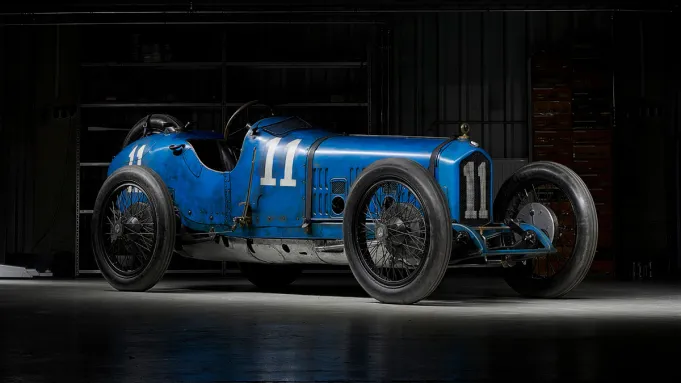
At the end of the first 20 years of the last century, the Ballot 3/8 LC Grand Prix Two-Seater represented what was then bleeding-edge automotive tech and motoring at its visceral finest. On January 29, one of the only four examples presumed to have been made of the French model will be offered through Gooding Christie’s as part of its Rétromobile Paris Auction.

This 1920 Ballot 3/8 LC Grand Prix Two-Seater will be a headliner at the Gooding Christie’s Rétromobile Paris Auction on January 29.
Courtesy of the owner
The idea for the rare Ballot racer, of which only three now exist, was born in 1919, as the world began the recovery process after its first eponymous war. Part of that return to a new normal included getting motorsport back in gear. According to the Gooding Christie’s lot description, “Frenchman René Thomas convinced engine manufacturer Ernest-Maurice Ballot, who had made a considerable fortune supplying engines for the war effort, to build a complete car that would make his mark in racing.” For this project, Ballot enlisted the help of Ernest Henry, the man responsible for what the auction house notes “was the first engine to combine twin camshafts, four valves per cylinder, and hemispherical heads in a four-cylinder powerplant.”

According to its current steward’s evidence, chassis No 1006 was the car piloted to overall victory at the 1921 Italian Grand Prix.
Courtesy of the owner
When it came to the car he was developing for Ballot, though, Henry gave his milestone mill four additional cylinders and, ultimately, a displacement of 3.0-liters. With a total output of 108 hp—managed by a four-speed manual transmission—the innovative model was dressed in bodywork also designed by Henry and equipped with cable-operated drum brakes and leaf-spring suspension.
“Ballot made an indelible mark in international racing in the early 1920s, competing at Indianapolis, the French and Italian Grand Prix with their 3 Liter, 8 Cylinder, Twin Cam hemi head engine penned by engineering genius Ernest Henry,” says Rupert Banner, senior specialist at Gooding Christie’s, when asked by Robb Report to comment on the car.

A look at the car’s 108 hp, 3.0-liter inline-eight engine by Ernest Henry.
Courtesy of the owner
The research provided by Gooding Christie’s mentions that three examples of the Ballot 3/8 LC Grand Prix Two-Seater, piloted by René Thomas, Ralph DePalma, and Jean Chassagne, lined up at the starting grid of the 1920 Indianapolis 500. DePalma was the frontrunner for all but the final 35 miles of the contest when a fire resulted in his fifth-place finish. Yet Thomas managed to place second overall.
The Ballots would finish in second and third at the following year’s French Grand Prix, but the model’s true claim to fame occurred at the 1921 Italian Grand Prix. According to its current steward’s evidence, the matching-numbers car on offer—chassis No. 1006—was the overall winner at that contest (though another Ballot owner asserts that it could have been their example). The average speed of the first-place finisher was reported at the time to be 144 kph (89.4 mph).

The model is equipped with cable-operated drum brakes and leaf-spring suspension.
Courtesy of the owner
In 1923, chassis No. 1006 was sold to UK-based Malcolm Campbell, who raced it until 1927, then sold it to Jack Dunfee, one of the legendary band of gentlemen racers known as the Bentley Boys. The auction house mentions that, with the car, Dunfee “continued Campbell’s racing legacy, starting some 38 races over the following six years and achieving 11 wins along with numerous additional podium finishes.”
The provenance of the vehicle goes on to include ownership by, among others, racer Joan Richmond as well as a Michael Crowley-Milling and, eventually, his nephew Humphrey. The car was acquired in 2016 by the consignor, whose painstaking efforts restored it to road-ready condition. “This car, with a pedigree that stretches back to day one and includes ownership by Malcolm Campbell, is the most original of only three survivors and has been shown at many European show and touring events,” Banner tells Robb Report.

Rupert Banner, senior specialist at Gooding Christie’s, states that chassis No. 1006 “is the most original of only three survivors” when it comes to this Ballot model.
Courtesy of the owner
In summing up the relevance of chassis No. 1006, Banner states, “It is an incredibly important piece of engineering and motorsport history and an unrepeatable opportunity.” This opportunity carries an estimated price varying between €3.5 million and €6 million (approximately $4.07 million and $6.98 million).
Click here for more photos of this 1920 Ballot 3/8 LC Grand Prix Two-Seater.

The 1920 Ballot 3/8 LC Grand Prix Two-Seater set to be auctioned through Gooding Christie’s.
Courtesy of the owner
Authors
-

Viju Mathew