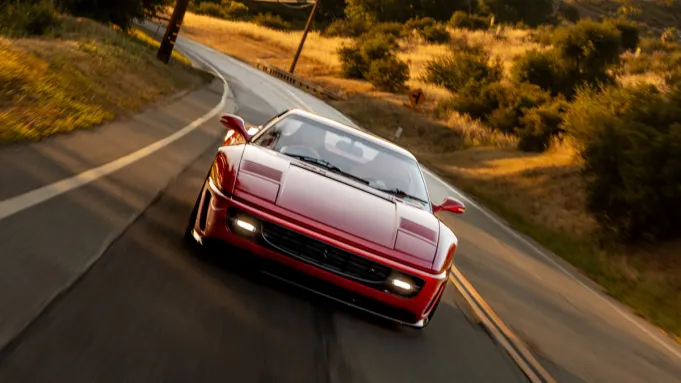
It’s 1995, and you’ve had a dope year. Your stock portfolio is booming and there’s a sports car–sized hole in your garage itching to get filled. You could go for the wide-hipped Porsche 993 Twin Turbo or a rowdy Lamborghini Diablo SV. But the Prancing Horse beckons. Fortunately for you, Ferrari president Luca di Montezemolo, who famously griped about the mediocrity of the 348, has launched the radical new F355.
If the 348 was one of the few forgettable Ferraris, its successor knocked it out of the park with peerless styling, an exotic five-valve-per-cylinder V-8, and a quantum leap in performance. The F355 would reestablish Ferrari‘s dominance. But three decades later, the model has been eclipsed by countless exotic sports cars since . . . or has it?

British firm Evoluto Automobili aims to close the gap between nostalgia and reality by addressing the 30-year-old Ferrari F355 the same way shops like Singer and Tuthill have been transforming Porsche 911s for years: by optimizing, hot-rodding, and rebuilding these dated machines with a fresh vision for what an analog sports car can be. All it takes is a donor car—possibly crashed but “not burnt or bent,” according to Evoluto’s communications manager Rob Borrett—nine months of patience, and $795,000. Voila, your F355 has been transformed into a highly functioning reinterpretation of its Bill Clinton–era former self.
New for 2026
Evoluto’s parent company, DRVN Automotive Group, is no stranger to the high-end market, with involvement in the tech, aerospace, and engineering spaces, and serving as the official U.K. distributor for Koenigsegg.
Evoluto came about when DRVN’s chairman, Darren McDermott, was fed up with the long waits associated with hypercar acquisitions, inspiring him to fund the business. He assigned Ian Muir as C.E.O. and set out to create a Ferrari restomod that could do battle with the industry best in terms of fit, finish, and performance. DRVN acquired the Penso engineering consultancy to execute the 355 restomod. The firm has previously done white-label work on high-performance projects like the Jaguar Project Seven.

The 355 by Evoluto requires more build time than it took to make the original Ferrari F355.
Rob Borrett, courtesy of Evoluto Automobili Limited
Donor 355s are first stripped down to the chassis and dipped, cleaned, and reduced to bare metal. Ten pieces of carbon fiber are affixed to the chassis, which has the benefit of increasing torsional stiffness by 23 percent. Lightweight components are installed throughout, including a carbon-fiber skin. The new interior has zero panels in common with the original, and the engine, transmission, and suspension are, of course, also modified (more on that later).
Suffice to say that the resulting 355 by Evoluto is essentially as brand new as a car that just rolled off the assembly line, with more man hours dedicated to manufacturing, assembly, and fettling of each example than it took to build an original Ferrari F355. The resulting car is 220 pounds lighter and 100 hp more powerful than the original.
Design
Evoluto’s head designer is Ian Callum, famed for his work with Aston Martin and Jaguar, and he certainly knows a thing or two about proportion. That’s critical to this car’s success, because messing with the delicately proportioned F355 could have easily ended disastrously. Whereas the original relies on primarily planar surfaces, the Evoluto replaces every exterior panel with subtly flared carbon fiber, and gives the car rear vents that recall the 288 GTO. Wider wheel positioning enhances tire grip at turn-in and cornering traction.

The car’s aesthetic modifications reflect the vision of renowned automotive creative Ian Callum, head designer for Evoluto Automobili Limited.
Rob Borrett, courtesy of Evoluto Automobili Limited
One subtle visual trick involves slightly enlarged side air intakes, which lend the car a more aggressive look. The door handle was rearranged in order to accommodate the bigger breathers, and one resulting tradeoff is the awkward need to push with one hand while using another to open the door.
Ferrari’s signature engine-bay window can be ordered in a tinted or clear polycarbonate and reveals the 3.5-liter V-8 surrounded by slick carbon-fiber panels and air intakes. The curved rear window is also polycarbonate, enabling more engine sound to permeate the cabin.
Not a single interior panel remains from the original car. The cockpit is a sleek, carbon-and-leather-trimmed space with beautifully finished aluminum switchgear and absolutely zero digital screens, save the option for one: your cell phone, which can be cradled in an available mount that incorporates finishes of matte carbon fiber and polished aluminum.

The interior is an analog oasis.
Evoluto Automobili Limited
The view from the driver seat is refreshingly clear, with a low windshield offering excellent visibility of the road ahead. The redesigned steering wheel has a lightness to its look, and as with the original, the famous Ferrari gated shifter remains a visual highlight of the interior and can be ordered as a replacement for the paddle shift–actuated F1 gearbox. Instead of the metal ball sitting atop the hand shifter, a unique donut-shaped knob—composed of metal and carbon fiber—offers an ergonomically easy place to rest your hand when not clinking through the gears.
Power Train and Hardware
Evoluto’s naturally aspirated 3.5-liter V-8 incorporates a series of modifications to squeeze an additional 100 hp from the power plant, giving it a total of 420 hp. Among the 200-plus altered drivetrain components are ported heads, a bespoke stainless steel exhaust system, titanium driveshafts, a lightweight flywheel, and an upgraded cooling system. An available larger-bore 3.7-liter option features titanium connecting rods and produces 473 hp. The engine is engineered for easier maintenance by incorporating a new, one-piece aerospace-grade wiring harness. Because the service procedure for the engine belt usually involves the arduous removal of numerous harnesses, the revised setup saves time and labor through just one connection.

Evoluto’s naturally aspirated 3.5-liter V-8 delivers 420 hp.
Evoluto Automobili Limited
The suspension has been reworked by completely altering its geometry, mounting points, and damping. Critically, Evoluto widens the vehicle’s front track (width) by 77 mm (3.03 inches) and the rear by 66 mm (2.59 inches), enabling sharper turn-in and a more planted feeling. The new hardware includes new wishbones, uprights, wheel hubs, and bearings. Working with the suspension specialists at R53, Evoluto offers new dampers that are tuned for the revised setup to optimize ride and handling. A new electrohydraulic steering system features a quicker ratio of two turns, lock-to-lock.
Performance
As much as an Evoluto looks similar to a Ferrari F355, it drives like the classic was struck by lightning and transformed into a sharper, more aggressive and responsive version of a 90s-era sports car. Quicker steering enlivens it on Malibu’s tightest stretches, such as Latigo Canyon Road, where it flicks, rotates, and occasionally slides through the succession of zigzags. The suspension feels thoroughly modern, articulating over road irregularities with ease. However, the low ride height made it a challenge to keep the nose from scraping on some of the elevation changes. Apart from the ride height, which was set aggressively low and can be adjusted, the Evoluto feels agile and is quick to change direction without an abusive ride.

The 355 by Evoluto may look similar to a Ferrari F355, but it drives like the classic was struck by lightning.
Rob Borrett, courtesy of Evoluto Automobili Limited
The engine is a thing of joy, singing its way to 8,500 rpm and sending tingles to your spine as it climbs to redline. Ferrari five-valve engines are known for their thin low-end power, but this tuned V-8 breathes freely enough to pull more strongly throughout the rev range. Slaloming through the gears is a symphony for the senses, especially when the windows are down and the titanium exhaust notes are echoing off the canyon walls. One small gripe is that the drilled pedals are a bit far apart for proper heel-toe downshifts; apart from that, the 355 by Evoluto is a dynamic and fitting tribute to Maranello’s automotive mastery.
For some perspective on this newbie, I consulted friend and former F355 owner Joe Richardson for his recollections. He highlighted several standouts that made the period Ferrari feel, well, 30 years old. “In terms of performance, the only weak point for me was slightly over-assisted steering and a slow ratio lock-to-lock,” Richardson says. When it’s time to climb back into the car, it all comes naturally to me: the thin-rimmed steering wheel, the sharp throttle response, the simple connection between man and machine. The brakes are commensurately capable, encouraging the driver to party like its 1999.

The 355 by Evoluto starts at $795,000, plus the cost of a donor car.
Rob Borrett, courtesy of Evoluto Automobili Limited
Is It Worth It?
The 355 by Evoluto is an homage to Ferrari’s golden comeback era of elegant, driver-focused cars. And while you will likely spend seven figures for this restomod after all is said and done, there is also no experience quite like piloting a screen-free analog period piece that has been upgraded with today’s best equipment. Evoluto is limiting its run of coupes to 55 examples before its team tackles the open-air-spider model. For those with the means, there is virtually no other way to extract these levels of fit, finish, and engineering from a 90s-era Ferrari for any less money, which makes Evoluto’s solution a no-brainer.
Specifications
- Vehicle Type: coupe restomod
- In production since: 2026
- Power train: 3.5-liter naturally aspirated V-8, 420 hp/273 ft-lbs of torque
- Price: $795,000 + donor car
Click here for more photos of the 355 by Evoluto restomod.

Driving an example of the 355 by Evoluto, a Ferrari F355 restomod.
Rob Borrett, courtesy of Evoluto Automobili Limited
-
Coastal Coin Necklace
$34.00 -

Resort Palmtree Necklace
$64.00 -
Oceanside Sparkle Studs
$38.00 -

Coin Necklace
$34.00