
We’ve seen humanoid robots do parkour, yoga, and backflips, but few have done anything, well, useful. One Chinese start-up is hoping to change that.
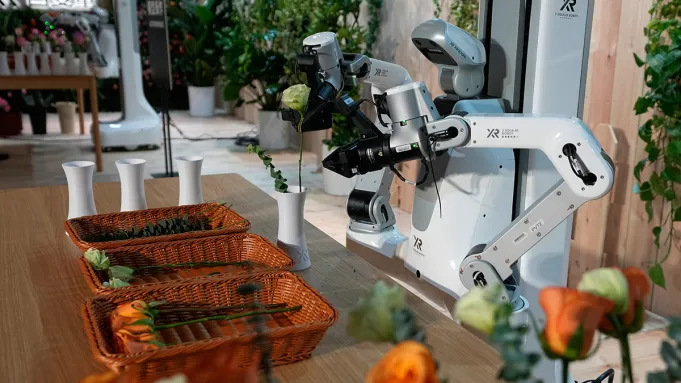
X Square Robot unveiled a new model at an event in Beijing on Tuesday that could be smart enough to help with everyday household tasks. The new Wall-B didn’t do any crazy tricks during yesterday’s demonstration, but rather slowly picked up litter off the floor and arranged flowers in a bouquet, as reported by Reuters.
Those seemingly simple actions are actually harder for the average humanoid robot to execute than, say, running or dancing, because they require a more sophisticated understanding of the environment. “The hardware is largely there,” X Square Robot founder and CEO Qian Wang said at the event. “But the brain hasn’t caught up.”
These machines still struggle with tasks like folding clothes or loading a dishwasher because of their fiddly nature. “Why don’t marathon robots face this challenge? Because what they mainly contend with is a constant gravitational field,” explains Wang. “But when we manipulate things with our hands, if we are off by 0.1 millimeters, the whole task may fail.”

The new Wall-B picking up rubbish on stage.
Andy Wong/AP
Navigating an unpredictable and chaotic household also requires more advanced artificial intelligence, or a bigger “brain,” that can process things like gravity and light as humans do, whereas repetitive actions like running only require the robot to be trained on a relatively simple dataset. To build the Wall-B’s “brain,” the robot was trained on data collected from over 100 households. The company believes exposure to “noisy” conditions is critical to improving performance.
X Square Robot isn’t the only company trying to build machines that can help around the house. The Consumer Electronics Show in January was a sea of humanoid robots, with DYNA Robotics showing one that can fold laundry and LG demoing another that can load the washing machine—though very slowly, according to Bloomberg.
The Wall-B is also slow and clumsy, according to some consumer feedback. Wang argues only by entering real households can the robots improve, though. “Sometimes it may put slippers in the kitchen, or stop halfway through wiping a table to ‘think,’” he notes. If the robot malfunctions or can’t complete a task, the company can intervene remotely.
Obviously, all these robots have a few hurdles to clear before becoming fast and reliable household helpers. Cost and safety will also affect the scale and speed at which they roll out. But Wang thinks they have the potential to improve the economy by taking on everyday tasks and freeing up more humans to work. “Household labor accounts for roughly 20 percent of GDP, so in theory this is a 20 percent-of-GDP market,” he adds. They’ll need to master folding clothes first.
Authors

-

Coastal Coin Necklace
$34.00 -

Resort Palmtree Necklace
$64.00 -

Oceanside Sparkle Studs
$38.00 -

Coin Necklace
$34.00