
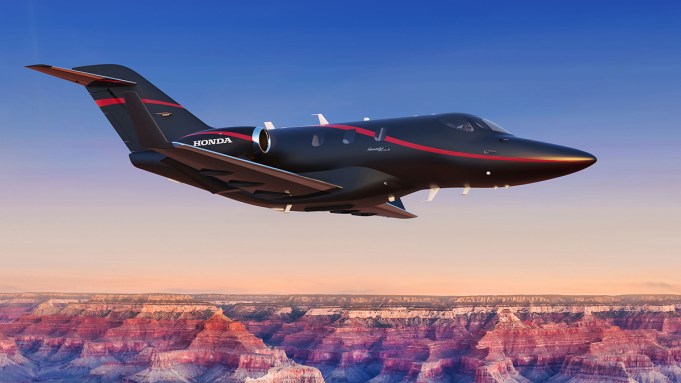
Flying a HondaJet just got a little safer.
Honda Aircraft Company today announced that the Elite II will be equipped with Garmin’s Emergency Autoland (EAL) system, allowing it to land autonomously when needed. It is the first very light twinjet in the business segment to gain certification for the system by the Federal Aviation Administration (FAA).
Honda says the installation of this safety tech has been “highly anticipated” by jet owners and operators across the States. As such, the company is also pursuing EAL certifications from regulatory agencies in other markets to give those abroad the same peace of mind during flight.
Released in 2019, the EAL system directs the jet to a nearby airport for an emergency landing. It first evaluates weather, terrain, fuel, and runway dimensions to select the optimal airport, then configures the aircraft for landing, guides it safely to the ground, and applies the brakes to a full stop on the runway. The system can be easily activated with the push of a button, but it also kicks in automatically if the pilot is unresponsive. It automatically alerts air traffic control of the emergency, too.

The cockpit of the Elite II.
Honda Aircraft Company
That isn’t the only nifty autonomous feature the Elite II has gained since launching in 2022. It became the first jet of its type to add Garmin’s Autothrottle in 2024. That system automatically manages engine power levers from takeoff to landing, reducing the pilot’s workload. Together, the EAL and Autothrottle systems allow the aircraft to be operated with one pilot. That is something that customers have been asking for, according to Honda Aircraft Company president and CEO Hideto Yamasaki.
That continued innovation has helped to cement the HondaJet as the most popular light jet in private aviation, with global deliveries surpassing 250 in 2024. The Elite II was the last model in HondaJet’s 420 series and will be followed by the Echelon. The production version of the groundbreaking 2600 Concept that was unveiled in 2021, the new business jet will have a range of 2,625 nautical miles (3,020 miles), making it capable of nonstop transcontinental flight across the U.S. It will also be 20 percent more efficient and produce fewer carbon emissions than the average light jet. You can expect all the Garmin gadgetry, too. The Echelon‘s first flight is scheduled for later this year, with type certification expected in 2028.
Authors