Carlo (Karl) Abarth founded his eponymous Bolognese company in 1949 after acquiring the assets of race-car builder Cisitalia. Throughout the 1950s, Abarth & C. produced street, competition, and speed-record cars whose prolific variety was inversely proportional to the diminutive scale of the vehicles themselves.
Most were built using Fiat underpinnings—in large part because Abarth was in the business of producing performance parts for Italy’s then-ubiquitous Fiat 600 series. These hopped-up Fiats squeezed the last ounces of power from their tiny engines, and became unholy terrors within their respective competition classes. The rear-engined daredevils were highly successful, though by the early 1960s were doing battle with BMC’s front-engine/front-wheel-drive Mini. Amusingly, both four-passenger sedans looked much the same in outward appearance and size.

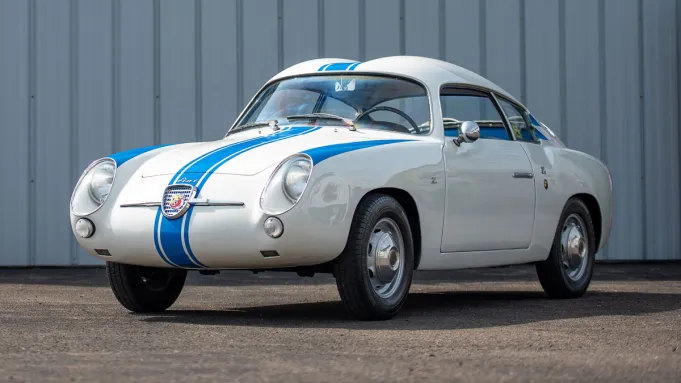
This 1959 Fiat-Abarth 750 GT “Double Bubble” Coupe Zagato sold for $123,200 through RM Sotheby’s in 2021.
Corey Escobar, courtesy of RM Sotheby’s
The Fiat-Abarth 750 GT, unveiled at the 1955 Turin Motor Show, is undeniably the most famous of all the Abarth models. It’s based on Fiat’s 600, and yet looks nothing like its boxy cousin, thanks to voluptuous aluminum coachwork by Zagato. Converting the original chassis for use as a two-seat sports car, though, posed aesthetic and ergonomic challenges given a short 97-inch wheelbase, an overall length of less than ten feet, and a much lower roofline required to impart a sporting look and disposition.
The result was severely compromised headroom, for which Zagato’s novel solution was the now-signature double-bubble roof that added precious space for drivers and their helmets (although some cars were made with a “standard” roof). In all, no more than 600 examples of the 750 GT and its variants were made through about 1961, including roughly 300 of the 750 GT “Double Bubble.”

This example’s interior is dressed in blue vinyl and is equipped with a rally clock on the dash.
Corey Escobar, courtesy of RM Sotheby’s
The 750 Bialbero, whose more powerful twin-cam engine made about 56 hp, was introduced in 1958 for homologation, with 100 examples made. The 750 Sestriere was powered by a pushrod engine and used a heavier steel body by Zagato. The “Record Monza” version, campaigned by the Franklin D. Roosevelt Jr. racing team (also the U.S Abarth importer), established Abarth’s greatest competition successes in the United States.
At less than 1,200 pounds, the 750 GT was engineered with weight savings in mind, using aluminum instead of steel for body panels, and plastic side and rear windows instead of heavier glass. Every extra pound challenged the tiny four-cylinder inline engine, which initially displaced just 747 cc and made about 48 hp on a cold day.

The car’s 72 hp, 981 cc inline-four engine is mated to a four-speed manual transmission.
Corey Escobar, courtesy of RM Sotheby’s
Mechanicals were simple but sufficient, including a four-speed manual gearbox, independent front and rear suspension, and hydraulic drum brakes on all four beautiful 12-inch-diameter wheels. The smaller and more agile the driver, the more likely they will feel at ease in the narrow, two-seat cabin, which, while stark, would be quite appropriate for a racing Ferrari of the period. Sitting quite low in the classic race seats, one is captivated by a three-spoked steering wheel and three big Jaeger instruments set into the black dashboard’s domed pod.
The 750 GT makes its Fiat origins clear with a high-strung but willing engine that makes plenty of noises, amplified by the aluminum body and—originally, at least—a genuine Abarth muffler—the latter being the company’s bread and butter, and each, like the cars themselves, featured Abarth’s trademark scorpion logo—derived from the astrological sign of the founder. Fiat acquired the company in 1971, and the logo continues to be used today on top-line Fiat models.

The “double bubble” roof adds precious space for drivers and their helmets.
Corey Escobar, courtesy of RM Sotheby’s
An Abarth is rare and rewarding to own, and as jewellike as a car can be. However, restoring a 750 GT is not a casual affair, and—apart from the car’s simple drivetrain—can entail as much effort and expense as might be put into a much more valuable Italian classic. Acquiring a carefully restored example is the most sensible way go. The best “Double Bubble” should command $100,000 to $150,000, while a “Record Monza” can bring well north of $200,000.
Click here for more photos of this 1959 Fiat-Abarth 750 GT “Double Bubble” Coupe Zagato.

A 1959 Fiat-Abarth 750 GT “Double Bubble” Coupe Zagato that sold through RM Sotheby’s in 2021.
Corey Escobar, courtesy of RM Sotheby’s
Authors
-

Robert Ross