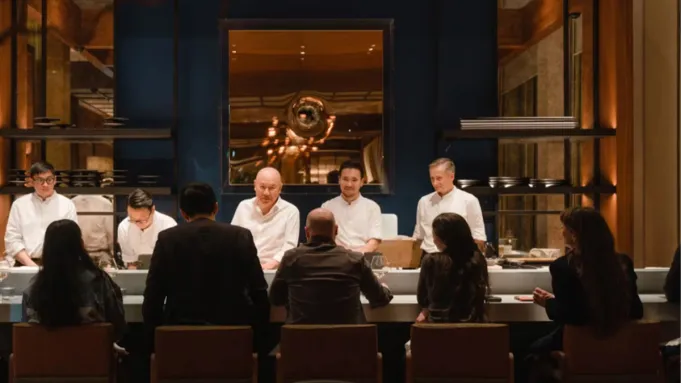
In Mayfair, amid art galleries, private clubs, and five-star addresses, a new ritual is playing out behind noren curtains and polished doors. The omakase counter—once the preserve of Tokyo’s most exclusive addresses—has become the hottest seat in London. And not just any counter, but the kind helmed by the most influential figures in modern Japanese cuisine, whose reputations were forged in Michelin-starred kitchens and whispered about in Manhattan boardrooms.
This spring, the Japanese art of surrendering to the chef’s hand is experiencing a renaissance in W1. At the forefront is Masayoshi Takayama, the architect of New York’s famous thousand-dollar omakase, and the first Japanese chef to receive a Michelin star in the U.S. His London debut, Tobi Masa at the Chancery Rosewood, introduced a seven-seat omakase counter in February, completing the restaurant’s offering within the new hotel. Priced at about $350 (260 pounds) per person, it is an intimate, chef-led dining experience described as “the purest expression” of his philosophy: restaurants that feel “inviting, elegant and comfortable”, with dishes rooted in “exceptional ingredients prepared with exceptional techniques”.

Masayoshi Takayama at work; coco curry carabinero shrimp at Tobi Masa.
Tobi Masa
For Takayama, the British capital was a long time coming. “I love London,” he says. “The atmosphere, the pubs, the feeling . . . I love the city.” Having first visited in the mid-2000s, he had long imagined bringing his work here. Yet rather than replicate the intensity of his Big Apple flagship, he has chosen a different tone for this address. “In New York, my restaurant is very high-end, very particular,” he explains. “In London, I wanted it to be more casual, more relaxed.” That informality is, of course, relative: it remains the omakase concept at the highest level. The intention is clear, though: an experience that feels playful rather than pretentious.
The evolving menu is constructed so that no two visits are ever the same, with specifics guided by seasonality. One evening might begin with “nuta”—tuna, sea greens and cucumber dressed in sweet Kyoto miso and mustard—prepared just inches from the guest. From there, the progression might include toro tartare with caviar, delicately grilled fish and a soup course before moving into sushi: slices of fatty toro, kinmedai or scallop shaped by hand and passed directly across the counter. If you’re lucky, you may encounter one of Takayama’s signature surprises, such as his fish-based pasta—flourless noodles made almost entirely from seafood.
The intimate counter ambience encourages interaction at every stage. “With omakase, the chef will ask, ‘Did you enjoy it? Would you like another piece?’” he says. “We give space. People can choose.” The exchange is part of the ritual.

Tobi Masa’s omakase counter can be found at The Chancery Rosewood, London.
A few streets away, another master is adding to Mayfair’s growing omakase momentum. Until July, Endo Kazutoshi is hosting a 10-seat residency at Annabel’s, marking his first and only planned London residency during the temporary closure of Endo at the Rotunda. The counter will run four evenings a week, with two services reserved for members of the private club and two open to special guests of Endo’s.
The experience (around $330, or 245 pounds per person) is described as a highly personal “hand-to-hand” encounter defined by close exchange between chef and guest. “Omakase means ‘chef’s choice,’ but it also means responsibility,” says Kazutoshi. “Guests are putting their trust in my experience and skill, so it’s my role to make sure they are comfortable and well taken care of.”

Until July, Endo Kazutoshi is hosting a 10-seat residency at Annabel’s.
Guests are served a blind 14-course tasting menu; dishes are revealed only as they are placed before them. The opening gesture is Endo’s “business card”—a handroll of seaweed and tuna passed directly from chef to guest—a greeting rooted in “Omotenashi,” the Japanese art of selfless hospitality. What follows is a seasonal progression of delicately prepared sushi and small dishes, each shaped, sliced, and served across the counter in a carefully paced rhythm—perhaps translucent slices of squid, rich akami tuna, delicate crab shinjo, or langoustine, before finishing with Wagyu and a light soufflé.
Endo believes Mayfair is uniquely attuned to this “very specific type of dining” which “relies on attention, trust, technique and quality ingredients . . . the area supports it because it attracts people who already engage with craft through art, design, and culture.”
Completing the trio is Sushi Kanesaka at 45 Park Lane, the 13-seat omakase set-up from acclaimed sushi master Shinji Kanesaka. The Michelin-starred eatery feels less like a Mayfair address and more like a portal to Ginza. Accessed via a discreet doorway within the hotel, the intimate dining room is defined by traditional Japanese craftsmanship and meticulous detail. The nine-seat counter is carved from a single piece of Kiso hinoki—approximately 500-year-old Japanese cypress—and a sphere-shaped flower vase, produced exclusively for the restaurant by renowned ceramic artist Shiro Tsujimura, sits as a beautiful focal point. Even the ice chests and service rituals nod to the Edo period, creating an almost ceremonial atmosphere.

Guests are served 20 courses at Sushi Kanesaka.
45 Park Lane
Here, up to 20 courses are prepared with ritual precision, from seafood treated with the ikejime (humane fish-slaughtering) method, to rice and wasabi sourced from long-standing Japanese suppliers. Pieces of sushi—perhaps buttery otoro, delicate shimaaji, or sweet scallop—are shaped by hand and passed across the counter at precisely the right moment. Guests are encouraged to leave their preferences at the door and lean into the surprise menu (priced at about $570, or 420 pounds per person). The result is an experience that is immersive, intimate, and deeply traditional—a small slice of Tokyo in the heart of central London.
On 5 May, as part of its annual Michelin Series, the restaurant will host a one-night, four-hands collaboration with Michael Wignall. “I’ve always admired the respect that Japanese culture shows toward ingredients,” he says. “The ethos behind the cuisine resonates strongly with my own philosophy . . . that sense of care, precision and seasonality is reflected in my dishes.” Of Kanesaka, he adds: “It’s an honor to work alongside someone whose craftsmanship and dedication to the guest experience are so inspiring.”
Taken together—Takayama’s relaxed yet compelling London debut, Endo’s intimate pop-up sanctuary at Annabel’s, and Kanesaka’s Michelin-starred temple and its culinary collaborations—the pattern is unmistakable. Omakase is no longer a niche indulgence: it has become one of the most compelling ways to dine in the capital. And at the counter, where chef and guest are separated by little more than a stretch of the hand, everything rests on precision, presence and the quiet thrill of relinquishing control to the chef’s capable hands.
-
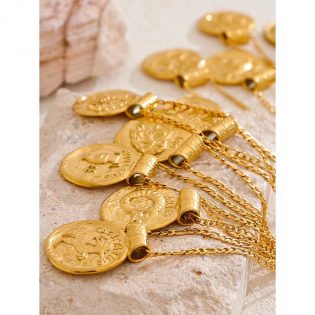
Coastal Coin Necklace
$34.00 -
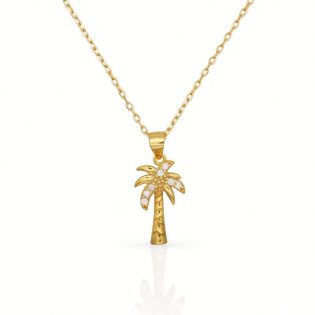
Resort Palmtree Necklace
$64.00 -
Oceanside Sparkle Studs
$38.00 -
Coin Necklace
$34.00