The 1960s proved a fertile decade for automotive invention on the part of ambitious manufacturers tight on resources and big on ideas. Small European sports-car makers were eager to tap into a rich American market, whose buyers were already familiar with pinnacle Italian, British, and German marques such as Ferrari, Aston Martin, and Mercedes-Benz. The art of coachbuilding, though, was nowhere as established as in Italy, where dozens of designers and carrozzerie were turning out some truly wild creations.
The Achilles’ heel of small-volume producers has always been engine development, which can challenge even the most well-funded company. Which is why the original “hybrids” weren’t electric, but rather, “exotic” British and Continental marques powered by cheap-and-cheerful American V-8 engines.

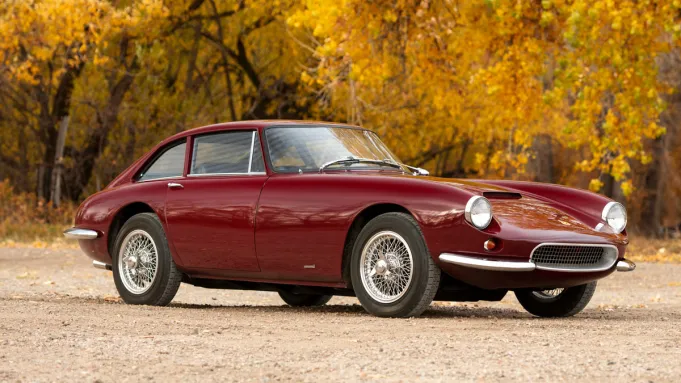
This 1963 Apollo 3500 GT, built by International Motor Cars, sold for $123,200 through RM Sotheby’s in 2023.
Nathan-Leach Proffer, courtesy of RM Sotheby’s
These proven engine designs from the Big Three weren’t just inexpensive, but were usually more powerful than anything from Europe, were infinitely more reliable, and could be repaired at any local service station. Engineer Giotto Bizzarrini, whose V-12 designs for Ferrari and Lamborghini were elaborate and expensive, chose Chevrolet’s 327 ci V-8 to power the race cars made under his own name.
Then there was the Apollo, envisioned by a trio of Californians—Milt Brown, Ron Plescia, and Ned Davis— as a reliable alternative to more costly and finicky imported models. While produced only briefly, it expressed similar ambitions as other Italo-American hybrids from Iso, De Tomaso, Ghia, and Intermeccanica Italia.

According to RM Sotheby’s, the example shown here was the second Apollo GT built, and was initially sold in Southern California through Phil Hill Buick of Hollywood.
Nathan-Leach Proffer, courtesy of RM Sotheby’s
While at the 1961 Monaco Grand Prix, Brown, an engineer, met Frank Reisner, owner of Carrozzeria Intermeccanica, whose Turin-based factory agreed to provide finished bodies for the forthcoming Apollo. The original design by Plescia received some subsequent improvement at the urging of Reisner. These enhancements were done by none other than Bertone’s Franco Scaglione, and the result could pass for a Ferrari GT of the era.

The car is fit with a 3.5-liter all-aluminum Buick V-8 engine.
Nathan-Leach Proffer, courtesy of RM Sotheby’s
The Apollo 3500 GT’s steel body, with aluminum hood and doors, sits atop a traditional steel ladder frame that used a front subframe from the Buick Special, fitted with Buick’s then-new aluminum 215 ci (3.5-liter) V-8 engine. Later, the Apollo 5000 GT used Buick’s 300 ci (5.0-liter) V-8 power plant, which made 250 hp and 335 ft lbs of torque. Most examples were equipped with a Borg-Warner close-ratio four-speed transmission, but a few were ordered with GM’s two-speed automatic, which exacted less of a penalty in acceleration, thanks to the Apollo’s weight of under 2,300 pounds—500 pounds less than that of Jaguar’s E-Type.

The Apollo 3500 GT’s steel body, with aluminum hood and doors, sits atop a traditional steel ladder frame.
Nathan-Leach Proffer, courtesy of RM Sotheby’s
Facing financial difficulties, Brown and team’s International Motor Cars only survived through 1964, turning out just 42 Apollos (40 coupes, one spyder, and one prototype) at their factory in Oakland, Calif. Vanguard Motors, in Dallas, Tex., took over production and built an additional 11 cars called the Vetta Ventura. Shop foreman Tom Johnson purchased 11 remaining body/chassis units, selling the final example as late as 1971.
Subsequently, attorney Robert Stevens’ Apollo International in Pasadena, Calif., built 14 additional cars, with his foreman Otto Becker finishing an additional six. Finally, four body and chassis, never claimed by Apollo International, were sold by U.S. Customs to Ken Dumiere. In total, 88 examples were built (79 coupes and nine convertibles).

The Apollo’s weight of under 2,300 pounds is 500 pounds less than that of the Jaguar E-Type.
Nathan-Leach Proffer, courtesy of RM Sotheby’s
The Apollo sold for upwards of $6,000 when new, a not insignificant amount of money that was more than a Jaguar E-Type, though about $4,000 less than a Ferrari. Apollos only occasionally come to market, and depending on condition, bring anywhere from $120,000 for a solid coupe to over $250,000 for a concours spyder. And while restoration will be no less costly or arduous than what is often required for any other Italian or British car of the era, owners can laugh all the way to the bank—and Pep Boys—to buy tune-up parts and an oil filter for their examples’ Buick V-8 engines.
Click here for more photos of this 1963 Apollo 3500 GT Coupe.

Built by International Motor Cars, this 1963 Apollo 3500 GT sold through RM Sotheby’s in 2023.
Nathan-Leach Proffer, courtesy of RM Sotheby’s
Authors
-

Robert Ross