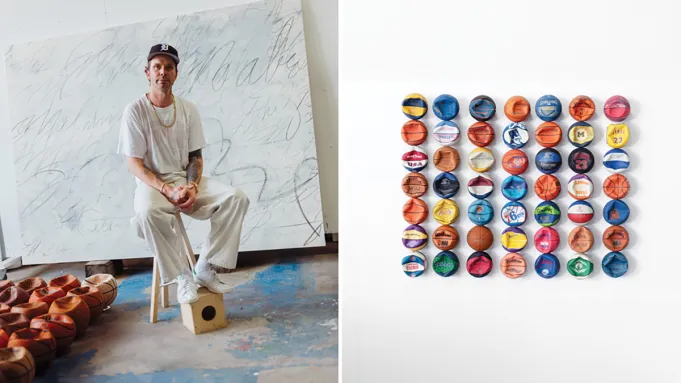
Growing up in Orange County, Calif., Tyrrell Winston fantasized about becoming a pro basketball player. His hoop dreams faded in high school, but his artwork continues to feed off the obsession.
Best known for his gridded wall sculptures of basketballs in varying states of collapse, Winston considers his work a bridge between art history and sports culture. “I think the art world—I mean, it’s gotten better, but it’s incredibly exclusionary,” he says. “I like using sport to bring people to art.”
Winston is talking via video call from Detroit, where he relocated temporarily from New York in 2022 to prepare an exhibition at the Cranbook Art Museum. The inexpensive studio space and the innovative community being formed by his gallery, Library Street Collective, persuaded him to stay.

Sweet as a Piece of Day Old Bubblegum, used basketballs, liquid plastic, steel, and epoxy, 2023.
Tim Johnson/Courtesy of the Artist and Library Street Collective
Departing the white-hot center of the art world has not held him back: Winston is working on a commission for N.B.A. superstar Kevin Durant’s restaurant in Austin and has even collaborated on paintings with skateboarding legend Tony Hawk. His first pair of sneakers, part of a multi-season partnership with Adidas, dropped in March. Meanwhile, he is getting ready for Brotox, a show of new work at Library Street, creating what he describes as “more chaotic” compositions with the basketballs, both on the wall and freestanding. He also plans to include a group of photorealistic paintings of memorable sports moments.
Winston was no overnight success. He moved to New York in 2006, at age 21, having fallen in love with the city watching Home Alone 2 as a kid. Once there, he became enamored of a clique of rebellious young artists. “It was, like, rock ’n’ roll, very subversive,” he says. “These guys—Dash Snow, Dan Colen, Nate Lowman, and Hanna Liden—were making work that was direct and immediate, and I wanted to contribute to that.”
-

Featured Listing
The Westerly Estate: A Tuscan Villa in Paradise
Santa Ynez, CA
$52,500,000 USD -

Featured Listing
111 W 57th St, New York, NY 10019
New York, NY
$98,000,000 USD -

Featured Listing
161 Stillwater Rd, Aspen, CO 81611
Aspen, CO
$300,000,000 USD -

Featured Listing
Paris, Île-de-France 75002, France
Paris, France
$21,201,400 USD | 18,000,000 EUR

Bad Boy, found tarp, aluminum panel, and auto paint, 2022.
PD Rearick/Courtesy of the Artist and Library Street Collective
Winston was collecting discarded basketballs without a clear idea for them when he heard some kids griping about the condition of the playground court’s nets. He calls it a light-bulb moment. He bought a bunch of new nets and went to local courts, climbing atop overturned trash cans to replace the raggedy ones, which he then strung from curtain rods to create dense tapestries.
“To this day, it makes me well up inside with what a joyful moment that was—like, maybe I have something that’s my own language,” he recalls.

Winston created Horse, a “hoop tree” sculpture with 21 baskets, and invited the public to play it.
Kyle Powell/Courtesy of the Artist and Library Street Collective
The nets won him some attention. Pascaline Smets of Belgian gallery Stems urged him to make the basketballs into a show for Art Brussels. One piece made the cover of the fair program, and the booth sold out on the preview day. “I remember calling my wife, and I was crying,” he says. “I was like, ‘I figured it out.’ ”
Over time, Winston has perfected his technique. Now, rather than attaching the balls to strips of steel, he pierces metal poles through them, à la shish kebab, hence the series name: “Skewers.” He manipulates the balls’ form but never their patina. “My dad is a pastor,” Winston notes. “I wouldn’t consider myself overly religious by any stretch of the imagination, but the idea of resurrection—taking something that’s broken or downtrodden and giving it new life—has become a pillar of my work.”

The Red Balloon, brass rod, hardware, replaced basketball nets, 2025.
Courtesy of the Artist and Library Street Collective
While sticking to the intersection of sports culture and art history, he has continued to evolve. In an act of desecration akin to Robert Rauschenberg’s erasing a de Kooning drawing and Ai Weiwei’s smashing a Han dynasty urn, he brashly affixed his own autograph to valuable, signed memorabilia by Michael Jordan and others as a means of “adding myself into the canon of greatness,” he says.
Next, Winston tried his hand at painting by replicating athletes’ signatures, which eventually became a riff on Cy Twombly’s acclaimed graffiti-like “Blackboard” series. Then, he tipped his hat to On Kawara’s iconic “Today” paintings of dates with his “Box Scores,” stark renderings of games’ outcomes. For an exhibition last summer, he made Horse, a giant basketball-hoop tree—and invited the public to play it.

Peace and Quiet (Barry Sanders), acrylic and oil stick on canvas, 2022.
PD Rearick/Courtesy of the Artist and Library Street Collective
Winston’s sports allegiances have changed, too. The former Angels and Clippers superfan now bears a Yankees tattoo on his chest and roots for Detroit teams, as well as for the Cleveland Cavaliers. Owner Dan Gilbert collects his work, and his son Grant is Winston’s partner in the product-design enterprise Win Sport. (The senior Gilbert’s Rockbridge Growth Equity is also a stakeholder in Robb Report.) But Winston does draw one line in the sand: “I hate every team from Boston.”
-
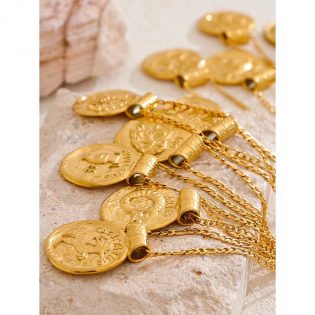
Coastal Coin Necklace
$34.00 -
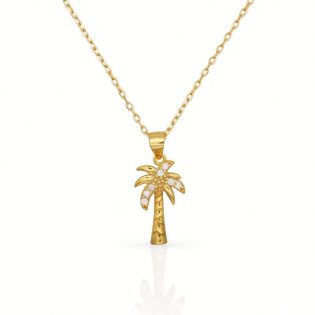
Resort Palmtree Necklace
$64.00 -
Oceanside Sparkle Studs
$38.00 -
Coin Necklace
$34.00