If you’re a watch collector with a penchant for buying sought-after timepieces at retail, you’ve probably embraced—or at least surrendered to—the wait.
Whether you’ve added your name to a list of people who’ve expressed interest in a coveted model from one of the Big Three (Rolex, Audemars Piguet, and Patek Philippe) or placed a deposit on a timepiece by an in-demand independent maker, you know that waiting months, if not years, to acquire it is part of the game in high-end horology.
And while there’s a difference between waiting to learn if you’ll receive an allocation and waiting for a watchmaker to deliver a piece that’s already yours (and partially paid for), the outcome is the same: Gratification is anything but instant.
Gary Getz, a founding member of the NorCal Gang, a group of watch collectors in Northern California, has over the years become accustomed to waiting. “It used to be that I’d go into a store and say, ‘I’ll take that one,’ and they’d put it in a box, and you’d take that home,’” Getz tells Robb Report. “Patek has for a long time had application lists where you have to be an established customer and someone they think isn’t going to go out and flip the watch, but this whole practice of interest lists and waiting lists is relatively new, maybe slightly pre-pandemic.”
He was referring to the wait for an allocation, which, depending on the brand and the model, could easily rival the absurdity of Waiting for Godot.

A Audemars Piguet Royal Oak 15202 Jumbo
About three years ago, Priya Raj, a writer in London, added her name to a waitlist for a Rolex Day-Date at an authorized dealer in Glasgow (“Somehow I thought registering there rather than a bigger city meant less competition, but maybe it means less allocation?” she says).
“I got a call for it this summer,” Raj writes in a DM. “Have since moved to London, safe to stay I no longer want the watch.”
Amanda Rittenberg, a medical doctor in California’s Palm Desert, tried to sidestep the wait by buying overseas.
“I wanted my first Rolex back in 2021 and traveled to Poland to see my mom so I added myself to a waiting list at the W. Kruk store in Poland,” she says. “It was a Rolex Datejust—something simple—but they were sold out completely. I ended up getting the watch in 2023. I am now on the waiting list for multiple other watches, but it takes such a long time. I tried local stores in the desert, but they didn’t have anything. Now, I’m waiting on the Land-Dweller.”
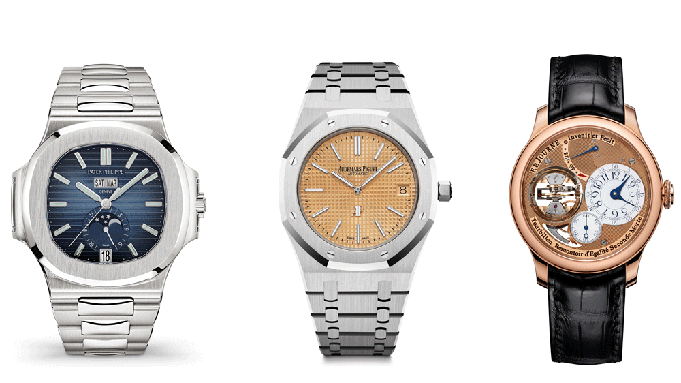
Getz attributes the rise of allocation waitlists to changes in distribution strategies and the industry’s explosive growth during the pandemic, when secondary market prices for models like the Rolex Daytona, Patek Philippe Nautilus, Audemars Piguet Royal Oak, and anything by F.P. Journe soared to as much as five times retail.
“Watches used to be a niche hobby and now they’re a mainstream luxury so it’s more like getting a Birkin bag,” Getz says. “With the big brands, the transition point was maybe when Audemars and Journe started selling primarily through their own boutiques. Since they were controlling the distribution channel, they could allocate their limited edition and limited production watches as they wished, instead of delegating it to retailers.
While sales of Rolex and Patek Philippe watches are still managed by retail partners, how waitlists actually work remains a mystery to all but those administering them.
“There’s not a one-size-fits-all approach to how stores handle waitlists,” says vintage dealer Eric Ku. “Some call it a waitlist or a wishlist. There’s all kinds of nomenclature. A lot of jewelers do this forced bundling situation. But some legitimately have a waitlist—your number’s up when your number’s up.”
Ku’s reference to “bundling” hints at one of the most contentious aspects of the waitlist phenomenon. Widely practiced but rarely discussed publicly, the retail practice involves offering a client a hard-to-get model (say, a Rolex Daytona) only if they purchase a less-popular watch model or a piece of jewelry.
“It’s a numbers game for retailers,” says Giovanni Prigigallo, cofounder and head of business development at EveryWatch, a digital platform that tracks resale prices. “You buy this watch, that watch. You’ve made the retailer $30,000, $50,000 and now they’ll sell you a Daytona that sells for $15,000 with a market value of $30,000. They know they’re giving you a sweetener. But it’s a dangerous game.”
Around seven years ago, Prigigallo experienced bundling firsthand at Audemars Piguet. “I really, really wanted a Jumbo Royal Oak 15202 in steel,” he says. “At that time, it was slightly above retail but not much. I went to the Milan boutique, I kindly asked and they told me, ‘We get five—but if you buy a Royal Oak 15400, we’d give it to you and bump you on the list for the 15202.’ But I really wanted the Jumbo, I didn’t want to buy another watch and flip it. I never did get the 15202. But I regret not buying the regular Royal Oak—the retail was about €20,000.”
Prigigallo doesn’t mention that today, the 15400 sells for about 28,000 euros, or $33,000, on the secondary market. “I’ve made peace with it,” he says.

F.P. Journe’s Élégante Titalyt
F.P. Journe
The upside of waiting for an allocation is that big brands typically don’t accept deposits, so there’s no financial commitment. “Maybe they don’t want to be obliged, and a deposit means locking in the price,” Prigigallo says.
The downside is a frustrating limbo. “I am waiting for an Élégante Titalyt from Journe now,” Prigigallo says. “It’s been a good three years. The problem is that the value has skyrocketed, and everyone who walks into a boutique asks for an Élégante because it retails around 20,000 euros, and the market price is like €90,000, €100,000. I don’t know if I’ll get it.
“Certain things have become easier,” he adds. “With Rolex, I don’t think you’ll have a hard time buying a Datejust in any configuration, and potentially getting a Submariner is much easier. But getting a GMT or Daytona, any of the hot models, it’s pretty much the same thing: You need to be a good customer. These watches are given as a reward.”
Ku offers some time-honored advice to anyone on a waitlist or thinking about joining one. “Don’t be an a**hole. They have to like you. There’s a whole subset of Rolex buyers who go to every Rolex store when they’re on vacation, asking for a stainless Daytona. Versus those who establish a relationship with a retailer and show them support by buying other pieces. You’ve got to be realistic. An average-size Rolex store might get 12 steel Daytonas a year and thousands of inquiries. How do you prioritize? It comes down to: Is this person an a**hole? And the spend.”
Patek Philippe, by Getz’s reckoning, operates a little differently. “You become an established customer, or you know someone, like in my case, who’s a huge whale of a customer, and you say, ‘That’s the watch I’d like to have,’” Getz says. “And they say, ‘So noted.’ You keep visiting. And they say, ‘At the end of January, we’ll probably have that watch for you.’ And eventually such and such has come available. It gives them a lot of flexibility. What they don’t do is give all the watches to the same five people—they spread it around. But eventually, if you wait long enough, it will come.”
Even though he’s had to endure plenty of waits, Getz understands the dilemma facing retailers and brands, who are “under no obligation to have a first-come, first-served waiting list,” he says. “You want to balance new customer acquisition with rewarding your loyal customers with your dealers and their top customers. It’s highly complex. What you need is an ‘interest list.’ You’re free to allocate your watches however you’d like.”
Independent watchmakers tend to struggle even more with allocations, since many have been burned by buyers who promised to treasure their timepieces only to flip them immediately.
Once an independent accepts your deposit, however, the wait can stretch far beyond what was promised. Tamar Koifman, a first-time watch buyer based in Geneva is still waiting on a M.A.D. Edition 2 from MB&F x Éric Giroud that she won by lottery in April.
“Delivery was announced to be between April and October,” she writes in a DM. “Now that’s delayed to mid-November. I have a LOT of respect for the MB&F guys, but it is a bit disappointing not to be acquainted with my watch sooner.”
In an email, the brand explained that a delay from one of its suppliers on a crucial component, the rotor, had slowed the assembly process. To Koifman, that kind of transparency helped soften the blow.

Michael Hickcox waited seven years for his Rexhep Rexhepi Chronomètre Contemporain II.
Michael Hickcox
Of course, once a watch is in hand doesn’t mean the waiting game is over. Alexandre Furmanovich, a jewelry designer in Brazil, learned this lesson recently. About two years ago, he happened upon some Rolex ads from the 1980s on Pinterest. “I saw some wood dial watches, and I went crazy for them,” he wrote in an email. “I then started searching and found out that they were the Oysterquartz and I decided to find one for myself. But then, I also wanted one produced in my year of birth, 1984. It was an almost impossible mission.
“A few months after, I was randomly walking through the Burlington Arcade in London, and I saw one in a window. It was a 1984 model with the original burl wood dial. I bought it immediately, even though the bracelet was tight on my wrist. Then I brought it to Brazil and sent it to Rolex, to service it and make an extra link. It took around nine months. I realized that the time was literally the time of a pregnancy. It was definitely worth the wait.”
Michael Hickcox knows the feeling. The longtime collector, who in September received the Rexhep Rexhepi Chronomètre Contemporain II model he ordered seven years ago, is so familiar with the experience of waiting that he hardly flinched when a boutique Japanese watchmaker quoted him a shocking—even by independent standards—delivery time.
“I went to a Christmas party one year and saw someone wearing a Kikuchi Nakagawa,” Hickcox tells Robb Report . “They’re taking someone’s movement but the case, the dial, the hands are just out of this world. I knew I was late to the game, but I thought, ‘Let me shoot them a message.’ They were asking $22,000 for it. They said the wait time was 124 to 130 months. That’s 11 years. That’s not super unusual now, but when they said that a couple years ago, it was at least five years longer than anyone else. They also wanted a 45 percent deposit. I sensed they were saying that to eliminate flippers and to under promise and overdeliver. I took it. That was three years ago. I’ve got eight years to go. It’s a 34 mm watch—who knows what my eyesight will be by then!”
Authors
-

Victoria Gomelsky