
At Watches and Wonders Geneva, Audemars Piguet is taking a different approach to novelty. The brand is introducing an entirely new atelier—one that looks as much to the 18th century as it does to the future. Called the Atelier des Établisseurs, the initiative revives the historical établissage system, in which independent artisans produced individual components that were later assembled into finished timepieces. Now, Audemars Piguet is reinterpreting that model through a collaborative platform that brings together both in-house specialists and external craftspeople to co-create highly limited watches.
“It’s not about reproducing the past,” Sébastian Vivas, Audemars Piguet’s heritage and museum director tells Robb Report. “It’s about taking the best of that structure—the flexibility, the creativity—and combining it with the best of today to bring something new.” Each of the three inaugural pieces involves roughly 15 key contributors, from watchmakers and engravers to designers and engineers. But unlike traditional Swiss watchmaking, where many of these roles remain behind the scenes, Audemars Piguet is naming them (we have listed their names below). “In the past, even the watches were not signed,” Vivas says. “The people behind them were there—but ignored. We wanted to compensate that and bring more transparency.”
Many of the techniques featured in the project are increasingly rare. Vivas stresses that if the knowledge is not celebrated and transmitted it could disappear. He cites one glass cutter, who works on restoring old pocket watches. “There’s only one that we know at the moment,” he says. “So if he doesn’t transmit it, it disappears—all the glasses will be in a sapphire, but it doesn’t make sense for a pocket watch from the 19th century, and it would be extremely expensive to produce.” Many of these techniques aren’t even taught in watchmaking schools according to Vivas. “For chamfering, hand openworking, lapidiairies, there’s no school anymore, so if you want to learn this know-how that is very precious and very rare you must be very adventurous, because as a young man, a young woman, you start learning, but you know you will not have any diploma because it doesn’t exist.” One way to ensure these crafts endure is, quite simply, to give them work and that is the point of the new project.

Audemars Piguet Établisseurs Galets
Audemars Piguet
The Atelier des Établisseurs debuts with three distinct creations, each exploring a different dimension of craft and design. Établisseurs Galets translates the natural forms of the Vallée de Joux into a pebble-shaped 18-karat yellow-gold watch with a turquoise stone dial and fluid bracelet set with alternating tiger’s eye and turquoise stones, each with their own singular shape. What’s more is the Calibre 3098—derived from the extra-thin 9-line Calibre 3090 (AP’s first movement developed and manufactured in-house in 1999)—follows the shape of the case and features bridges grained by hand. It is assembled, adjusted and cased by a single watchmaker. Five variations in different stone combinations will be available this year.

Audemars Piguet Établisseurs Peacock
Audemars Piguet
Établisseurs Peacock pushes into automaton territory as a secret watch whose wings and head unfold to reveal a hand-engraved dial in translucent enamel hidden beneath. When closed it is a finely engraved 18-karat white-gold beetle, but with a simple push it reveals the hand-crafted peacock. “When you push at the back, it opens the two wings and the neck and the head come up, and also the case,” Vivas says. “And for that the system to close, to open with the springs so that it’s done smoothly and securely..it’s extremely challenging.” It is so difficult to execute, Vivas says the team will need until the end of the year until it is ready to be produced. Three variations will be available in 2027.

Audemars Piguet Établisseurs Nomade
Audemars Piguet
His personal favorite, however, is the Établisseurs Nomade, which looks at once futuristic and antique, underscoring the project’s focus to preserve endangered techniques while pushing them forward. The Nomade transforms from a pocket watch into a table clock and features a movement skeletonized entirely by hand using a traditional hacksaw. Hand-skeletonizing a movement in this way can take up to a month—and leaves no margin for error. “Today, 99.99 percent of movements are prepared mechanically,” he notes. “But this is a know-how we want to preserve.” The outer dial is made of natural stone and slips into an architectural case made of a bevelled metal mesh and faceted stones. Like the Galets, five variations with different combination of stones will be available in 2026.
As for the movements, both the Nomade and the Galets use the Calibre 3098. They may look different at first glance, but according to Vivas only the shape of the main plate and bridges have been transformed on each. The position of each axis, wheel, balance, etc. remain the same. The Nomade houses the Calibre 7501—an adaptation of the 7121, made in 2022 for the Royal Oak Jumbo. “We took away the rotor self-winding system, the date and we reshaped the position of the axis so that now it’s more symmetrical,” Vivas explains. “But we did not change any of the main components, we did not recalculate the forces and the frictions and everything, because everything was already done, calculated and perfect. It looks different but in fact, it’s the same movement for a watchmaker.”
Nevertheless, it was no small endeavor. The project was ultimately born out of a conversation, between Vivas and Audemars Piguet CEO, Ilaria Resta, around two historical pieces the company was interested in buying. Noting how extraordinary they were, Resta asked if they might redo them. “I explained her that these watches were made during a period when we were etablisseurs” Vivas recalls. “An etablisseur is a small structure, mostly of watchmakers working with many different partners who produce the parts of the watch and who co create them. And if we want to come back to this creativity in terms of shapes, the best way would be to also re introduce this structure that is more flexible, that is working with very small, independent craftspeople who are, most of them unknown. And also to include the crafts people inside the company who are talented and who sometimes don’t have this playground to participate in the development of the watches.”
The project, of course, expanded into a much larger operation over the course of two years. Vivas concedes that it is an investment, but insists it’s more an investment of time. “It’s not a commercial project,” he says. “It’s a project to explore new horizons in terms of shapes, in terms of craftsmanship, and to support the craft.” So far, mission accomplished. In an industry often defined by secrecy and scale, the Atelier des Établisseurs offers something rarer: a reminder that watchmaking, at its core, is still a collective craft.
Below are the artisans employed for each creation:
Établisseurs Galets:
Watchmakers: Aline Gagneux, Joris Lavanchy; Jewellers: Nadia Morgenthaler, Mathieu Rigault; Designer: Xavier Perrenoud; Dial makers: Mario Senape, Pablo Brenlla; Stone cutter: Mario Senape; Case designer and manufacturer: Theo Massaoutis; Movement designer: Arthur Gallezot; Blank manufacturer: Marco Tedeschi; Decoration and graining: Luca Soprana; Hand bevelling: Nathalie Jean-Louis; Project initiation: Ilaria Resta; Direction: Claudio Cavaliere, Sébastian Vivas; Coordination: Nikolaas Dockx, Claude Meylan, Kevin Quaresma.
Établisseurs Peacock:
Watchmakers: Aline Gagneux, Joris Lavanchy; Jeweller: Ywan Kuntzle; Designer: Kenan Geraud; Secret mechanism conception: Giulio Papi; Case manufacturer: FabLab Le Sentier; Engraving and decoration: Guy Froidevaux; Gemsetting: Sylvain Vandel; Movement designer: Arthur Gallezot; Machining and blanks: Ricardo Monfardino; Dial enamelling: Vanessa Lecci; Côtes de Genève: Luca Soprana; Hand bevelling: Nathalie Jean-Louis; Shaped sapphire crystal: Alexis Bernard; Project initiation: Ilaria Resta; Direction: Claudio Cavaliere, Sébastian Vivas; Coordination: Nikolaas Dockx, Claude Meylan, Kevin Quaresma.
Établisseurs Nomade:
Watchmakers: Aline Gagneux, Joris Lavanchy; Designer: Ludovic Python; Dial makers: Mario Senape; Gemologists and stone cutters: Mario Senape; Case designer and manufacturer: Emmanuel Dessuzinge; Movement designer: Julien Martel, Claudio Dos Santos; Blank manufacturer: Marco Tedeschi, Alexandre Burkhard; Hand bevelling: Jérôme Besançon; Shaped sapphire crystal: Alexis Bernard; Project initiation: Ilaria Resta; Direction: Claudio Cavaliere, Sébastian Vivas; Coordination: Nikolaas Dockx, Claude Meylan, Kevin Quaresma.
Authors

-
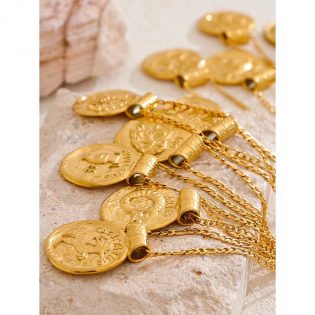
Coastal Coin Necklace
$34.00 -
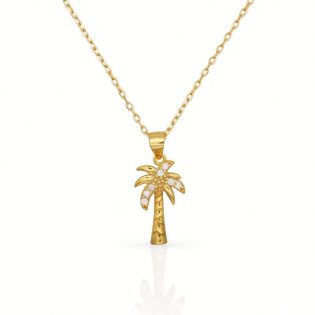
Resort Palmtree Necklace
$64.00 -

Oceanside Sparkle Studs
$38.00 -
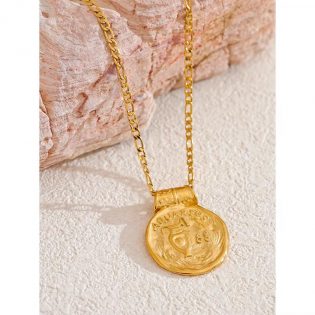
Coin Necklace
$34.00