Medium-format cameras have always rewarded patience. With their bulky frames, sluggish focus, and massive file sizes, they have traditionally occupied a niche corner of photography—favored by landscape artists and studio pros willing to slow down and treat every frame as a potential masterwork. For these artisans of light, the process was less about capturing the moment than crafting an image. The trade-offs in size and speed were simply part of the equation.
Hasselblad’s X2D II aims to change that. By leveraging the engineering prowess of its strategic partner DJI—the drone and gimbal pioneer—the Swedish manufacturer has modernized the X-system it introduced in 2016 as “the world’s first digital compact mirrorless medium-format camera.” The X2D II pushes that concept further, transforming what was once a deliberate, slow-paced platform into a tech-forward, go-anywhere camera that retains Hasselblad’s signature picture quality while gaining meaningful agility and reliability.

A surfer searches for the barrel off Southern California’s Huntington Beach Pier. (f5.6, 1/750 sec, 3200 ISO).
Robb Rice
Nowhere is this evolution more apparent than in the autofocus system. By borrowing DJI’s LiDAR technology, Hasselblad has effectively accelerated the medium-format process. The X2D II uses laser-ranging to map depth in real time, allowing the new AF-C (continuous autofocus) mode to track subjects with a confidence once reserved for high-end sports cameras. Whether it’s a surfer carving the face of a wave or a restless pet that refuses to sit still, the camera’s 425-point phase-detection autofocus helps ensure those 100 megapixels land exactly where you want them.
Further evidence of the X2D II’s maturation is the upgraded in-body image stabilization, now boosted to a staggering 10 stops. In practice, this means you can leave the tripod behind—hand-holding exposures in dim environments while still walking away with tack-sharp files.

A model, wearing Michael Kors, at the West Hollywood Edition (f5.6, 1/320 sec, 1600 ISO).
Robb Rice
The camera’s 43.8 mm x 32.9 mm sensor offers roughly 70 percent more surface area than a standard full-frame sensor, giving it 1.5 times more real estate with which to record light and tonal information. The result is smoother color gradation and exceptional post-processing flexibility—qualities that even the highest-resolution full-frame setups struggle to match.
Detail is also impressive: With 16-bit color depth capable of 281 trillion colors, the camera ensures that subtle transitions such as the shift from sunset orange to a deep-blue twilight aren’t merely captured but are preserved. Combined with 15.3 stops of dynamic range, the X2D II creates images that feel less like photographs and more like data-rich slices of reality.

A howler monkey amid a verdant backdrop in Nosara, Costa Rica (f4, 1/320 sec, 1600 ISO).
Robb Rice
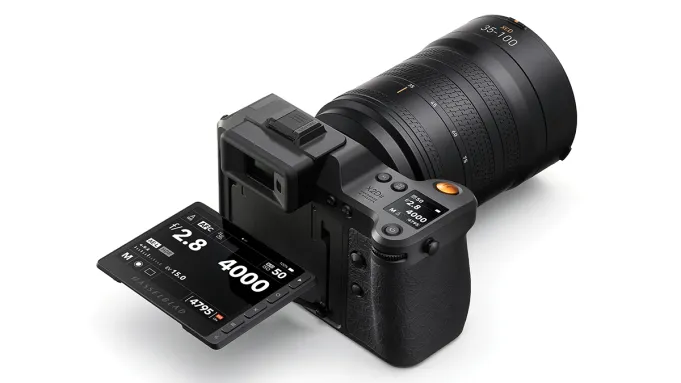
Yet one of the most immediate pleasures of using the X2D II isn’t buried in its spec sheet. It’s the new tilting rear touchscreen, which, in my opinion, is the finest display ever fitted on a camera. Measuring 3.6 inches with a peak brightness of 1,400 nits, the screen remains crystal clear under the Mediterranean sun at high noon. Even purists who prefer composing through the viewfinder may find it difficult to resist its gravitational pull.
The user interface is equally refined and mirrors the machine itself—fluid, intuitive, and refreshingly free of the labyrinthine menus found in many rivals. In the end, this Hasselblad retains the hallmark soul of its Swedish heritage while delivering a new level of speed and intelligence. $7,399
Click here for more photos taken by the Hasselblad X2D II 100C.

The Hasselblad X2D II 100C.
Hasselblad
Robb Recommends: The Harlowe Rocket Tripod
I will admit that I have often sacrificed image quality in low-light scenarios to retain the creative flow and speed of handheld shooting rather than resort to using a tripod. Extra grain and unreliable sharpness were a price I was willing to pay, rather than feeling chained to a mess of twisting locks on telescoping stilts.
Yet shortly before setting out to Miami to shoot the 2026 Robb Report Car of the Year feature, I was introduced to the Harlowe Rocket—and everything changed. Through innovative features, quality materials, and high design, the Rocket proved to be an impressively responsive, multi-functional tool that erases nearly all the friction associated with tripods and heavy gear.

The Harlowe Rocket tripod.
Harlowe
The core of the Rocket is its quick release system—a one-step height-adjustment mechanism activated by a single press of the hand lever. Gone are the manual clamps or twist locks. And at 2.3 pounds, this tripod features a carbon-fiber frame that offers a high strength-to-weight ratio, as it’s engineered for environments where speed is as critical as stability.

The Rocket has a suite of connectors that include a camera mount, a V-mount ballhead, and a light connector.
The pedal-actuated base unlocks a tilting mechanism, allowing for fast hands-free adjustments to the monopod’s angle, and reengaging the pedal re-centers the unit and locks it vertically. With interchangeable feet and a suite of connectors—including a camera mount, a V-mount ballhead, and a light connector—the Rocket transitions seamlessly between camera support and lighting duty. No longer must we feel constrained by our gear to achieve professional precision and control.
-

Coastal Coin Necklace
$34.00 -
Resort Palmtree Necklace
$64.00 -

Oceanside Sparkle Studs
$38.00 -

Coin Necklace
$34.00