Now positioned at the top of Aston Martin’s DB food chain, the DB12 S offers a range of tweaks inside and out which are designed to dynamically hone an already-impressive luxury GT. Yet during the lead-up to our seat time in the new variant, Simon Newton, the British marque’s director of Vehicle Performance, found himself backpedaling a bit.
On the subject of chassis updates, Newton explained that the S model’s dampers allow the car’s suspension to “breathe” more than the standard DB12, which was voted Robb Report’s Car of the Year in 2024. This improvement seemingly indicates that despite the new aero, additional power, and more performance-minded look, the DB12 S is actually a more compliant proposition.

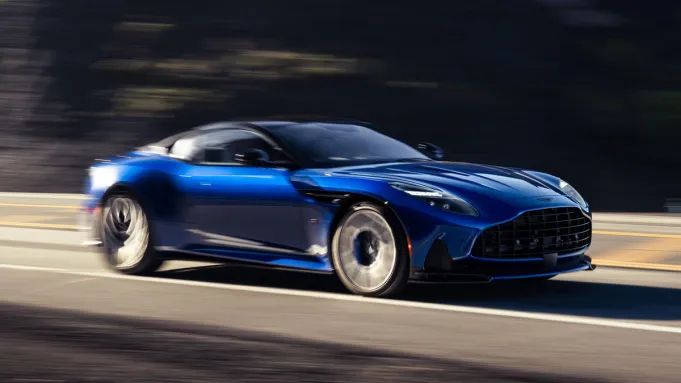
The 690 hp Aston Martin DB12 S.
Aston Martin Lagonda Global Holdings PLC
While mid-engine monsters like the Valkyrie and Valhalla have opened up a new, track-focused chapter for Aston Martin’s road cars, the DB lineup has long sought to strike a balance between stirring performance and refinement, often sacrificing a bit of the former for the sake of the latter. Yet in a world of electronically controlled differentials and software-driven damping strategies, those compromises are quickly becoming inconsequential.
“In terms of character, it’s a more dynamic proposition for sure,” Newton reassured us. “It’s about getting the best of both worlds, and I think we’ve been very successful in that regard.” And after a day spent carving Malibu’s canyon roads, as well as stints plodding along in commuter traffic, I’m inclined to agree.

Despite the new aero, additional power, and more performance-minded look, this is actually a more compliant version of the DB12.
Aston Martin Lagonda Global Holdings PLC
What’s New For 2026?
Aston Martin has a longstanding tradition of applying the “S” suffix to the highest-performing iteration of a given model, and this version of the DB12 earns the designation with a variety of relatively subtle bits of fine-tuning that, when combined, yield a car that’s simultaneously more responsive and more composed.
Offered in both coupe and Volante form, the DB12 S scores a power bump from 671 hp to 690 hp by way of software adjustments for its 4.0-liter twin-turbocharged V-8 from Mercedes-AMG, while revised suspension geometry, a stiffer rear anti-roll bar, new calibrations for the steering, Bilstein DTX dampers, a rear differential, and torque vectoring systems are on board to ensure that the chassis can keep up. Carbon-ceramic brakes are also standard here and reduce unsprung mass by nearly 60 pounds, while a new front splitter and rear spoiler aid high-speed stability.

Among the enhancements to this model variant are revised suspension geometry, a stiffer rear anti-roll bar, new calibrations for the steering, and a 19 hp bump in output.
Aston Martin Lagonda Global Holdings PLC
Inside, the metal drive-mode knob is treated to a red anodized finish, which also informs the color of the contrast stitching, seatbelts, headrest embroidery, and piping. But if our test cars are any indication of what’s possible during the ordering process, these accent colors can be altered or removed as would-be owners see fit. The 16-way adjustable sport seats are standard, while performance seats shelled in carbon fiber—presenting more aggressive thigh and shoulder bolsters—are optionally available. Three interior trim treatments are also on offer: Accelerate leather and Alcantara, semi-aniline leather and Alcantara, and full semi-aniline leather.
Design
The S treatment gives this Aston 2 + 2 coupe a more purposeful vibe. The automaker doesn’t cite specifics about increased downforce or reduced lift, but the new aero is integrated tastefully, with the character lines established by the DB12 S’s new front splitter leading to matching gloss-black side sills. A fixed rear spoiler replaces the retractable “Aeroblade” spoiler found on the standard DB12, but it’s an equally subtle affair, rising just a few inches off of the decklid.
The bigger news at the rear is the revamped exhaust system, which ditches the conventional dual-tip layout in favor of a vertically stacked, quad-pipe configuration. The new approach actually cleans up some visual clutter while ratcheting up the aggression, making the DB12’s standard arrangement appear somewhat unfinished by comparison.

A fixed rear spoiler replaces the retractable “Aeroblade” spoiler found on the standard DB12, and there’s a new quad-pipe configuration for the exhaust system.
Aston Martin Lagonda Global Holdings PLC
The changes in the cabin are even less obvious, but aside from a lack of fanfare, there’s very little to complain about. The introduction of the DB12 back in 2024 ushered in Aston Martin’s first infotainment system developed in-house, a thoroughly modern solution that looks sharp and is quick to respond to user inputs. It’s currently also one of the few systems in the industry that supports Apple’s enhanced CarPlay Ultra screen mirroring standard, which offers deeper vehicle integration and a wider range of customization features.
Aston Martin also deserves credit for resisting the temptation to move all of the adjustments for features such as the drive modes, climate control, and audio settings onto the touchscreen. Instead, the automaker outfitted the center console with physical buttons and lovely barrel-style knurled dials that include controls for volume, temperature, and fan speed, which make quick changes easy to perform without taking your attention off of the road.

Tactile elegance is found with the center console’s physical buttons and barrel-style knurled dials.
Aston Martin Lagonda Global Holdings PLC
A wireless charging pad hidden underneath the floating center stack also keeps your smartphone juiced up but out of sight, and the rubber bumpers that border the pad ensure that your phone won’t slide out of place when the going gets fast. Design quirks like the central tunnel–mounted front-seat adjustments remain, but for what it’s worth, I never inadvertently changed a setting with my leg during my time with the car.
Power Train And Hardware
Some folks would say that a 3 percent increase in output for a car that already had 670 hp isn’t going to be very noticeable, and in the case of the DB12, they would be right. The standard DB12 certainly isn’t lacking for power, but the DB12 S certainly sounds faster thanks to its revamped active exhaust, which Aston has tuned for “added depth and potency.”
A stainless-steel system is standard equipment, but when you’re pouring over the available upgrades in the DB12 S configurator, make sure you check the box for the titanium exhaust. The optional system further amplifies the rumbling V-8 soundtrack by 1.5 dB while also reducing weight by another 25 pounds.

The 4.0-liter twin-turbocharged V-8, from Mercedes-AMG, delivers 590 ft lbs of torque.
Aston Martin Lagonda Global Holdings PLC
The boosted V-8 is paired with a rear-mounted eight-speed automatic, and the transmission’s calibration has been reworked as well. Aston Martin says those efforts have resulted in gear changes that are more than 50 percent quicker than the standard DB12’s when launch control is activated, an improvement which helps the DB12 S hit 60 mph from rest in 3.4 seconds—that’s a tenth-of-second quicker than the standard DB12—on its way to a top speed of 202 mph. Although that’s right on par with the Amalfi, Ferrari’s new V-8 grand tourer, the latest Porsche 911 Turbo S will still lay down the law at the stoplight drags. The Bentley Continental GT offers a more opulent experience on the luxury-focused side of the grand-touring equation, but it can’t match the DB12 S dynamically.
Performance
It’s hard to find much fault with this twin-turbocharged V-8. A press of the jewellike ignition button on the center console brings the mill to life with a baritone growl—a high-performance moment of Zen that’s becoming alarmingly uncommon in today’s electrified and hybridized world. After pulling downward on the knurled lever just below that button to put the car in gear, I set off into midday Los Angeles traffic in pursuit of some quality time with Malibu’s legendary canyon roads.

The DB12 S offers GT, Sport, and Sport+ drive modes.
Aston Martin Lagonda Global Holdings PLC
Newton told me that the S “breathes” a bit more than the standard DB12 because Aston’s goal is to ensure that the car absorbs bumps at speed rather than bouncing over them. Yet this approach runs somewhat contradictory to my understanding of sport-oriented tuning: If the goal is maximum stability and grip, a car should be tuned for its intended environment rather than an outlier use-case. And despite its sharper tuning, the DB12 S is still a car built to tackle roads in the real world, so Aston helps set drivers’ expectations by offering GT, Sport, and Sport+ drive modes (listed here from least to most aggressive) while reserving track-related modes for models like the Vantage and Valhalla.
You sit low in the DB12 S, and with the center console canted upward toward the dash, it feels like a cockpit in the aeronautical sense of the term. While the rotary knob that surrounds the ignition button provides quick access to the various drive modes (which includes a customizable Individual mode), hard buttons for features like damper stiffness and exhaust volume allow for specific alterations to the driving experience on the fly.

You sit low in the DB12 S, and with the center console canted upward toward the dash.
Aston Martin Lagonda Global Holdings PLC
I found myself cruising around town in GT mode, with the exhaust system in its most extroverted setting. This is a V-8 that is absolutely worth celebrating, and the exhaust doesn’t actually get rowdy until you push into the upper regions of the rev range, which is an occasional affair when the DB12 S is operating in its most relaxed drive setting.
The DB12 S does a great job of maintaining its composure on LA’s pockmarked pavement in this mode, keeping road noise and harshness to a minimum without resorting to suspension tuning that allows for wayward body motions when the need to hustle arises. This is still very much a grand tourer, so the cabin is quiet and comfortable when you want it to be, and with the electronics set appropriately, the DB12 S can still assume the role of the affable, relaxed cruiser whenever the situation calls for it.

The DB12 S can cover zero to 60 mph in 3.4 seconds while on its way to a top speed of 202 mph.
Aston Martin Lagonda Global Holdings PLC
Venturing onto roads like Mulholland Highway and Latigo Canyon reveals the other side of the DB12 S’s personality. Here, the Sport+ drive mode does a commendable job of keeping the transmission in the meaty parts of the powerband, while dialing the dampers back to Sport achieves the right balance of body control and compliance on these less-than-perfect road surfaces.
The AML-spec Michelin Pilot Sport 5 S tires provide a genuinely impressive amount of grip in this environment, but the DB12 S is still willing to wag its tail if you get a bit brave with the loud pedal on corner exit. And while the carbon-ceramic discs do get a bit noisy on occasion, they offer the kind of relentless stopping power that encourages you to use the output on tap rather than fear it. This car may not be “track tuned” in the traditional sense of the term, but there’s a newfound sense of immediacy to its handling that I’d credit to the recalibrated steering and torque vectoring systems, and I have no doubt that this thing would be a riot on fast road courses.

The AML-spec Michelin Pilot Sport 5 S tires provide a genuinely impressive amount of grip.
Bradley Iger
Is It Worth It?
Starting at $272,000, the DB12 S certainly makes good on its promises, especially considering performance that’s on pace with Ferrari’s aforementioned Amalfi, the sumptuous cabin, and a properly boisterous soundtrack. The real question is whether to select the DB12 or DB12 S. To that end, if you’re on board with the notion of trading some elegance for edge in the name of a sharper and more refined drive, the S will deliver.

Aston Martin’s new DB12 S starts at $272,000.
Aston Martin Lagonda Global Holdings PLC
Specifications
- Vehicle type: 2 + 2 coupe
- In production since: 2024
- Power Train: 4.0-liter twin-turbo V-8, 690 hp, 590 ft lbs of torque, eight-speed automatic transmission
- Performance: 202 mph top speed, zero to 60 mph in 3.4 seconds
- Starting Price: $272,00
- Price as Tested: $347,500
Click here for more photos of the new Aston Martin DB12 S.

Driving the new Aston Martin DB12 S.
Aston Martin Lagonda Global Holdings PLC
-

Coastal Coin Necklace
$34.00 -

Resort Palmtree Necklace
$64.00 -

Oceanside Sparkle Studs
$38.00 -

Coin Necklace
$34.00