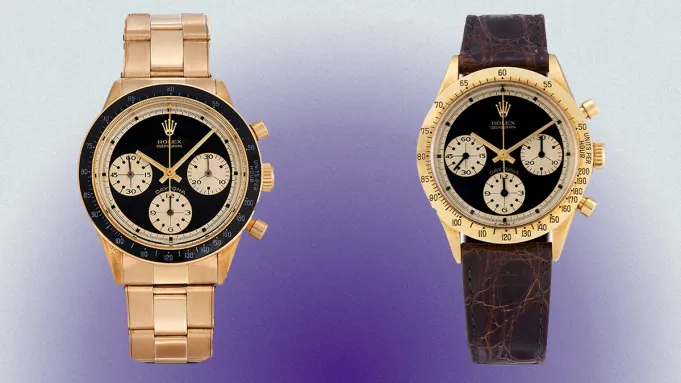
Finding a Rolex Daytona “Paul Newman” is like finding a needle in a horological haystack, but, thankfully, Sotheby’s has done the legwork for you. The auction house is offering not one but three at the Important Watches sale in Geneva this month.
This specific configuration of the Daytona dates back to 1963, when the Crown debuted a Daytona (Ref. 6239) with what it called an “exotic dial.” It subsequently released six variations throughout the ‘60s and ‘70s, switching up bezels from metal to acrylic, swapping between screw-down and pump-style pushers, and tweaking that famous face. These Daytonas were initially unpopular with Rolex clients, but that quickly changed thanks to Paul Newman. The late, great actor and race car driver was gifted a Daytona (Ref. 6239) by his wife, Joanne Woodward, in the late ‘60s, wearing it in the subsequent decades and becoming the face of the exotic dial; hence, it became known as the “Paul Newman” dial.
His iconic piece, which features a white dial with black chronograph registers, or a “panda” dial, and a steel case, bezel, and bracelet, hammered down for a record $17.8 million at Phillips in 2017, cementing the Paul Newman Daytona (PND) as the most coveted watch in the world and pushing the price of such pieces ever upward.

The Daytona Ref. 6241.
Sotheby’s
The first PND up for offer this month is an extraordinarily rare gold example (Ref. 6241) produced in 1969. Rolex produced fewer gold Daytonas than steel, making them even harder to find. This particular one is crafted in 14-karat gold rather than the standard 18-karat, meaning it was likely made for an American client. The Crown used this lower-carat gold on pieces intended for the U.S. market to avoid paying the higher import duties on the 18-karat-gold references. Adding another layer of exclusivity is the distinctive “John Player Special” dial. This configuration, with a black dial and yellow-gold subdials, was named after John Player & Sons, a U.K-based tobacco company and Formula 1 sponsor, as it shared the same colorway as the cigarette boxes. As with all PNDs, the subdials are topped with Art Deco numerals.
It is believed that fewer than 400 examples of Ref. 6241 were cased in 14-karat gold, and only a handful of these are known with the John Player Special dial configuration. This piece is in “excellent condition,” according to Sotheby’s, even after half a century. The auction house says it is one of the most compelling vintage Rolex chronographs to appear at auction in recent years. As such, it is expected to fetch between $570,000 and $1 million.

The Daytona Ref. 6265.
Sotheby’s
The second PND going under the gavel is an 18-karat gold example (Ref. 6239) produced in 1979. Introduced in 1969, Ref. 6239 has a classic metal bezel, like Newman’s Ref. 6239, rather than acrylic like the Ref. 6241 above, and screen-down pushers. A smaller number were crafted in yellow gold, making pieces like this very rare. It is coming to auction for the first time since it was purchased by the original owner nearly 50 years ago. It is expected to sell for between $380,000 and $760,000.

The Daytona Ref. 6239.
Sotheby’s
The third and final PND up for grabs is a steel piece (Ref. 6239) produced in 1967. This is almost the same as Newman’s chrono, but features a white-over-black “reverse panda” dial rather than a classic “panda.” It is expected to hammer down for between $128,000 and $255,000, making it a comparative steal.
Sotheby’s Important Watches sale will take place at the Mandarin Oriental in Geneva on May 10. You can check out the full catalog online here.
Authors

-
Coastal Coin Necklace
$34.00 -
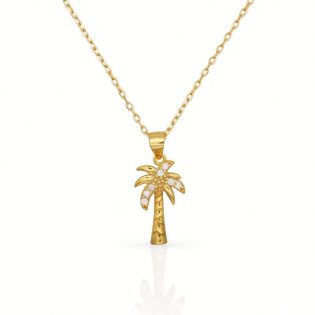
Resort Palmtree Necklace
$64.00 -
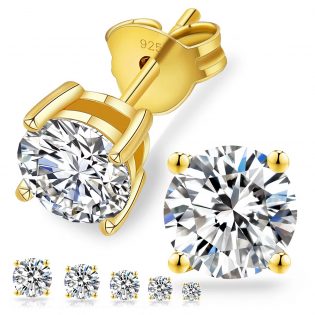
Oceanside Sparkle Studs
$38.00 -
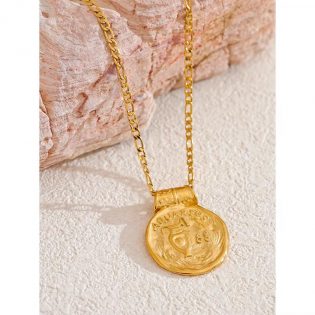
Coin Necklace
$34.00