The automotive industry is already feeling the pain of President Donald Trump’s tariffs.
Import taxes have cost companies more than $35.4 billion over the last year, according to an analysis of automakers’ financial records, reports Automotive News. Tariff bills vary widely by automaker, but there’s no denying that they are having a drastic effect on the industry as a whole.
An automaker may be headquartered in a specific country, and even build all its vehicles there, but can still source parts from outside its borders. The stated goal of Trump’s tariffs is to bring as much of the manufacturing process into the U.S. as possible and are thus dependent on how much of a company’s lineup and key components are shipped from overseas.

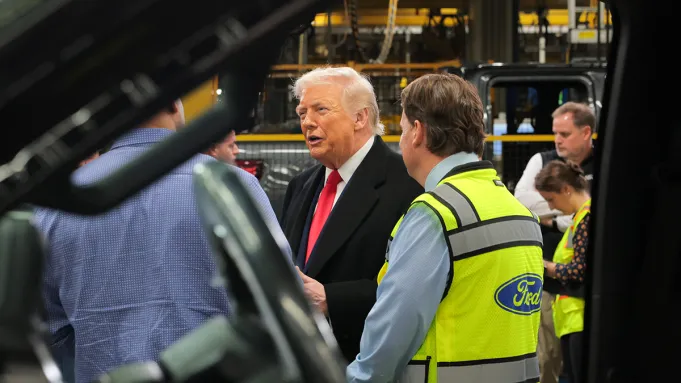
President Donald Trump‘s automotive tariffs are based on how much of a company’s lineup and key components are shipped from overseas.
Bill Pugliano/Getty Images
Because of this, it’s little surprise that the companies most affected by increases in import tax are those based outside of the U.S. Japan’s Toyota is estimated to pay ¥1.45 trillion, or $9.1 billion, in tariffs for the 2026 fiscal year, which ends this month, according to the weekly industry newspaper. Companies like BMW, Genesis owner Hyundai-Kia, Honda, Mercedes-Benz, and Volkswagen all expect or project to spend over $1 billion in duties.
U.S. companies are not immune to Trump’s tariffs, either. The Big 3—Ford, General Motors, and Stellantis North America (historically known as Chrysler)—are expected to spend $6.5 billion on import taxes.
Automakers based in and out of the U.S. are also still searching for clarity about this administration’s long-term trade policy. A year into Trump’s second term and it is still ambiguous which tariffs will remain in place, which can be negotiated, and which may be discarded all together.
“That’s still pretty hard to do because the administration has just not been very clear or consistent in application and what stays and what goes up and what goes down and what gets added,” Dan Hearsch, a global co-leader of the automotive and industrial practice at AlixPartners, told the publication.
The hefty tariff bills come at a time of great uncertainty for those involved in every aspect of the automotive business. Sales of battery-powered vehicles have not been as strong as expected, something that hasn’t been helped by the Trump administration’s decision to cancel the $7,500 EV tax credit. Automotive News says changes in electrification strategies have cost automakers $70 billion industry-wide.
Authors

-

Coastal Coin Necklace
$34.00 -

Resort Palmtree Necklace
$64.00 -
Oceanside Sparkle Studs
$38.00 -

Coin Necklace
$34.00