Cold heaters and the smell of diesel, oil, and mold. Clunky transmissions, a jarring ride, and glacial progress. Those are a few of the things I remember about Land Rovers from being bounced about in them as a child in the days before they were seen as hip accessories for well-heeled types with a yen for adventure. Who could have seen that coming, especially when the utilitarian vehicle now universally known as the Defender (among the uninitiated) was employed almost exclusively as a workhorse, not as a trinket?
It all changed, ironically, around the time that Jaguar Land Rover decided the “old” Defender was no longer fit for purpose. It’s crash-unfriendly bodywork, lack of safety devices, harsh ride, and terrible turning circle, they said, deemed it eligible for the axe in 2016 after almost 68 years of loyal service. But, as Joni Mitchell sang in “Big Yellow Taxi”: “Don’t it always seem to go, that you don’t know what you got ‘til it’s gone . . . ”

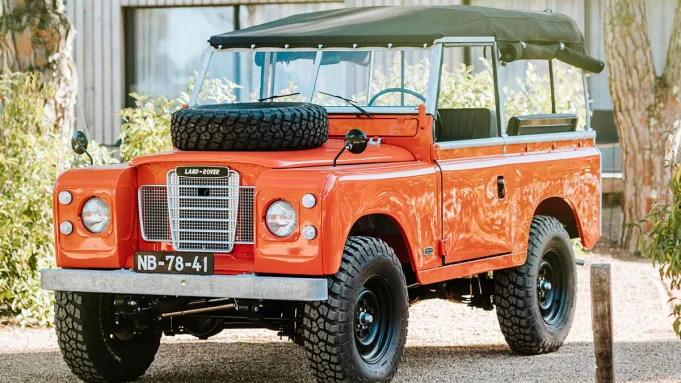
Examples from Land Rover provide the blank canvas for Coolnvintage restomods.
Coolnvintage
In this case, however, plenty of people did know what they had (or what they wanted): a super-cool style statement which, due to its basic shape, simple engineering, and built-in versatility, represented a perfect blank canvas on which to express an owner’s individuality.
One man who recognized that years ago is Ricardo Pessoa, who set out to turn his love for old Landys into a business back in 2012 by founding Lisbon-based Coolnvintage, one of the first to specialize in next-level Land Rover restorations.
Pessoa, a self-confessed perfectionist, wanted to do things differently: he wanted a Land Rover reimagined by Coolnvintage to be not just a usable rebuild, but a rolling work of art with perfect panels, flawless paintwork, and tailored upholstery draped over the top of a pristine chassis and perfect mechanicals. Being a perfectionist, however, means Pessoa needs time to craft your ideal Landy—which is why it takes up to three years for his 17-strong team to transform a down-at-heel donor vehicle into a gleaming machine that will turn heads from Los Angeles to Saint-Tropez, and everywhere in between.

The goal of Coolnvintage’s founder, Ricardo Pessoa, is to present restomods with flawless paintwork paired with tailored upholstery draped over the top of a pristine chassis and perfect mechanicals.
Coolnvintage
The magic doesn’t happen in a typical, oil-soaked workshop but in a two-story industrial building that feels more like a vast art space. Here, the installations take the form of Land Rovers (strictly the Series models built between 1948 and the early ‘80s, and the 90 and 110 range that followed before being renamed Defender in 1990).
Rows of donor cars in the basement contrast with finished restorations on the ground floor to show the “before-and-after” contrast of a Coolnvintage project, which can turn a $5,000 wreck into a $350,000 leather-lined Landy on which the paint job alone has cost five times the unrestored car’s purchase price.
Among the lineup awaiting restoration, we spotted some true rarities, such as one of a believed 700 Defenders made in Pretoria, South Africa, during BMW’s ownership of Land Rover. These were fitted from new with the Bavarian marque’s smooth and powerful 2.8-liter, six-cylinder engine. Another example of a model rarely seen in Europe is a genuine NAS (North American Specification) Defender 110 that Pessoa is restoring for himself.

The final assembly aims for millimeter-perfect panel gaps, impeccable door closure, and a rattle-free ride.
Coolnvintage
Although Range Rovers were sold in the U.S. for many years, it wasn’t until around 1994 that the first Defenders were made available there and, to pass safety regulations, they had to be fitted with both internal and external roll cages and safety lights. The NAS cars also got cage-type roof racks, air conditioning, and Rover’s famous 3.9 liter V-8 petrol engine. Little more than 7,000 examples were built before sales of Defenders to the U.S. had to be abandoned when crash-test rules became even stricter.
Pessoa admits he’s personally not much good with a spanner, but his artist’s eye and marketer’s brain has put Coolnvintage among the top contenders in an ever-burgeoning field of Land Rover restorers, customizers, and restomodders across the globe.
It helped that he was among the first to realize that there are plenty of clients who have the financial resources but lack the skill, time, or inclination to do such work themselves, yet will pay whatever it takes for someone else to create a vehicle that is entirely bespoke to their requirements.

Where necessary, chassis are replaced with galvanized versions, and body panels are preserved or remade to original quality.
Coolnvintage
Such customers can be demanding, but few are as demanding as Pessoa, who was so determined that the rebuild process should be as smooth as possible that he employed U.K-based consultancy the Kaizen Institute to work out the best setup to ensure optimum workflow. That means each project begins with every nut, bolt, washer, and grommet being stripped off, labelled, photographed, bagged, and boxed. Larger parts are palletized, with the components from each dismantled vehicle being kept together in crates in their own dedicated areas.
After that, everything is individually assessed and either fully refurbished or replaced with another OEM part with the aim of keeping the rebuild as original to Land Rover as possible—and meticulous documentation of the whole process means there’s a permanent record of every part that comes off or goes on. Where necessary, chassis are replaced with galvanized versions, and body panels are preserved or remade to original quality. Even the smallest components are painted or treated to ensure maximum longevity, while final assembly (carried out after at least one dry run) aims for millimeter-perfect panel gaps, impeccable door closure, and a rattle-free ride.

Meticulous documentation of the whole process means there’s a permanent record of every part that comes off or goes on.
Coolnvintage
And since each build is unique, buyers can choose everything from the color of the paint to the materials for the interior trim to the type of engine (so long as the power plant was originally used by Land Rover) and whether it drives through an automatic or manual transmission.
While clients are waiting, Pessoa keeps them interested by sending his own beautifully framed, large-format art photographs of unrestored bits from their car, such as a time-worn ignition key, a rusty radiator cap, or a buckled VIN plate.
And, as soon as a lengthy build is completed, he records the engine sound at initial start-up and has it pressed onto a vinyl record that he hands over on delivery. All of this helps to explain why a Coolnvintage resto can take three years, and why prices start at $200,000.

Each build is unique, and buyers can choose everything from the color of the paint to the materials for the interior trim to the type of engine (so long as the power plant was originally used by Land Rover).
Coolnvintage
If you’ve been thinking about taking off on a Land Rover adventure but just need a little more encouragement, Coolnvintage has recently published a book that might provide all the inspiration you need. MZURI tells the story of the Trans-Africa expedition made during the 1950s by George Rodger and his wife Jinx in a Series I Land Rover.
Rodger had been a war correspondent for LIFE magazine during World War II and captured many remarkable and harrowing images before going on to cofound the legendary Magnum photo agency along with Robert Capa, Henri Cartier-Bresson, and David Seymour. As you can surmise, the 168 large-scale images in this book (which also includes 24 essay pages about the journey) are unfailingly superb. It can be ordered online directly through Coolnvintage.
Click here for more photos of Coolnvintage Land Rover restomods.

A Land Rover restomod from Coolnvintage.
Coolnvintage
-

Coastal Coin Necklace
$34.00 -
Resort Palmtree Necklace
$64.00 -

Oceanside Sparkle Studs
$38.00 -
Coin Necklace
$34.00