It’s around 5:45 a.m., dawn in Republic of the Congo. The sun is burning off the final clouds from last night’s rain, and there’s a gentle breeze rippling the thick humidity in the air. I’m waist-deep in the waters of Lango Baï, a swampy waterway deep in the forest of Odzala-Kokoua National Park, absorbed by the near-total silence of the nascent morning. Suddenly the breeze changes direction. Just a few hundred feet away, the adolescent bull elephant that my group spotted seconds earlier, freezing us to our spot, sharply lifts his trunk and flares his ears. He can smell us now. He knows we’re there.
On most traditional safaris, boots-on-the-ground encounters like this would be rare, perhaps even cause for concern. On a Kamba Africa walking safari, they’re intentional. Their expeditions through the Congo Basin (in the safe and stable ROC as opposed to the more volatile Democratic Republic of Congo) are designed to be slower and more focused than the vehicle-based safaris luxury travellers are accustomed to. The result is an experience unlike any other I have encountered: intense, challenging, rewarding, and exhilarating, all at the same time.
But the swamp is not where a Kamba journey begins. After arriving at Brazzaville’s Maya-Maya International Airport (Air France via Paris is the recommended commercial route; private landings can also be arranged) their representatives meet you airside. Kamba, a conservation company turned tour operator that’s been active here since 2012, has special dispensation from the government to process visas on arrival, which is far more convenient than having to deal with the ROC mission in your home country. After an overnight stay in Brazzaville’s Hilton, housed in two gleaming glass towers with exceptional views of the mighty Congo River, a private charter heads north into Odzala before a roughly two-hour jeep transfer into the forest. Destination: Ngaga Lodge. Aside from transfers between Kamba’s three luxury camps, that’s the last you’ll be in a vehicle for the duration of your expedition.
Ngaga can barely be seen amid the rainforest canopy—the same seemingly impenetrable jungle that’s home to lowland forest gorillas we’re hoping to witness. The 11-day Odzala Immersion begins with four nights at Ngaga and three gorilla treks—one each morning into the dense Marantaceae foliage to search for the semi-habituated families who live nearby.

As close as it gets to being one with the forest at Kamba’s Ngaga Lodge.
Gorilla treks at Ngaga begin before dawn and are entirely on foot. Just a few steps from breakfast is the forest, and silence. Kamba’s trackers rely on sound as much as sight to locate the three gorilla groups habituated enough to receive guests, and the tension and focus is high—more so than any other gorilla encounter I’ve had. Keeping up with the tracker adds another layer of stress, as they seem to glide through the vegetation at speed. Then a sudden stop: the guide hears the chewing of leaves, smells the bittersweetness of the animals’ sweat. To a layman like me nothing has changed, but to an expert the signs are clear: we have found the family at their breakfast.
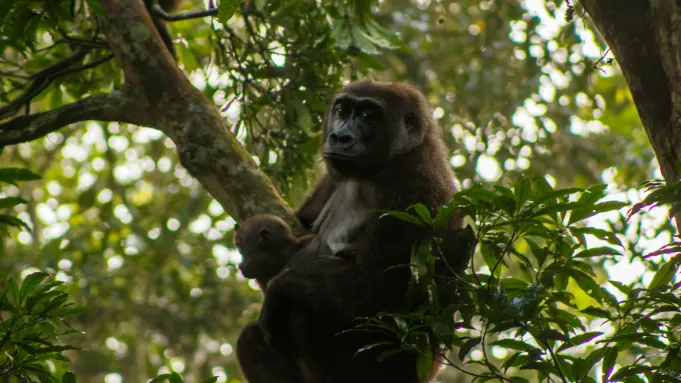
The following 60-minute observation is breathtaking. The need for stillness to appease the gorillas also means your attention to them is unbroken; their lack of concern for and interest in you makes the behavior you see truly authentic. These gorillas have had far less human exposure than their mountain-dwelling cousins farther east in Rwanda and Uganda, and the overwhelming majority of that has been hands-off scientific observations. They are wary, yet tolerant, of our presence, rather than curious or enthusiastic. And they spend more time high up in the trees than on the ground; the grace with which the large males flit between branches contradicts their 350-pound mass. I kneel on the forest floor, concentrating my breathing to slow my heart rate after the hike, and gaze up at an infant copying every move of its mother to try to reach the tastiest leaves. Comparison in hindsight made my previous trip to Rwanda feel like an extravagant zoo visit.
Each gorilla trek has a strict one-hour time limit. Once we’re back in camp—greeted by a second lavish breakfast to supplement our pre-dawn meal—our group trades tales of the morning’s visits. No more than six people can visit one family of gorillas at a time (one tracker, one guide, and four guests) so a full camp of up to 12 people is split into smaller teams and visits a different gorilla family each morning. A few hours’ rest and recovery is followed by light lunch and a more gentle afternoon activity: a forest walk that ends in sundowners with your feet in a stream; a trip to a local village whose inhabitants work with Kamba, be it in the lodge’s back of house, on conservation efforts, or as Forest Guardians, an initiative to both train locals in conservation and help them use their existing knowledge of the forest to protect it. Proper observation and immersion are the goals of a Kamba trip.
Like any top-tier safari operator, Kamba has exclusive access to the area in which it operates. Only a few hundred people per year enter this forest; in contrast, Rwanda makes 35,000 tracking permits available annually. That exclusivity, along with the extraordinarily close connection to the ecosystem, is just one reason Kamba is trusted by leading tour operators like Cookson Adventures, one of Robb Report’s own Travel Masters: “This is next-level safari. It’s extremely remote,” says Carlo Muies, a senior project manager with Cookson with experience leading guests on bespoke versions of the Kamba trip. Another advantage to working with Kamba is the opportunity for lasting, meaningful philanthropy. “[On a previous bespoke tour] we brought in two helicopters, which was the first time it had been done,” Muies tells Robb, “and took clients into the most remote part [of the Congo Basin]. They wanted to bring local scientists and herbologists from the capital, looking for species thought to be extinct. The local ranger told us the last time anyone had been there were park officials in the ‘90s.”

A Lango Baï sundowner with water buffalo as esteemed guests.
A wise guide once told me safari should be less about the Big 5 and more about the Small 500. Time spent in Lango and Mboko, Kamba’s two other lodges just a few miles north and east of Ngaga, focuses on exactly that. After the first four nights at Ngaga, we journeyed on to Lango Baï, seeing how the different ecosystems of Odzala-Kokoua National Park give way to one another: from forest to savannah to swamp, then a kayak down the Lekoli River. To see the rainforest from this angle, and at this gentle pace, is special. The gentle drift of the river’s current gives kayakers time to truly appreciate the myriad shades of green in the foliage; the clashing blues and grays in the imposing sky. If you’re really lucky, chimpanzees may make their way through the trees lining the river bank.
At that speed, 30 minutes of kayaking feels like a full afternoon. By the time I moor my craft in the shallows where the baï meets the stream, the sky is beginning to darken, though the journey isn’t quite over. After the first in a series of ‘wet walks,’ sloshing through knee-deep water, one wary eye always on the nearby grazing herd of buffalo, Lango emerges from the distance, just as the pink sky turns dark purple.
Much of the next few days is spent hip-deep in water or knee deep in mud. Distances are measured in meters rather than miles. Tiny creatures are appreciated for their beauty. Suddenly, every minute detail is perceptible and mesmerizing: the sharp flash of a violet Ipomoea flower among the endless green; the contrast markings of an inchworm crawling along a branch. The cacophony of the forest shocks me on the first night; by the second it’s a comfort.
Instead of being a safari observer, perched high above nature behind the steel barrier of a vehicle, I was part of it. My feet were in the tracks of that elephant in the baï, and of the buffalo and bongo (a rare forest antelope known for their striped pattern) we had seen on the mornings before. Our final swamp trek brings us to a forest known for an unusually high concentration of African grey parrots; Kamba’s head guide Dylan Smith informs us only around 50 other people had made it there all year. The parrots are elusive, conditioned by years of poaching to avoid humans, but after patience and perseverance we spy them, flocking above us in such numbers and with such noise it was a mystery how they managed to hide from us for so long. That forest feels primordial, ancient—like a place no human had ever dared tread before. Comfortable lodges and lavish meals are one thing, but that sensation is true luxury.
Full Buyout of the 11-night Odzala Immersion (up to 12 guests) from $178,000. See kambaafrica.com. Special experiences like the helicopter access mentioned can be arranged separately by Cookson Adventures.
-

Coastal Coin Necklace
$34.00 -
Resort Palmtree Necklace
$64.00 -

Oceanside Sparkle Studs
$38.00 -

Coin Necklace
$34.00