Wood & Pickett became famous in the 1960s for its maximalist Minis. The coachbuilt Mini Margrave was trimmed in polished walnut and high-grade leather, and could be customized with chrome nudge bars, Mercedes-Benz headlights, and tiny “opera” side windows. Celebrity owners included Mick Jagger, Elton John, John Lennon, and Peter Sellers.
Sixty years later, Wood & Pickett is back with a fresh twist on an old idea. The car is a joint project with Callum Designs, the consultancy founded by Ian Callum—best known for his former role as Director of Design at Jaguar. Priced from $101,000, each Wood and Pickett Mini by Callum (to use its official title) will be hand-built to the buyer’s chosen specification. Can it recapture the glamor of the 1960s original? That’s what we were about to find out.

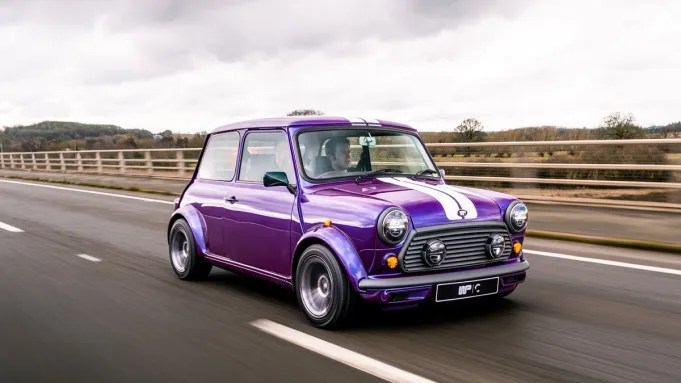
“Purple Myrtle,” a Wood & Pickett Mini by Callum that was commissioned by British comedian Paul Smith.
Owen Loach, courtesy of Wood & Pickett
Ian Callum is certainly the right candidate for the job of reimagining this Mini. Aside from having the Aston Martin DB7 and Jaguar I-Pace on his design résumé, the Scotsman has a longstanding affection for the Mini. “I still remember being seven years old, watching the Mini’s first Monte Carlo Rally in 1961,” he explains. “The servicing stop was directly opposite our house in Dumfries. The atmosphere was fantastic, and the sight of the red-and-white Coopers tearing past made an indelible impression.” Callum has owned five Minis since, including a 1969 Cooper S, and is currently restoring one of the final Sport 500 editions for his son.
The collaboration with Wood and Pickett was initially “a bit of fun,” says Callum. “We imagined that we’d sell less than 10 of them, but it had a really enthusiastic response.” The first new W&P Mini was built for British model and car collector David Gandy. Painted metallic bronze, in homage to Steve McQueen’s classic Cooper, it was displayed at several British concours events last summer. The order book now stretches to 27 cars, a handful of which will be exported to U.S. customers under the 25-year rule.

Stylistically, Callum has stopped short of Wood & Pickett’s past excesses, giving the Mini more visual attitude without eroding its classic identity.
Owen Loach, courtesy of Wood & Pickett
Design
The Callum Designs production facility is crammed with cool cars, including an achingly gorgeous Aston Martin Vanquish 25 (the company’s restomod V-12 supercar) and the prototype Callum Skye (a lightweight electric off-roader due in 2027). Even so, there’s no missing the commissioned Mini restomod that we’re here to drive. Commissioned by the British comedian Paul Smith (no relation to the fashion designer who created his own limited-run Mini), its eye-popping paint flips from blue to bright purple under the workshop’s strip lights. It’s only the second car completed, and Robb Report is the first media outlet behind the wheel.

The interior features a walnut dashboard complemented by Smiths gauges, a Moto-Lita steering wheel, and “piano key” switches made from billet aluminum.
Owen Loach, courtesy of Wood & Pickett
In terms of design, Callum has stopped short of Wood & Pickett’s past excesses, giving the Mini more visual attitude without eroding its classic identity. “I saw it as an opportunity to improve on the design of late Sport Pack Minis,” he says. The makeover starts with a set of Wood & Pickett wheel arches, which wrap snugly around 13-inch dished alloy rims. Elsewhere, deeper valances and vented sill covers help to smooth airflow, chrome parts—such as the bumpers and grille—are ceramic-coated, and all lights are upgraded to super-bright LEDs. Interestingly, Callum chose not to remove the external body seams—a common practice on modified Minis, including the rival David Brown Mini Remastered—deeming them “a part of the car’s character.”
Inside, the Wood & Pickett is even more bespoke, like a Mini Margrave for the 21st century. Its walnut dashboard is complemented by cream-faced Smiths gauges, a Moto-Lita steering wheel, and “piano key” switches made from billet aluminum. There’s even that most modern of accessories: a cup holder. The unique seats were created in-house by Callum Designs, with quilted inserts inspired by an Oswald and Pablo armchair that Paul Smith has at home. We especially love the electric window controls, which are made to resemble manual winders.

The quilted seat inserts were inspired by an Oswald and Pablo armchair that client Paul Smith has at home.
Owen Loach, courtesy of Wood & Pickett
Smith admits that the Mini was a basket case when he bought it: “a drunken eBay purchase that had been sitting in a barn since about 2007.” Surprisingly, the “Amaranth” purple is the car’s original paint color, albeit resprayed from a bare shell for a deep and mirrorlike sheen. The build process has taken about six months, Smith explains, elongated by him “choosing pretty much every option available.” These included a five-speed gearbox, power steering, air conditioning, a rearview camera, and a premium Audison sound system. “You get a million-dollar-specification journey on a car that costs about $100,000,” says Callum’s engineering director, Adam Donfrancesco.
Power Train and Hardware
Each Callum conversion starts with a late-model Mini (originally built from 1996 through 2000) fitted with the 1.3-liter fuel-injected “MPi” engine. The four-cylinder A-Series mill is rebored to 1,380 cc (84.2 cubic inches), then uprated to “Stage 3 road/rally spec” with a gas-flowed head, twin-point injection, a tweaked ECU, and a stainless steel Maniflow exhaust. Twist off the oil filler cap and you’ll spot a set of anodized-aluminum Wood & Pickett high-lift rockers, too.
According to Donfrancesco, the end result is “somewhere between 100 and 110 hp”—enough to outgun any pre-BMW Mini Cooper. “Our focus was primarily on boosting low-down torque, though, rather than headline power.” Wood & Pickett Minis always majored on luxury rather than point-to-point pace, after all.

The car is fit with a 1.3-liter, fuel-injected four-cylinder engine making roughly 100 to 110 hp.
Owen Loach, courtesy of Wood & Pickett
Further modifications include a lowered, sportier suspension setup, ventilated 8.4-inch front disc brakes, and sticky Yokohama A539 tires. No performance figures are quoted, but given a modest curb weight of around 1,600 pounds, we’d guess the car covers zero to 60 mph in 7.5 seconds.
Could an EV transplant make the Mini both quicker and quieter? “We were asked about making an electric version, but I’m not sure the demand is there,” says Callum. “It would also add around £30,000 [$40,500] to the car’s price.”
Performance
The roads around Callum HQ in Warwick, England, are awash with post-winter grit and sludge, and Paul Smith is due to collect his car the following day. So, in an effort to preserve his perfect paintwork, it’s agreed we will take the Mini test mule out first. After a proper drive in this mechanically identical prototype, a quick run in “Purple Myrtle”—as Smith has christened her—will serve for the purposes of photography.

Given its curb weight of around 1,600 pounds, we’d guess it covers zero to 60 mph in 7.5 seconds, though no performance figures are quoted.
Owen Loach, courtesy of Wood & Pickett
Callum’s mule is based on a tatty 1999 Mini 40th special edition. This little sedan could originally muster a mere 63 hp. Now, with close to double that output, it really flies. The tuned engine feels particularly muscular in the midrange, with a woofly snarl from the upswept twin tailpipes that builds to an angry blare. The ride is definitely less choppy than that of the stock Mini setup, despite the relatively large wheels, and the beefed-up brakes provide reassuring stopping ability (still without ABS, mind you).
There are quirks, of course, such as the lorry-like angle of the steering wheel, which demands an elbows-out driving position, but they’re all part of the classic Mini experience. And when you find the right road, those well-worn cliches about “go-kart handling” still seem apposite. The Mini seems to change direction with almost no sense of inertia, biting into corners with terrier-like tenacity. Unlike most of Europe’s other postwar people’s cars—the Volkswagen Beetle, Renault 4, and Fiat 500 among them—it’s a genuine joy to drive.

Further modifications include a lowered, sportier suspension setup, ventilated 8.4-inch front disc brakes, and sticky Yokohama A539 tires.
Owen Loach, courtesy of Wood & Pickett
Our two main issues with this particular Mini test mule are its heavy steering and lack of a fifth gear—both of which have been addressed by Paul Smith’s chosen specification. Adding electric power steering is controversial (Callum thinks it removes some sensitivity at speed), but it makes for easier parking and calmer, more controlled progress. The feel of heaving the Mini’s wheel through tight corners, occasionally fighting kickback from the wide tires, gives way to a newfound finesse. The additional gear ratio makes highway cruising much more relaxed, too—it’s a must-have for us.
Is it Worth It?
That ability to cover long distances in comfort will be a relief to Smith, who is planning a three-week road trip around Europe with his wife. “We’ll go from London to Amsterdam, then Bruges, Cologne, Krakow, Salzburg, and Florence. After that, we will head home via Monaco, Geneva, and Reims.” The adventure will be filmed for the comedian’s YouTube channel, with Purple Myrtle in a starring role.
Even without a camera crew in tow, the car attracts a huge amount of attention. Indeed, it’s hard to believe the Mini used to be ubiquitous on U.K. roads, with almost 5.4 million sold during its 41 years in production. Smith may well discover the Mini turns as many heads as his (equally purple) Lamborghini Huracán Evo.

Priced from $101,000, each Wood and Pickett Mini by Callum will be hand-built to the buyer’s chosen specification.
Owen Loach, courtesy of Wood & Pickett
All restomods are a substantial investment in time and financial resources, and the Wood & Pickett Mini by Callum doesn’t buck that trend, considering a tidy original Cooper S is half the price. Conversely, this is one of the most affordable ways into a bespoke, hand-built vehicle. And it’s also a car that defies cold logic, being brimful of character and, as we already mentioned, joyous to drive. “Each generation rediscovers the Mini,” says Callum. “It seems to have as much relevance today as it ever did.” In an automotive world where excess is exalted and everyday cars feel increasingly like appliances, we reckon he might be right.
Specifications
Vehicle Type
In Production Since
Power train
- 1.3-liter four-cylinder, 110 hp
- Five-speed manual transmission
Performance
- Zero to 60 mph: 7.5 seconds (est.)
- Top speed: 115 mph (est.)
Price as Tested
Click here for more photos of this Wood & Pickett Mini by Callum restomod.

Driving “Purple Myrtle,” a commissioned Wood & Pickett Mini by Callum restomod.
Owen Loach, courtesy of Wood & Pickett
-
Coastal Coin Necklace
$34.00 -
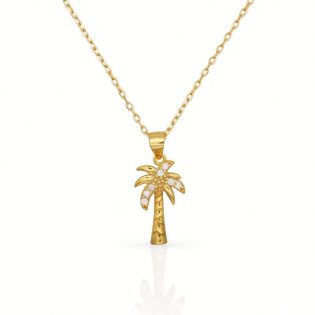
Resort Palmtree Necklace
$64.00 -
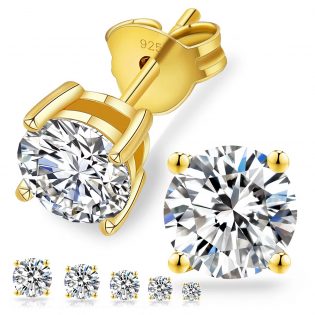
Oceanside Sparkle Studs
$38.00 -
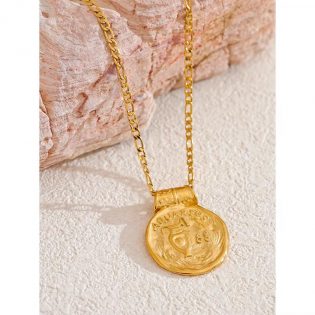
Coin Necklace
$34.00