This story is from an installment of In the Loupe, our weekly insider newsletter about the best of the watch world. Sign up here.
What’s an “under-the-radar” watch?
The answer depends largely on your familiarity with the vast world of high-end watchmaking—and where your personal collecting instincts tend to point. For some, it might mean once-revered maisons whose vintage pieces remain surprisingly attainable. For others, it’s the work of small but mighty independents poised to become the next F.P. Journe. And in today’s hype-driven market, it might even include overlooked models from mainstream houses that collectors are rediscovering after the frenzy fades.
To get a clearer picture of where the smart money is heading, we spoke with a group of seasoned dealers about the brands and timepieces they believe offer exceptional value today—and the potential to resonate with collectors in the years ahead.
Several of them were preparing to gather in Miami for the Original Miami Beach Antique Show (a.k.a. OMBAS), one of the vintage market’s most important annual events. Others were looking ahead to Geneva next month, when the industry converges for Watches and Wonders and the constellation of satellite events that now orbit it.
From neo-vintage classics of the 1980s and ’90s to overlooked references from storied names like A. Lange & Söhne, the watches these insiders shared remain under the radar today but may not stay that way for long.
Their remarks have been condensed and edited for clarity.
Roberto Chiappelloni, owner, Manfredi Jewels in Greenwich and New Caanan, Conn.
Since day one of my business, when I would go to Basel, or now Geneva, I’d always go to the back of the room, to the small independents, to the Academy—that’s what always intrigued me, these people that put everything on the line to practice their craft. For four or five years, we were the only dealer in the United States who sold Laurent Ferrier.
In my book, there are three or four watchmakers that have some stature but are still relatively independent. The Grönefeld brothers—they’re doing an amazing job. We are representing a small Chinese company run by French guys, Atelier Wen—they’re doing some amazing work.
Mr. Dominique Renaud of Renaud & Papi is finally coming out with a watch under his own name this year, a beautiful watch with a big balance wheel. That’s one to watch! He’s a guy who has great credibility.
I do the buying for the company and my brother is more sales focused. As the buyer, I tend to look for opportunities for value regardless of hype, or almost the opposite of hype—because a hype watch generally offers little to no value to the buyer but does offer other things (when you’re buying a hype watch, you’re buying it because it’s a flex and you want to be in that club).
Today, a lot of the value resides in neo-vintage classic watches from the ’80s to ’90s: round case Audemars Piguets [APs], round-case Vacheron Constantins, and round Patek Philippes. They offer great value relative to what their catalogs show today. I almost forgot to include Breguet. Today, those same brands don’t offer the smaller diameters, gold has gone through the roof, and they aren’t offering the same designs. The vintage pieces are safe bets.
What I’m also looking at—but for a more long-term strategy—is what was front and center before and has come down: ’90s Rolex. It has come down precipitously and there are great values in there. But it’s not something you can turn around and make a profit on right away. It’s only an opportunity if you wait it out. And that includes Rolex Daytonas with Zenith movements—those have come down massively since their peak right after Covid. Today, the Daytona is still an icon. And the Zenith Daytonas were only produced in a finite amount and they’re never going to make them again.

A Patek Philippe Ladies’ Nautilus
Oliver Smith
Also, I’ve been actively making a push on ladies’ watches—a lot of Patek and AP from the ’80s and ’90s. I love that world; there’s a ton of value. You can buy a mini [Patek Philippe] Nautilus, a mini [AP] Royal Oak. Now, I have my eye on a Vacheron Overseas miniature. The full size is probably $15,000. But the miniature quartz for ladies, at 26 mm, is probably $4,500.
Kevin O’Dell, collector and dealer, @theydid
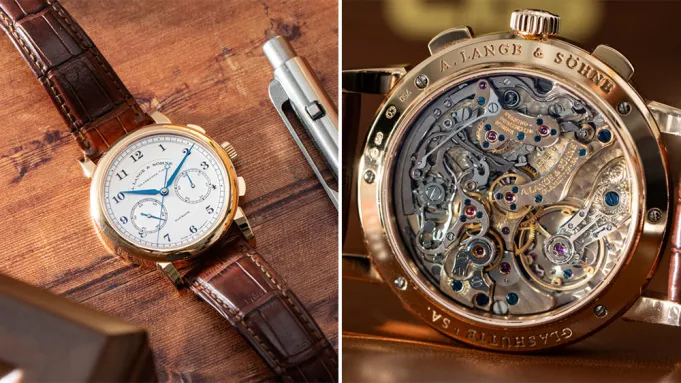
I am noticing that more people are finally appreciating A. Lange & Söhne. It’s been a long time coming for the brand. They are really deserving of this. I’m not saying prices are doubling or tripling like we saw with Cartier, but the market is looking at them more and desiring them more—specifically the older Langes from 1994 to early 2000s, the smaller models like the Little Lange 1 at 36 mm, the original 1815 that was 36 mm, the original Saxonia 34 mm. Even the Arkade, a ladies watch, is really desirable.
As far as independents go, they’re all kind of hot. The Sylvain Berneron watches seem to be doing really well but they don’t come up in the market very often. And older Breguets—from the Brown era and early Chaumet-Daniel Roth era. I’m seeing people get really excited about those.
The one that I think is really under the radar is the Biver-Jacques Piguet era of Blancpain—the Villeret models form the late ’80s and early ’90s offer a great value and people are starting to take notice.
James Lamdin, founder and vice president of vintage & pre-owned, Analog Shift
On the vintage side, I have one word for you: Movado. Movado has an incredibly rich legacy of making really high-end timepieces between the 19-teens and 1960s. Personally, I inherited a vintage 1960s Movado chronograph from my grandfather, and it’s one of the reasons where I am today. The ’60s stuff is primarily what I’ve been focused on, but the reality is that it’s almost the last act in a great 40+-year run of making some of the most exquisite, really thoughtful and magnificently elegant timepieces from that period. And collectors are starting to tune in in a really serious way.
I think we could make a really compelling argument that the width and breadth of what Movado was manufacturing was astounding. The last few years we’ve seen a newer appreciation of smaller case sizes. That was the first step. And then a new appreciation of avant garde design language. And then a renewed appreciation for the mechanical side of even simple watches. Movado, to me, is kind of the undiscovered country. I’ve personally fallen down the rabbit hole. Look at timepiece manufacturers from that era—the ’20s, ’30s, ’40s, ’50s—and there are obvious standouts. But very few, with the possible exception of LeCoultre, are known for having everything—entry level to highly complicated pieces and truly artistic creations. Patek was making fabulous watches then but they’re all high-end. Rolex was the same way, with more focus on sports pieces. LeCoultre is the best brand I could give you—they did entry level, complications, artistic pieces that are really exquisite and Movado did the same. There’s a lot of energy around them.

A. Lange & Söhne Saxonia Thin
Analog Shift
The new watch/pre-owned business is being led by Cartier and Patek. The big question on everybody’s mind: What’s going to come up and take that elevator space that’s been dominated by F.P. Journe for the last several years? Because frankly, they’ve left the building. You can’t get into a Chronomètre Bleu for under $175,000 for a $37,000 watch. All Journes are now in the realm of unicorns, $200,000 to a million-plus. What are people going to replace that with?
My personal money is on Lange. They have entry level stuff: the Saxonia time-only is under $25,000. In the mid-range and high-end, you’ve got Lange 1s all the way to Zeitwerks. But then you have the special things: the Lumens, the Honey Gold boutique editions and those have already started to get really big. So the big stuff is getting bigger. And similarly to Journe, it’s not one model. Do I think a Saxonia Thin is going to be $200,000 [in the secondary market]? No, but it probably won’t be 20-something.
Chris Daaboul, founder, EsperLuxe in Boston
Brands-wise, an incredible one is Romain Gauthier. Their stuff is incredible—precision engineering, finishing that is sublime, architecture of movements that is really beautiful and well thought out. And they do everything there. Romain is an engineer by trade—he’s inspired by the automotive world, music and art. We’re going to be hearing about Romain Gauthier in the years to come.
If we want to go to the German part of Switzerland, to Biel/Bienne, I think with Armin Strom, you’re talking about truly innovative technical watchmaking. It’s like the watchmaker’s watch. The evolution of their Resonance watch has been incredible—they’ve since developed that line into the new Dual Time Resonance. And the quality of their finishing is also exceptional, from their entry level pieces under $20,000 up to their $150,000 watches.
A German watchmaker, Moritz Grossmann, is highly underrated. It’s artisanal watchmaking from the Glashütte region. What’s also awesome: It was founded and operated by a woman, Christine Hutter. She’s tremendous. Moritz Grossmann was one of the forefathers of German watchmaking in Glashütte. Unfortunately, he didn’t have any heirs and the legacy faded. Christine worked in the industry, and when she discovered Moritz Grossmann, she did a deep dive and became enamored of the work. She did that over 10 years ago, raised capital to build the manufacture. They make traditional ¾ plate movements with hand-engraved balance cocks, but they’re also innovative: They’re the only ones who have a Hamatic movement.
From a watchmaker standpoint, it’s a hard one. There are so many good ones that are coming along. And we’ve seen a plethora of watchmakers with subscription models come up in the last five years. I’m not sure he’s necessarily underrated—his waitlist is certainly strong—but Sylvain Pinaud’s work is incredible.
Miguel Sherlock, technical director of watchmakers, Ben Bridge Jeweler in Seattle
For a modern pick, the Tudor Ranger 36 mm is quietly becoming a favorite among collectors. This latest Ranger captures the vintage spirit of the original while delivering a thoroughly modern wearing experience. Its 36 mm case sits comfortably on the wrist, and the watch transitions effortlessly between bracelet and strap, making it one of those fun pieces that works with virtually any look. It’s understated, versatile, and has that “if you know, you know” charm that resonates with today’s collectors
Authors
-

Victoria Gomelsky
-
Coastal Coin Necklace
$34.00 -
Resort Palmtree Necklace
$64.00 -
Oceanside Sparkle Studs
$38.00 -
Coin Necklace
$34.00