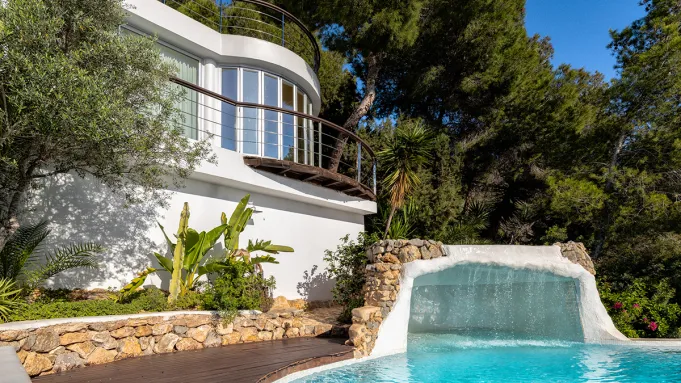
If the latest wave of billionaires arriving in South Florida shares anything, it’s that they are not dabbling in the Sunshine State. Miami is no longer just a seasonal weekend diversion or a maybe secondary address to post up for a few weeks in the winter; it has become a primary residence, a strategic decision reflecting where global wealth chooses to live.
As recently as 2020, there were no recorded residential sales above $50 million, but by 2025, Miami had emerged as one of the country’s most active ultra-luxury markets, where nine-figure transactions are no longer unusual. The broader market may be cooling, but at the very top, activity remains concentrated, and along a narrow stretch tracing Biscayne Bay, properties trade quietly, often before they are formally listed.
The buyers of these high-priced homes, however, are increasingly familiar. Mark Zuckerberg and Priscilla Chan recently paid a record $170 million for an unfinished estate on Indian Creek Island, where neighbors include Jeff Bezos and Tom Brady. Larry Page has been assembling a huge spread in Coconut Grove, while Sergey Brin has put down roots on Allison Island. And on Star Island, as well as Palm Beach, Ken Griffin continues to set new benchmarks.
At this level, residential real estate functions as much as a financial strategy and lifestyle enhancer as it does as a shelter. Buyers are not simply acquiring places to live; they are increasingly purchasing adjacent parcels to create larger, more private compounds. The homes designed to cater to these folks have followed that shift.

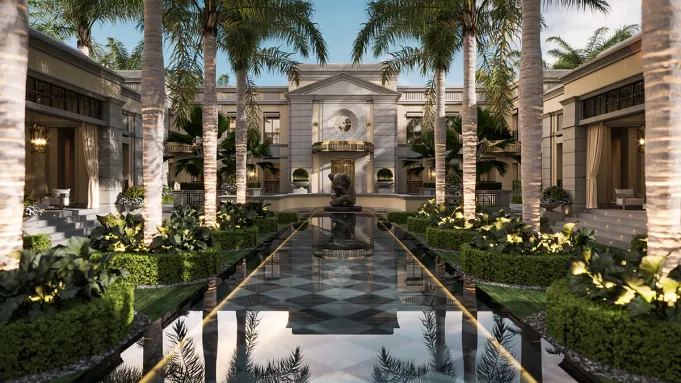
Inside Mark Zuckerberg’s new house on Indian Creek Island.
Rendering by Ferris Rafauli Design
Ferris Rafauli is working across several of these kinds of uber-luxe projects, including the Indian Creek Island estate acquired by Zuckerberg and Chan. Known for Drake’s opulent Toronto mansion, the Canadian tastemaker has increasingly focused his practice in South Florida, where projects tend to unfold at a much larger scale. On Indian Creek, he’s currently working on another waterfront home for another billionaire, part of a small cluster of new mansions reshaping the island, and further north, in a private golf community near Palm Beach, he’s designing homes for former hockey player Wayne Gretzky and pro golfer Dustin Johnson.
Rafauli approaches these houses as fully integrated projects, with architecture, interiors, and landscape developed together from the outset. The goal is continuity, spaces that feel resolved rather than assembled. “For me, design is an insurance policy on the land it’s built on,” he said. “The right architecture elevates the investment. The wrong one diminishes it.”
He is also working on a 10,000-square-foot penthouse at the forthcoming Aman Residences in Miami Beach, where the challenge is more compressed. “You’re delivering impact in a single moment,” he said. “Every line of sight, every proportion—it all has to work instantly, then reveal itself over time.”

Interiors by Evan Edward are designed to support work, family life, and entertaining.
Nicole Franzen
For Josh Evan Goldfarb and Michael Edward Moriano of Evan Edward, the shift in Miami is less about aesthetics than about how a house performs over the course of a day. The Miami-based firm has built a reputation for high-end residential work across South Florida, particularly in Miami Beach and Coral Gables, where scale and livability are equally prioritized. As the city has become a year-round base, their clients—often finance and tech principals relocating from New York and California—expect homes to support work, family life, and entertaining without interruption.
Indeed, multifunctionality has changed how they plan space. Offices are treated more like private work suites, usually with the same level of finish as the main living areas. Entertaining spaces are designed to expand and contract depending on use, accommodating larger groups without feeling oversized when empty. “The goal is for everything to feel seamless,” they said. “You shouldn’t have to think about how a space works—it should just keep up with you.”

As more buyers relocate full-time, homes across Miami are being planned to function continuously.
Nicole Franzen
At Wecselman Design, led by Deborah Wecselman, that same shift is playing out across a portfolio that includes waterfront estates in Bal Harbour and Fisher Island, as well as high-end condominium work. Her projects often attract international clients, including energy and finance executives, and balance strong architectural frameworks with quieter, material-driven interiors.
Projects are moving away from decorative finishes toward natural materials—wood, stone, and layered surfaces that hold up over time. Floor plans are also becoming more segmented, with larger homes organized into distinct zones. “People still want scale,” Wecselman said, “but they also want a sense of separation within it.” Her instincts are clearly pointed in the right direction. In Bal Harbour, a waterfront estate she designed for Invenergy founder Michael Polsky sold for $24 million, setting a local record, while a nearby condo at Oceana Bal Harbour she redesigned is now asking significantly more than its last trade.

A South Florida residence by Wecselman Design.
Douglas Friedman
The way these homes are used has changed as well: stays are longer; work and leisure overlap; staff operates continuously but with minimal visibility. Houses in South Florida’s most coveted areas are increasingly expected to accommodate all of it. That thinking is shaping Miami’s next wave of development.
Katie Earl of HBA Residential is leading interiors at the Delmore in Surfside, a new oceanfront project designed by Zaha Hadid Architects. HBA, part of the global hospitality design firm Hirsch Bedner Associates, is known for large-scale luxury hotel and branded residential projects, including work with Four Seasons, Ritz-Carlton, and Mandarin Oriental. For Earl, the expansion and reorientation of priorities is not just about adding more amenities but about how cohesively they are integrated.

A shift toward quieter palettes and more durable materials reflects how these homes are now used year-round.
Douglas Friedman
“We’re seeing a real shift in how people want to live,” she said. “Wellness is at the heart of it—not as an add-on, but as a framework for the whole environment.” At projects like the Delmore, that means thinking beyond individual amenities and focusing on how the residence functions day to day, from daily routines to long-term stays.
Though much of Miami’s top tier is moving toward polished restraint, not everyone is following that direction. In Little River, a former industrial pocket turned creative hub, Moniomi Design is leaning into something more expressive. Founded by Monica Santayana and Ronald Alvarez, the Miami-based studio has built its reputation on dynamic interiors that mix saturated color with a more relaxed approach to materials.

A residential project by Moniomi Design leans into color and custom furnishings.
Jeanne Canto
That perspective is carrying into their residential projects, where the brief is often less about uniformity and more about personality. For Chelsea Hirschhorn, founder and CEO of Frida, Moniomi designed a Miami bungalow that operates as a standalone extension of her primary residence. With a softer, beach-driven feel, the project reflects a broader shift in how these homes are conceived.
“We’ve seen a move away from single-residence living toward more of a private campus,” they said, with separate guest and amenity houses designed specifically for entertaining. In this case, the bungalow functions more like a boutique hotel than a traditional guest wing, with color-saturated suites and dedicated recreation spaces.

The quiet luxury trend is slowly giving way toward more personalized interiors.
Jeanne Canto
Projects incorporate layered textures, bolder palettes, and highly specific programming, from guesthouses to spaces built around individual interests. “An elite home now is about how well it reflects the client’s lifestyle,” they said. “Not just how it looks, but how it functions day to day.”
Whether Miami’s top-tier homes double down on restraint and systemization or push in the opposite direction, toward identity and personalization, both approaches point to the same recalibration of what an ultra-luxury home is, no longer just a residence but a self-contained and multifunctional environment, part headquarters, part social space, and part retreat, often all at once.
Authors
-

Abby Montanez
-

Coastal Coin Necklace
$34.00 -

Resort Palmtree Necklace
$64.00 -

Oceanside Sparkle Studs
$38.00 -

Coin Necklace
$34.00