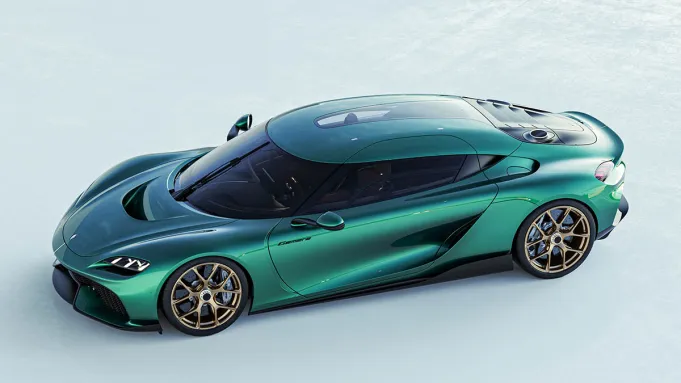
Jaguar has been in the midst of a massive reinvention, years in the making, centered on phasing out its gas-powered cars and building a new four-door all-electric grand tourer that will weigh nearly three tons. There is a new Jaguar logo, which some purists claim to hate, and a move upmarket as well, with the new flagship model likely to start at around $130,000, putting it beyond premium and into the realm of genuine luxury.
That car will fully debut in September, but the long lead-up time between its initial announcement in December 2024 until then has given doubters plenty of chance to mock the automaker’s strategy, even though it’s not as if Jaguar was exactly killing it before. Jaguar has also spent that time refining its pitch and offering journalists a sneak peek at the car’s capabilities, including a trip to northern Sweden. This month, Jaguar hosted a further procession of journalists—including myself—at its headquarters in Gaydon, U.K., to put the prototype through some paces on its test track.
Jaguar also had us do the same laps in two E-Types and two XJs, in part to counter the notion that the new all-electric four-door GT Jaguar—it has no official name yet—is a clean break with the company’s past, as had been somewhat implied. Indeed, the continuities were startling, with this all-electric four-door GT offering ride comfort that exceeded the best of Jaguar’s revered cruisers, and driving dynamics that, when compared with those of the E-Type, show just how much several decades of technological advances make a difference.
“At its best, Jaguar has always delivered two characters—performance and comfort—in perfect harmony, and our new luxury GT is no different,” Matt Becker, Jaguar Land Rover’s vehicle engineering director said in a statement. “It embodies everything the brand stands for. Jaguar’s founder, Sir William Lyons, used to say that ‘driving should be a joy not a chore.’”

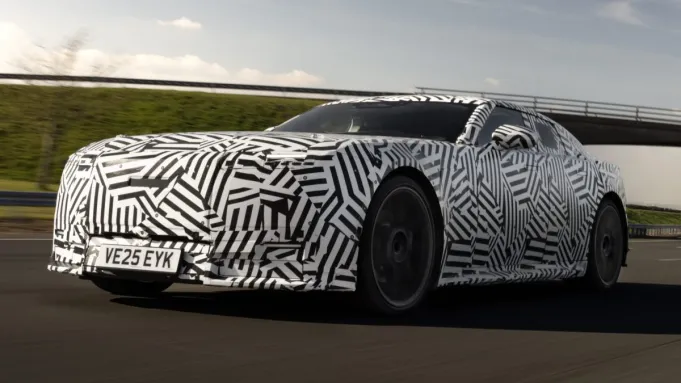
The new Jaguar four-door GT sits in camouflage and waits to be admired.
Jaguar
Jaguar said that the hardware for the new EV is 100 percent done, and the software is around 70 percent completed, meaning that the car’s looks will not change significantly, nor will the vast majority of its parts. That shows how much simpler EVs are to build than gas-powered cars, with fewer moving physical parts, but also how much more complicated they are as well, with much of the new work being done by computers. Left to do, among other things, is refine how the new EV uses power to maximize grip, comfort, and the car’s range. The new four-door GT will use three electric motors to make around 1,000 brake horsepower and have a range of around 400 miles, numbers that have become the new standard, more or less, for luxury EVs.
The new EV is built on its own platform, which Jaguar called a “completely irrational decision,” but one necessitated by the demands of the specs the company is aiming for. The first deliveries are slated for 2027, but Jaguar, for now, isn’t setting a precise timeline beyond the first half. Jaguar says that they did not look at competitors in building the new car, instead looked at Jaguars of the past. An internal design competition determined the winning prototype.
The car also represents a shift from decades of Jaguar trying to beat the Germans at their own game—volume premium. The Jaguar XE and XF had many charms, but competing with the BMW 3 Series and 5 Series, and especially with BMW’s economies of scale, was a math problem that Jaguar simply couldn’t solve. So Jaguar decided to change the equation, and the ensuing polarizing response was exactly what the company was looking for, at least to hear Jaguar tell it.
“Jaguar’s back in the conversation,” Rawdon Glover, managing director at Jaguar, said. “It was getting less and less relevant . . . We have people’s attention, and that’s a great position to be in.”

The new Jaguar four-door GT takes the track alongside Jaguar classics.
Jaguar
Jaguar let the group of us test four classics from company history, including a 1978 XJ Coupé V-12 that was most similar to the new EV in terms of ride comfort. Jaguar encouraged us to drive over engineered bumps in the surface of the Gaydon track to test what is among the hardest challenges for engineers: ensuring a smooth ride over bumps on one side of the wheels. The XJ-C passed this test with aplomb, in many ways a more impressive feat than the new EV doing so.
The classics also included the 41st right-hand drive E-Type ever produced, built in June of 1961. That car is powered by a 3.8-liter inline six-cylinder making 285 brake horsepower, paired with a four-speed manual transmission. The instructor suggested I shift into second gear before attempting first gear, lest I accidentally shift into reverse. While at 100 mph on the test track, the wind noise was exceptional.
A 1974 Series 3 E-Type I had driven earlier in the day was significantly easier to pilot, though, as it happened, the Series 1 E-Type was the last car I drove in Gaydon, directly after taking the four-door GT prototype for a spin. The only commonalities the two shared were vaguely in shape, with the four-door GT getting up to 100 mph effortlessly, with virtually no exterior noise. The four-door GT was bigger and more comfortable in every way, a glider from the future that proved definitively that the company that built a defining car of the 1960s is now something else entirely.
“This car will go when it’s ready,” Glover said. “This has to be the best Jaguar ever.”
Click here for more photos of the new Jaguar four-door GT.

Jaguar
Authors
-

Erik Shilling
-

Coastal Coin Necklace
$34.00 -

Resort Palmtree Necklace
$64.00 -

Oceanside Sparkle Studs
$38.00 -

Coin Necklace
$34.00