To the casual, outside observer, the revamped Formula 1 racing season for 2026, which began in Melbourne on Sunday, might appear to be the same old, same old. The cars still have wings, roll hoops, open wheels, and thick slick tires; they continue to vaguely resemble the world’s fastest-moving lobsters.
And with the team that finished the event in first and second—Mercedes, with its drivers George Russell and Andrea Kimi Antonelli—being the same outfit that classified second in last year’s Constructors’ Championship as well as having dominated the inaugural race of the previous massive regulation change in 2014, it might feel like déjà vu all over again.

The start of the Australian Grand Prix, the first race of the 2026 Formula 1 season.
Paul Crock / AFP via Getty Images
Yet when the leading driver of the 2020s, Max Verstappen, crashes out in the first Qualifying session in his Red Bull and starts the Australian Grand Prix in 20th position, the local star Oscar Piastri destroys his McLaren on the way to the starting grid, and his teammate, the reigning world champion Lando Norris finishes only fifth, something has clearly changed at the pinnacle of auto racing.
The transformation was proven emphatically when Russell of Mercedes and Ferrari’s Charles Leclerc traded the lead seven times in the first 10 laps. That early duel confirmed that Formula 1’s latest technical revolution—arguably its biggest ever—has reshaped the racing itself. Not surprisingly, the drivers who struggled most are the least enthusiastic.

The drivers of the 2026 Formula 1 season prepare for a group photo prior to the Australian Grand Prix.
Jayce Illman/Getty Images
“I’m not enjoying it at all,” Verstappen said before fighting back from 20th to finish sixth. “It’s completely empty.” Criticism also came from Norris, Lewis Hamilton, and others, while Verstappen even suggested after the race that the rules need changing again. Russell, however, sounded very different over the radio after claiming the sixth victory of his career. “Very nice, very nice: I like this car. I like this engine,” the Briton said, adding to his team: “Very well deserved for all the efforts.”
What the opening race confirmed unequivocally is that Formula 1’s already complex cars have become harder than ever before to drive—and thereby more unpredictable to watch. “You’re going to see so many mistakes this year,” said former driver and commentator Martin Brundle on Sky Sports UK before the race. The Melbourne contest, in what is a likely preview of the entire season to come, as well as the intention of the new rules, delivered exactly that: a race packed with overtaking and incidents despite the absence of rain—the usual catalyst for chaos in the series.

Red Bull’s Max Verstappen careens across the gravel after the rear of his car locks up during Qualifying for the first race of the season.
Getty Images/Getty Images
Visually, to the more discerning fans, the new cars are smaller, lighter, and more agile. The maximum wheelbase has been reduced by 200 mm (7.87 inches) to 3.4 meters (11.15 feet), the overall width has been reduced by 100 mm (3.93 inches) to 1.9 meters (6.23 feet), and minimum weight drops by 30 kg (66.13 pounds) to 768 kg (1,693.15 pounds). The tires are narrower as well.
The aim is to make the cars more responsive—machines that “dance” through corners rather than lumber through them—and to improve racing on the tighter circuits. (Think Monaco.) Aerodynamically, the changes are just as dramatic. The ground-effect tunnels that defined the 2022 through 2025 era (that Red Bull’s Verstappen dominated, while Mercedes mostly struggled) have disappeared, replaced by flatter floors and larger diffusers. Downforce has dropped by roughly 30 percent and drag by around 55 percent, encouraging closer racing and more overtaking.

Formula 1 rookie Arvid Lindblad, of the Racing Bulls team, makes his way around the Albert Park Grand Prix Circuit, eventually finishing in eighth place.
Rudy Carezzevoli/Getty Images
Front and rear wings are simplified, and the sport’s controversial Drag Reduction System (DRS)—long considered to create artificial overtaking—has been abolished. In its place comes active aerodynamics. Drivers can flatten their wings on straights to reduce drag and increase speed, while keeping them closed through corners for maximum grip.
To help overtaking opportunities, however, Formula 1 has now also introduced an energy based “Overtake Mode.” When within one second of a rival at a detection point, a driver gains access to additional electrical deployment—up to 350 kW—giving them a temporary performance advantage. Drivers can also deploy maximum battery power anywhere on the lap if enough energy remains. The result is a far more complex strategic environment.

Kimi Antonelli, of Mercedes-AMG Petronas, and Ferrari’s Lewis Hamilton are all smiles during the drivers parade before the start of the race.
Anni Graf – Formula 1/Formula 1 via Getty Images
“The closing speeds are going to be a big issue this year,” Brundle said. “One driver might be harvesting energy while another is deploying everything—the closing speeds are going to be scary.” During the Melbourne race, they often were, especially when Russell surged towards Leclerc at one point during those opening laps and the two cars came close to touching.
Under the bodywork, the power units have also changed dramatically. The 1.6-liter turbo V-6 remains, but combustion output drops from roughly 550 kW (747.79 hp) to 400 kW (543.84 hp) while electrical power rises to about 350 kW (475.86 hp)—creating closer to a 50/50 split between gas and electric propulsion.
Energy management by the driver has therefore become central to performance. They now harvest electricity through braking, lifting early before corners, partial throttle running, or a controversial method called “super-clipping,” where the hybrid system absorbs power from the engine even at full throttle.

The Audi team’s Gabriel Bortoleto on his way to finishing ninth overall.
Joe Portlock/Getty Images
Despite the criticism from some drivers, the system still rewards pure driving skill, according to former Formula 1 driver and analyst Anthony Davidson. “The driver is still flat out,” Davidson said. “It’s the system that changes around them.” And it takes getting used to. After the race, Piastri stated that while part of the error going to the grid came from his own judgment, he also noted that he was kicked by “about 100 kW extra power that I didn’t expect.”
Other than the technology, the most visible change this year is the expansion to 11 teams—the first time since 2016. The newcomer is Cadillac, marking the U.S. carmaker’s debut in Formula 1. Powered initially by Ferrari engines, the team plans to introduce its own General Motors power unit in 2029. Only the Cadillac of Sergio Pérez reached the finish in Melbourne, in 16th place, while teammate Valtteri Bottas had to retire from the race.

Cadillac’s Valtteri Bottas exits his car after it had to be retired from the race.
Peter Fox/Getty Images
Audi also arrives as a full works constructor after taking over Sauber. Its Brazilian driver Gabriel Bortoleto finished ninth to score points in the team’s debut race. Ford returns to the sport through a partnership with Red Bull Powertrains, while Honda begins a new exclusive engine partnership with Aston Martin.
The race weekend itself began with logistical complications, as the conflict in the Gulf happened just as team personnel and some freight were scheduled to fly through the region on the way to Australia, causing the series to book charter flights for staff. Formula 1 officials warned that if next month’s races in Bahrain and Saudi Arabia are cancelled, they will not be replaced, potentially reducing the calendar to 22 events.

Mercedes-AMG Petronas driver George Russell, winner of the 2026 Australian Grand Prix, is showered with Champagne by Ferrari’s Charles Leclerc.
Anni Graf – Formula 1/Formula 1 via Getty Images
Despite finishing the first race behind the Mercedes drivers, Ferrari’s Leclerc and Hamilton showed encouraging pace. Waiting before the podium ceremony, Russell told Leclerc that the Ferraris looked quick. Leclerc responded only with a wry smile.
“For the sport, this was a very good race,” stated Ferrari team director Frédéric Vasseur. “There were some pessimistic comments about this new Formula 1 going into the season and I think today’s race start, and then the first 10 laps were the most exciting we have witnessed in the past 10 years—and not just because we were in front.” Yes, most certainly not.
Click here for more photos from the start of the 2026 Formula 1 season.

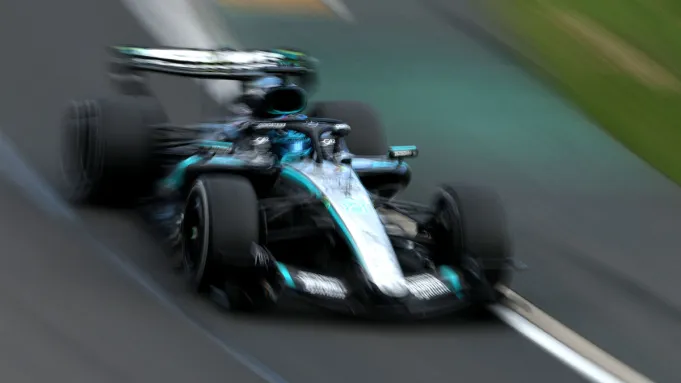
Mercedes-AMG Petronas team driver George Russell during Formula 1’s 2026 Australian Grand Prix.
Martin Keep / AFP via Getty Images
-

Coastal Coin Necklace
$34.00 -

Resort Palmtree Necklace
$64.00 -

Oceanside Sparkle Studs
$38.00 -

Coin Necklace
$34.00