
This story is from an installment of The Oeno Files, our weekly insider newsletter to the world of fine wine. Sign up here.
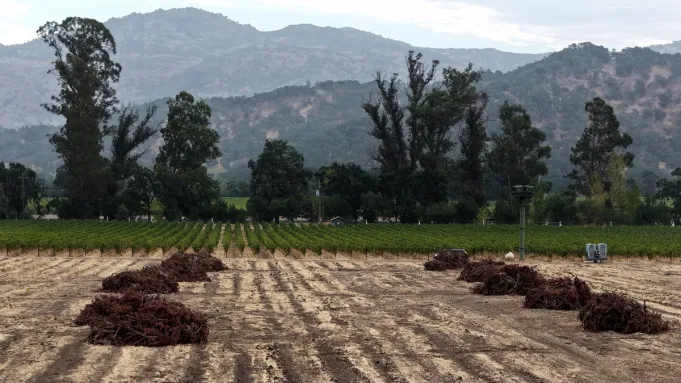
Regardless of the astronomical price a bottle may fetch or the attention lavished upon it by doting admirers, wine is, at its essence, an agricultural product, one whose economic value in the United States is $323 billion. And as anyone with a passing knowledge of the news is aware, the wine industry stateside and around the world is in trouble. The reasons are manifold—declining consumption, oversupply, effects of climate change, and tariffs, to name a few—but in California alone, winegrowers removed 40,000 acres of grapevines in the past year and countless acres of grapes went unharvested.
Home to 5,900 grape growers and 6,200 wineries, California is the fourth-largest wine producer in the world (behind Italy, France, and Spain) and is responsible for more than 80 percent of the wine made in the United States. Employing 422,000 people in the state of California, 1.1 million Americans across the country, and paying $59.9 billion in wages annually throughout the United States, the economic importance of California’s wine industry to the state and the nation cannot be overstated. While the U.S. Department of Agriculture has a program that assists grape farmers whose crop is affected by disease, there is no financial support for those who are ripping out their vines for the simple fact that they can no longer make living growing wine grapes.
Compare that to France, which has put forth a total of $356 million (€307 million) in the past three years (€57 million 2023, €120 million 2024, and €130 million in November 2025) for programs to assist grape growers with uprooting their vines. Additionally, France spent $232 million (€200 million) in 2024 on “crisis distillation,” converting unsold wine to industrial alcohol or biofuels. Or better yet, let’s compare it to the United States, which under the Bush and Obama administrations disbursed $80 billion to rescue the struggling auto industry and $245 billion to bail out banks in the wake of the 2008 financial crisis. And much more recently, seeing film and TV production flee the state, California passed $1.4 billion in tax credits to keep Hollywood as the world’s entertainment hub. The argument can certainly be made that the United States wine industry is worth saving not only for its economic value but for its cultural significance as well.

The wine industry’s roots run deep in Lodi.
Lodi Winegrape Commission
And while Napa is the AVA that most comes to mind when people think California wine, the industry stretches across the state. One region that is hit hard is Lodi in the Central Valley, where more than 700 grape farmers tend 82,303 acres, the total remaining after almost 8,000 were removed this past year. Lodi is “first and foremost an agricultural region that sells wine grapes all over the state and country,” says Stuart Spencer, executive director of the Lodi Winegrape Commission. But he tells us the region is straining as the large companies Lodi normally depends on “have been choosing to import cheap foreign wine in bulk instead of supporting their local communities.” Wine labeled with the American appellation can include up to 25 percent foreign wine, and a loophole in the federal duty drawback program allows bulk imports to enter the U.S. market virtually tax free, which creates a significant financial incentive to import instead of purchase local grapes. With a 2025 crop around 40 percent less than what was produced on average five years ago, Spencer says, “this has created significant harm to California rural communities that depend on agriculture.”
Lodi’s commission is focused on “highlighting federal policies that are incentivizing bulk imports of wine and illustrating the damage these policies are doing to rural winegrowing communities,” Spencer explains. Despite Lodi’s current difficulties, he prefers reforms to state and federal regulations over cash injections. “I don’t think the government should be in the wine or grape business by offering direct subsidies,” he says. “Subsidies create distortions that prevent the markets from functioning efficiently and properly.”
One politician who is keenly aware of the ailing condition of the wine industry is California State Senator Marie Alvarado-Gil, whose District 4 encompasses all or portions of 13 counties that include part of the Central Valley plus the Sierra Foothills AVA, which runs through Amador, Calaveras, El Dorado, and Tuolumne counties. Describing herself as a wine connoisseur who grew up in rural California, Alvarado-Gil tells Robb Report that despite the impression that wineries are owned by rich people who don’t need government support, her district has “many family farms with 20 to 100 acres” that are operating on razor-thin margins.
The senator’s recommendations focus on reforms to ease regulatory burdens, increase subsidies for wildfire insurance coverage, encourage marketing campaigns to promote California wine to young consumers, and provide grants to counter tariffs. Of course, as a fiscally conservative senator, she’s focused on what she sees as red tape. “California can help the wine industry by easing fees and regulations on wineries as it relates to labor, environmental regulations, small business fees and shipping,” she says. “Making it easier to ship nationwide would cost the state nothing and create a surplus of available cash to reinvest in winery operation [and] even hire more labor.”

The California Wine Institute showing off its regions in N.Y.C.
Tina Boyadjieva
Alvarado-Gil is not alone in her quest to bolster the health of the state’s wine business. Wine Institute, a public policy organization that advocates for wine at the state, federal, and international levels, supports a variety of initiatives to strengthen the California wine community. Activations in the past year include an online learning hub that gives the wine community insight into consumer preferences; a cross-border initiative to restore full access for American wines in Canada (the state’s largest export market); and the passage of AB720, a bipartisan bill that gives California wineries additional flexibility in hosting events on their property. In September, the Wine Institute also launched the first stateside edition of Eureka! California Wine Discovery, an education and tasting event for wine trade in the New York area and eastern Canada, which helped to highlight some of the lesser-known regions in Alvarado-Gil’s district and elsewhere.
Right now, though, people on the front lines of the wine business are adjusting to what could be their new reality. “In a place like El Dorado County, where the wine industry is deeply community-based, it’s incredibly hard to watch friends, neighbors, and multigenerational family businesses close their doors one by one,” says Clare Kessler, professor of viticulture and enology at Folsom Lake College and part-time assistant winemaker at an El Dorado County winery. The morale in the region right now is low, she tells us, but switching industries isn’t really an option as “there are few local jobs that could support a family at a livable wage,” Kessler says. She tells Robb Report that students enrolled in the viticulture and enology program understand that “this field is deeply passion driven and not always tied to high wages or long-term job security.”
One of the major differences between Europe and the United States is that wine is seen as an important component in the cultural fabric of countries such as France, Spain, Italy, and Portugal, while it holds a less-esteemed role on our shores. The fact that it is regulated by the Alcohol and Tobacco Tax Trade Bureau (TTB), a division of the Department of the Treasury, sends mixed signals: If it is important enough to warrant regulation by a government agency dedicated to taxation, it represents an important piece of the economy. At the same time, lumping it in with tobacco and hard liquor takes away from its cultural significance, including the history of immigrants who brought grapes and winemaking to the United States and its integral presence at meals or social events with family and friends. We believe that wine must first receive its due as part of our intangible cultural heritage before government leaders will get behind the idea of doing all that can be done to keep the United States wine industry alive and thriving. As Americans, we take many cues from the French, especially in the realms of fashion, art, and cuisine. It’s time for us to emulate that country’s support of the wine industry, too.
Do you want access to rare and outstanding reds from Napa Valley? Join the Robb Report 672 Wine Club today.
Authors
-
Mike DeSimone and Jeff Jenssen

-

Coastal Coin Necklace
$34.00 -

Resort Palmtree Necklace
$64.00 -

Oceanside Sparkle Studs
$38.00 -

Coin Necklace
$34.00