
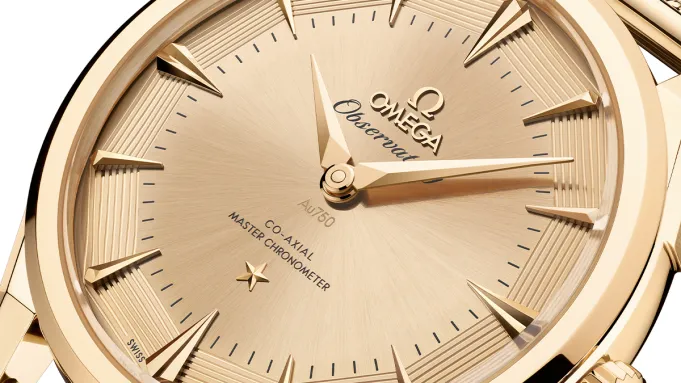
Omega’s latest watch is in a universe of its own.
The Swiss watchmaker just unveiled its new Constellation Observatory Collection today, the next step in its Constellation lineage and the first two-hand hour and minute timepieces to ever snag Master Chronometer certification. And if you were paying attention to any of the dazzling watches spotted at the Oscars this year, you would’ve caught a glimpse of the new line already: Sinners star Delroy Lindo rocked one of the models on the Academy Awards red carpet, giving us a pre-release preview of the collection.
Developed at Omega’s new Laboratoire de Précision (its chronometer testing lab open to all brands), the collection is home to a set of nine 39.4 mm watches. The watches underwent 25 days of scrutiny there, analyzed via a new acoustic testing method that recorded every sound emitting from the timepiece to track irregularities, temperature sensitivities, and more in the name of all things precision. (Details such as water resistance and power reserve are also thoroughly examined.) This meticulous process is all in the name of snagged that Master Chronometer label, meaning that the timepiece is highly accurate and surpasses the threshold for ultra-high performance. The Constellation Observatory Collection has now changed the game, though, thanks to its lack of a seconds hand.

A watch from the Constellation Observatory Collection, with the Observatory dome on display.
Omega
“Until now, precision certification has required a seconds hand,” Raynald Aeschlimann, president and CEO of OMEGA, said in a press statement. “The development of a new acoustic testing methodology has made that requirement obsolete. It is this breakthrough that has enabled us to present the Constellation Observatory, the first two-hand watch to achieve Master Chronometer certification.”
In addition to notching its place in history, the collection also debuted a new pair of movements: the Calibre 8915 and the Calibre 8914, each perched on a skeletonized rotor base. The former’s Grand Luxe iteration will appear on the 950 Platinum-Gold model in the collection, which offers up that base in 18-karat Sedna Gold alongside a Constellation medallion in 18-karat white gold with an Observatory dome done in white opal enamel surrounded by stars. The second Calibre 8915, the Luxe, will find its home on the other precious-metal models in the line, either made with the brand’s 18-karat Sedna, Moonshine, or Canopus gold seen across the case, the hand-guilloché dial, and, of course, the movement itself. (Lindo chose to rock the Moonshine Gold on Moonshine Gold iteration, priced at $59,000, for Sinners‘s big night at the Oscars.) As for the Calibre 8914, it can be found in the collection’s four steel models.

A look at a gold caseback from the collection.
Omega
Each model is a callback to myriad design features on past Omega models, too,—that two-hand dial, for one, comes from the 1948 Centenary (the brand’s first chronometer-certified automatic wristwatch), while the pie-pan dial (seen in various blue, green, and golden hues throughout the line) and that Constellation medallion caseback both appears on watches from 1952. The star adorning the space above 6 o’clock also harks back to 1950s timepieces from Omega. And to finish off the look, you can opt for alligator straps in a variety of colors, or perhaps a gold iteration to match the precious-metal models; the brick-like pattern on the 18-karat Moonshine bracelet was also inspired by Omega watches from the ’50s.
Well, that’s one red-carpet watch mystery solved. We’ll have to keep our eyes peeled for any other Constellation Observatory timepieces (or any other unreleased models from the brand) at the rest of the star-studded events headed our way next year—perhaps the Met Gala?
Authors

-
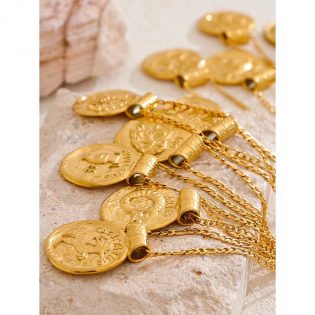
Coastal Coin Necklace
$34.00 -

Resort Palmtree Necklace
$64.00 -

Oceanside Sparkle Studs
$38.00 -
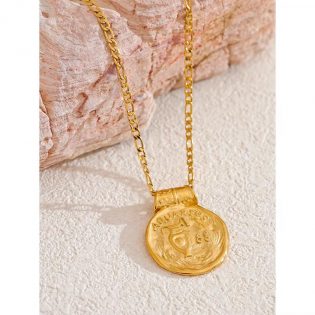
Coin Necklace
$34.00