
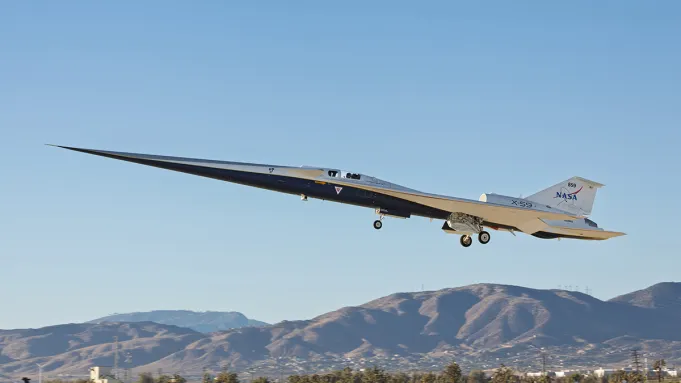
Aviation history was just very quietly made in the skies of Southern California.
NASA’s X-59 supersonic jet completed its first test flight on Tuesday morning, bringing ultra-fast commercial air travel one step closer to reality.
Built by aerospace contractor Lockheed Martin Skunk Works, the X-59 is designed to fly at supersonic speeds with minimal noise. During the inaugural flight, the aircraft traveled from the Skunk Works facility in Palmdale to NASA’s Armstrong Flight Research Center in Edwards. Lockheed Martin says it “performed exactly as planned,” reaching subsonic speeds of 230 mph and a peak altitude of 12,000 feet.
Measuring just under 100 feet, the single-engine jet features a distinctive sculpted body designed to reduce noise at high speeds. Rather than producing the typical sonic boom when breaking the sound barrier, the X-59 will reportedly make a sonic “thud” about as loud as a washing machine. The space agency believes that such low-decibel flight could expedite the return of commercial supersonic flight, which is currently restricted over land due to noise concerns.
The X-59 is expected to eventually reach a cruising speed of 925 mph (Mach 1.4) and a peak altitude of 55,000 feet, meaning it will fly more than twice as high and almost twice as fast as conventional airliners.
“It’s part of our DNA—the desire to go farther, faster, and even quieter than anyone has ever gone before,” acting NASA Administrator Sean Duffy said in a statement. “This work sustains America’s place as the leader in aviation and has the potential to change the way the public flies.”
NASA isn’t the only one on a supersonic quest: Boom, Spike, and a handful of other private firms are also developing high-speed aircraft, with the goal of replacing the supersonic Concorde plane that was retired in 2003 due to high operating costs, limited seating, and low passenger numbers.
Skunk Works will continue to lead the X-59’s initial testing, working closely with NASA to execute more flights in the coming months. That will include the X-59’s first supersonic flight, in which the aircraft will achieve the optimal speed and altitude for a boom—or thud, in this case. NASA can then measure the jet’s sound signature and see just how quiet it really is. Stay tuned.
Authors