
This story is from an installment of In the Loupe, our weekly insider newsletter about the best of the watch world. Sign up here.
On a recent video call, Nick Manousos, the executive director of the Horological Society of New York, holds an antique Swiss pocket watch up to the screen. Its spare white dial is punctuated by two apertures, a small round window at 12 o’clock marked “heures” and a larger rectangular window at center for “minutes.”
“This is from a brand that no longer exists called Cortébert,” Manousos says. “It has a device in it that was invented by a watchmaker called Pallweber. In two seconds here, you’ll see it jump.”
Sure enough, a beat later, the “11” in the minutes window silently gives way to a “12.” The effect is subtle but uncanny. The watch’s digital-style display was first popularized by Josef Pallweber, an Austrian engineer who licensed his 1883 mechanical invention to Swiss makers including Cortébert and, most famously, IWC Schaffhausen.
Also known as jump, or jumping, hour watches because the hour numeral instantly “jumps” to the next number at the top of the hour, these digital display timepieces were pure novelty in the 1880s. “Back then, a clock or a watch had a dial with hands that moved around it,” Manousos said. “If you saw this, it would look almost magical. How are the digits changing in front of my eyes?”
Their popularity proved fleeting. Eventually, they ceded ground to watches with standard analog displays—round dials with traditional sweeping hour and minute hands. Jump hour wristwatches, particularly those in rectangular cases, resurfaced during the Deco period in keeping with the era’s appetite for minimal, geometric design. But they fell out of favor again and largely remained there for decades (A. Lange & Söhne’s 2009 digital-first Zeitwerk collection notwithstanding).

Louis Vuitton unveiled its Tambour Convergence at the 2025 LVMH Watch Week.
Louis Vuitton
Until now. A flurry of jump hour introductions over the past year makes clear the style is back, and in a big way. The resurgence began in January 2025 with Louis Vuitton’s Tambour Convergence, a variation on the jump hour concept featuring what the brand described as “a dragging indication of hours and minutes, read at the conjunction of two rotating discs with a gold or platinum lozenge marker.” Known in French as a montres à guichet, or “window watch,” the model debuted in two refined iterations: a minimalist all-gold dial and a dazzling diamond-set platinum version.
The trend accelerated at Watches and Wonders 2025 with the debut of the Tank à Guichets, a series of rectangular Deco-inflected pieces from Cartier that generated strong buzz. At the same time, Bremont unveiled its Terra Nova Jumping Hour model, now available in four stylish iterations, including a 38 mm Stealth Black model rendered entirely in black DLC. From an editorial perspective—where, as the saying goes, “three makes a trend”—the jump hour watch was officially in.
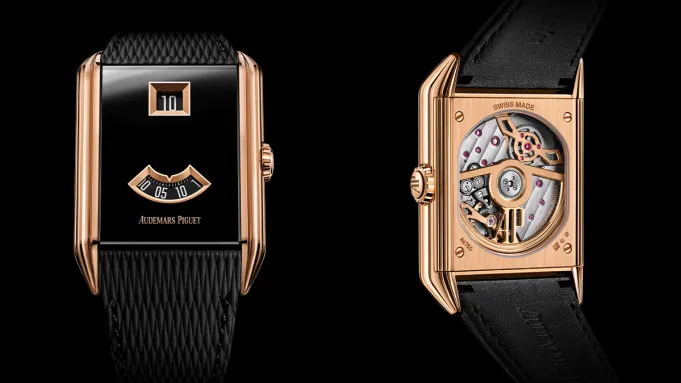
More releases followed, cementing the revival, including the distinctive retro-futuristic Time Jumper from Czapek Genève’s 10th anniversary collection and, as of this month, Audemars Piguet’s bold contribution to the category, the Neo Frame Jumping Hour, whose Streamline Moderne design nods to the jumping hour wristwatches the house produced in the 1920s.

Cartier debuted its Tank à Guichets last year.
Cartier
“The watch world is always looking for trends,” Stephen Pulvirent, founder of the creative agency Rime & Reason, tells Robb Report. “When somebody finds success with something, other people tend to chase it. We saw that with steel integrated bracelet sport watches. For a while, it was the Royal Oak, the Ingenieur, the Nautilus, the 222 and that was kind of it. Now, basically every brand needs to have an integrated bracelet sport watch. This jump hour trend seems like a smaller example of the same phenomenon.”
Pulvirent also pointed to the broad appeal of a jump hour mechanism. “It’s a complication that’s easy to understand,” he says. “It allows the brand to show off its mechanical knowhow without too much explanation. You can look it and intuitively understand what’s going on, even if you don’t understand how the cams work and how the energy is stored to move the disc. In that way, it’s like a chronograph: There’s something interesting to see. It has a fun, toy-like aspect.”
Even accounting for the Swiss watch industry’s copycat tendencies, it’s tempting to interpret the steady stream of jump hour novelties—spanning four-, five-, and six-figure price points—as a reflection of the broader zeitgeist, with a dose of business-minded pragmatism layered in.
“Watch brands are always looking for ways to maintain collectors,” Pulvirent says. “AP is a great example. If you’re a Royal Oak collector, maybe you start collecting Royal Oak Offshores and complicated pieces. But at a certain point, you’re going to need some variety, something new. And the Neo Frame could be that. It could also be an on ramp for a different kind of collector. ‘The Royal Oak isn’t for me, but I like the look of the Neo Frame.’ And once you’re in the family, they can try to sell you other things.”
Authors
-

Victoria Gomelsky
-
Coastal Coin Necklace
$34.00 -
Resort Palmtree Necklace
$64.00 -
Oceanside Sparkle Studs
$38.00 -
Coin Necklace
$34.00