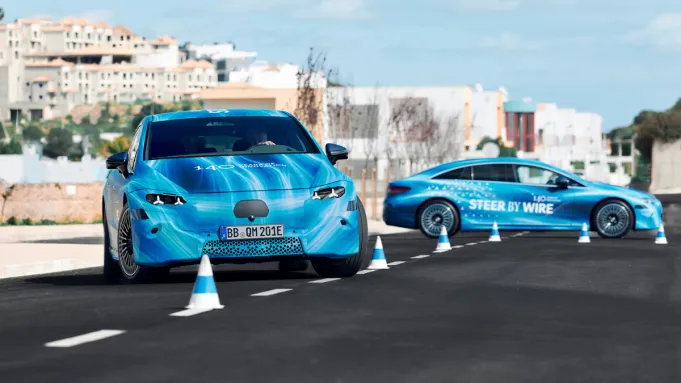
There’s a moment, deep in a tight U-turn on a closed handling circuit on the outskirts of Albufeira, Portugal, when you realize it’s wild that your hands haven’t crossed over as you achieve full lock from the steering. Yet the camouflaged Mercedes-Benz 2027 EQS sedan is darting through the corner, with more precision, a tighter radius (the standard rear-steering helps), and with more feedback from the wheels.
This is steer-by-wire. In traditional vehicles, a mechanical column physically links the steering wheel to the front axle. Steer-by-wire replaces that with sensors that read the driver’s input and motors that execute it electronically, with software mediating everything in between. (There’s still an electromechanical link as a redundancy. More on that in a second.) Think of it as an interpreter between your hands and the wheels, one that’s lightning fast.
On the handling circuit, the slightest of inputs to the wheel and the EQS reacts. To get it through a decently tight slalom section, move the wheel from horizontal to little less than 90-degrees and repeat. You’re through in a rapid time, notably quicker than a solely mechanically linked EQS, which we sampled immediately after. Compared to the usual hand-over-hand maneuvering, the steer-by-wire wheel is more elegant and effortless, operable with only a finger or two without any performance loss.
For those worried what happens should said steering wire lose communication, multiple redundancies will mitigate fears. For decades, automotive certification required that mechanical link to the front axle. That regulation has since been rewritten to be technology-agnostic, now requiring only that after a single failure, the vehicle remains steerable by some means. A dual-signal redundant system would satisfy that standard. But Mercedes chose to go further.
“One backup, for us, it’s not enough,” says Luc Diebold, a Mercedes-Benz engineer who helped bring steer-by-wire from concept to production. “After a normal failure, the customer would have to stop right now, no matter where they are. That’s not good. So we said, let’s add a third fallback.”

We preferred the Mercedes steering wheel to the Cybertruck version.
Here’s how the three-tier safety architecture works. Under normal operation, the steer-by-wire system communicates inputs to the front axle electronically. If that primary path fails, regular electromechanical steering takes over as a first fallback. The car flags the fault with a red warning light and limits speed to 90 km/h (56 mph), giving the driver enough runway to reach safety. “You can use it not just for ten seconds, but more than ten minutes,” Diebold said. “We don’t want you stopping in a tunnel. The longest tunnel in the world is in Norway and it’s about 10 minutes, so we thought you’d need to be able to get out of that. We want you to get to a safe place.”
If that electromechanical system fails as well, then you’re limited to 10 km/h (6 mph), but it must be steerable, so the rear steering and the car’s brakes step in, applying differential pressure across all four corners to guide the vehicle in the intended direction. Steering by rear-wheel and torque-vectoring is a last resort, but a functional one. Diebold says if you’re down to this option, your use time is much shorter; it’s meant to get you out of traffic immediately.
On the circuit, none of that anxiety is present. Just bright and responsive feedback. The steering effort is dramatically reduced without feeling numb; the system filters out road vibration while preserving the intuitive sense of what the front tires are doing. Practically, the EQS is agile and flingable for a four door sedan, and you find yourself getting into an easy rhythm as you twist the tiller. At a decent clip, it’s easy to see how steer-by-wire will be an improvement, but low speed maneuvering is also bolstered. As someone with a cramped driveway that requires a three-point turn to get headed the right way, I’m already dreaming about how much easier my daily ordeal would be with steer-by-wire.
There’s something to be said for the butterfly design of the wheel itself, too. It opens the sightline to the driver display and feels natural in your hands. And it’s not unrefined and ugly, like Tesla’s Cybertruck “squircle” or yoke; it’s more like it was plucked from a Batmobile or evolved from an F1 wheel.
“It looks sporty,” Diebold says of the design. “But it’s always everything about effortless, easy maneuvering. Comfort is a lot.”
He’s right, though I’d phrase it differently. The best technology often fades into the background, letting you focus on how you feel while using it. The EQS steer-by-wire offers a sense of enjoyment with every turn.
Authors
-
Sean Evans

-

Coastal Coin Necklace
$34.00 -

Resort Palmtree Necklace
$64.00 -

Oceanside Sparkle Studs
$38.00 -

Coin Necklace
$34.00