When the Mercedes-Benz GLC replaced GLK in 2015, the midsize luxury ute quickly became one of the most beloved Benz models, remaining one of the marque’s best-selling nameplates globally. Now, the 2027 GLC 400 4MATIC arrives in all-new electric guise, at a time when other luxury automakers are scrapping planned EV models. Is this a big bet or a logical next move for Mercedes?
After spending time behind the wheel, it feels like both.
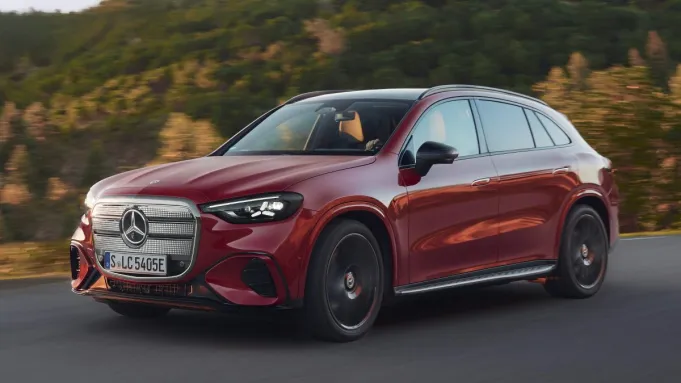
Proportionally, the electric GLC is handsome. Perched on 21-inch wheels, tucked under flared arches, and a downward swooping line from the top of the A-pillar through the spoiler atop the tailgate, the EV has aggressive presence. Our tester also had a lot of chrome, chiefly in the front fascia. In Mercedes’ first-ever deployment of its redesigned radiator grille, a hat tip to the iconic grilles of the Sixties and Seventies, though considerably larger. In concert with a chrome front splitter, this volume of shine may not resonate with those who prefer more subtlety.
Step in and you’re greeted by an (optional) 39.1-inch MBUX Hyperscreen, which spans the entire dashboard in a single unbroken sweep, the largest continuous display Mercedes has ever built. (It’s so enormous, one wonders how Stuttgart’s designers could possibly manage to enlarge it for future generations.) Eleven optional background motifs shift from cool to warm, technical to emotional, and the ambient lighting coordinates with whatever you’ve chosen. You can even select a faux fireplace view, with flickering flames. It’s immense and impressive, albeit slightly overwhelming at first blush. However, myriad customization options—such as dragging any settings you wish into an always-visible dock—make it easy to navigate.

The 2027 Mercedes-Benz GLC admires the sea.
Mercedes-Benz AG – Communicati
That screen is the front door to MB.OS, Mercedes’s proprietary AI-driven operating system, the architecture underneath everything the new GLC does. Proud engineers are quick to share this supercomputer’s 254 trillion operations per second capabilities. (Newer iPhones, for comparison, max out at 35 TOPS.) Functioning as the car’s central nervous system, MB.OS manages everything from driver assistance systems to charging to comfort settings, even capable of learning your habits and adapting to them. Over-the-air updates will keep it fresh for the foreseeable future.
The most engaging feature of MB.OS is the MBUX Virtual Assistant, which runs a multi-agent approach that draws simultaneously on ChatGPT 4o, Microsoft Bing, and Google Gemini depending on what you’re asking. Navigation questions route to Google’s Automotive AI Agent. General knowledge goes to ChatGPT. Vehicle-specific queries pull from a dedicated onboard source. In theory, your vocal inputs are meant to feel less like issuing commands and more like a conversation. In practice, it’s a solid system. Activate it by saying, “Hey Mercedes,” then you can ask it to change the radio station, turn on your seat massager, read today’s top news headlines, or find the nearest restaurant with the best wine list.
During our test drive on the outskirts of Albufeira, Portugal, the virtual assistant—a cute talking helmet avatar named LittleBenz—quickly found several restaurants with great wine reviews (from Google), going so far as to read some top reviews aloud. On a lark, the query, “What’s the best gym around here for CrossFit?” received a reply that used the proper nomenclature, referring to the locations as “boxes.” Intuitive, engaging, and helpful, the virtual assistant is TKTKTK.
The GLC 400 4MATIC’s twin motors produce 483 horsepower and 590-lb-ft of twist, enabling the SUV to hustle to 60 in 4.2 seconds. While a curb weight has yet to be declared, it’s not a lithe machine, but it’s proper quick. Especially in sport mode. Get to the end of an on-ramp, punch the accelerator, and you’re instantly tearing down a Portuguese highway at well over the speed limit. Interestingly, Mercedes has added a two-speed transmission, citing increased energy efficiency and power delivery. That second gear arrives only after 120 KPH, and while the handover is noticeable (though not harsh), your butt dyno will also note that the torque curve is in fact a straight line that doesn’t relent.

The steering wheel and large screen in the 2027 Mercedes-Benz GLC.
Mercedes-Benz AG – Communicati
The GLC promises 715 kilometers of WLTP range, and the 800-volt architecture enables DC fast charging up to 330 kW and puts 305 kilometers of range back in the battery in ten minutes. Under spirited sprints around the Algarve region’s sinewy mountain roads, the range depletion wasn’t terrible, losing about 20 or 25 percent after 90 miles of pushing. Puttering around the smaller seaside towns, at a more measured pace, energy losses were nominal.
The new One Box brake system helps recuperate some energy under braking. It handles over 99 percent of deceleration events through regenerative braking alone, leaving the hydraulic system in reserve. Even when you round a blind curve at a decent clip, only to find a semi truck passing a cyclist and coming directly at you in your lane, and the hydraulics are needed, you feel your heart pounding more than the system handover.
Tap the steering wheel shift paddles to move between recuperation levels, from maximum (D-) through standard (D), none (D+), or intelligent (D Auto). In D-, one-pedal driving is rather fun, requiring the lightest of lifts to activate disproportionately stiff deceleration. It’s incredibly engaging to use this on flowy backroads, where you can find a nice rhythm while watching your range edge back up. Should you utilize the brake pedal, however, you will find it firm, even, and natural-feeling.
If you’ve opted for the agility and comfort package. Tick that box and be rewarded with a ride as plush as the seats, thanks to an S-Class-derived air suspension that’s intelligent. Using both sensors and cameras on the car and Car-to-X data, the GLC will automatically detect potholes, bumps, or other road imperfections and adjust its suspension accordingly. On earlier test loops around Portugal, some tarmac blemishes were noted. By midday, the system had enough data in the cloud from other GLCs running the routes that more pockmarks were being flagged on the dash.

The moonroof in the 2027 Mercedes-Benz GLC.
Mercedes-Benz AG – Communicati
That package adds 4.5-degree rear-axle steering, too. Under 37 mph, it’s counter-steering against the front wheels, which reduces turning circles by about three feet. It’s immensely helpful getting in and out of parking spaces. Above 37, it moves to in-phase, helping you again carve a sharper corner. Benefits here are pronounced around tighter hairpins, where the GLC feels more point-and-shoot than something of its heft has any right to.
Lastly, you can select a Vegan Package, which means that soft-touch surfaces—from seat upholstery and headline to carpet to pillar and door trim panels—are certified by The Vegan Society. Mercedes also cut the GLC’s lifecycle carbon footprint by two-thirds compared to the outgoing ICE model, through reduced-carbon aluminum sourcing, greener battery cell production, and net-carbon-neutral assembly in Bremen.
All in, the GLC 400 4MATIC Electric is a solid offering, one that frequently delights and rarely disappoints. The big question mark is the retail price when it arrives at U.S. dealerships in the second half of 2026. The current internal combustion GLC lineup runs from $50,700 to $87,900 across four models — GLC 300, GLC 350e, AMG GLC 43, and AMG GLC 63 S E Performance. Pricing for the electric version hasn’t been announced for the U.S. yet, but given the 800-volt architecture, S-Class suspension, and Hyperscreen option, expect it to land above the base GLC 300.
Click here for more photos of the 2027 Mercedes-Benz GLC.

The 2027 Mercedes GLC
Mercedes
Authors
-
Sean Evans

-

Coastal Coin Necklace
$34.00 -

Resort Palmtree Necklace
$64.00 -

Oceanside Sparkle Studs
$38.00 -

Coin Necklace
$34.00