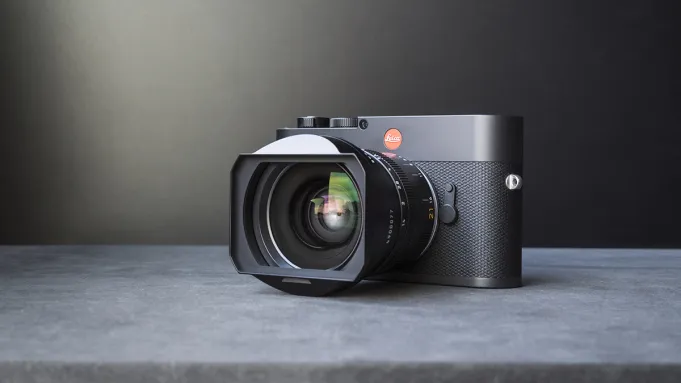
As Leica celebrates a century of developing some of the world’s finest photographic equipment, it has made a controversial move by offering an electronic viewfinder (E.V.F.) in place of the old-school mechanical rangefinder in its revered M-Series camera line—a first in the flagship system’s 71-year history. As a result, the new EV1 represents a technological leap akin to Porsche’s change from air- to water-cooled engines, and, as was the case with the automaker, some loyalists may cry foul.
After all, the camera series gets its name from the German word Messsucher, meaning “rangefinder” or “distance measurer,” and refers to the means by which the user rotates the focus ring until double images merge perfectly. An E.V.F., on the other hand, uses a high-resolution digital screen for shot composition. What you see is a digital depiction of your final image, and because it’s a screen, it can display a variety of focusing aids—including magnification—for optimal sharpness.
While Leica has previously offered an external viewfinder, or Visoflex, to assist focusing the M-Series, detractors may argue that this new variant removes the essential element of the camera altogether. But the EV1 isn’t the first M to break with tradition: Beginning in the 1960s, Leica has produced numerous non-rangefinder models, specifically the MD, MDa, and MD2, to be used with a Visoflex for scientific purposes, including lab photography.
Having recently tested the $7,950 EV1, I first noticed how it departed a bit in appearance from its predecessors. Gone is the window on the face of the camera, as it no longer serves a function. Also absent is an exposed ISO dial on the top plate due to the size and corner placement of the E.V.F. But the benefits of integrating an E.V.F. are plenty. It features a higher resolution than the external Visoflex accessory and is 80 grams lighter without the rangefinder’s optics. Importantly, the camera retains a similar size and form factor, has a familiar feel in the hand, and is compatible with any M lens ever created.
What makes the EV1 a real step forward is its edge in near-distance focusing, where a conventional M is hampered by parallax error; it also lets you focus and compose at the same time—which might be its biggest advantage. Introducing modern advancements to any legacy product, as Leica has done with the EV1, can be polarizing at first, but it often opens up a wellspring of new customers over time. Just ask Porsche.