
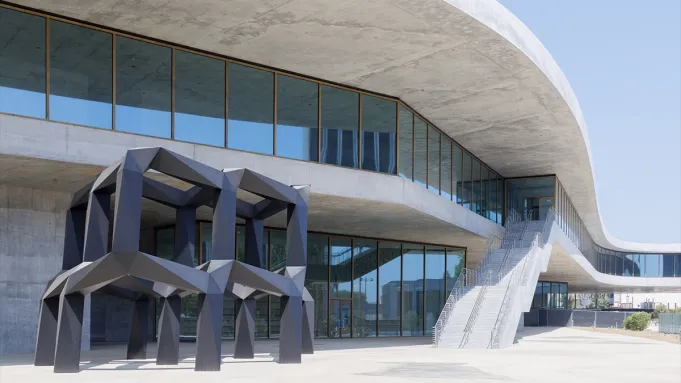
Twenty years after Michael Govan took the helm of the Los Angeles County Museum of Art (LACMA) and took charge of its campus overhaul, 17 years after Swiss architect Peter Zumthor began designing a massive new building for it, and nearly three years after that structure was originally scheduled for completion, the dramatic edifice will finally open its doors this spring.
Named the David Geffen Galleries in recognition of the billionaire’s $150 million donation toward the $720 million effort, the concrete building replaces four others that were deemed structurally unsound. At 900 feet long, it holds 110,000 square feet of gallery space on one level, allowing the museum to display roughly 2,500 to 3,000 objects from its collection of 150,000-plus works.
Pritzker Prize–winning Zumthor lifted the building almost 30 feet off the ground, creating an enormous shaded plaza beneath to host concerts and house cafes, a shop, an education center, and public sculptures.
Inside, the walls are gray concrete, an unconventional choice for an art museum, where drywall—easily patched and repainted—is most often the norm. Unprompted, Govan, LACMA’s C.E.O. and director, assures Robb Report it’s quite simple to drill and fill holes in concrete. And to those who question the wisdom of featuring an entire wall of floor-to-ceiling windows in the California sun, he notes that natural light was high on his wish list, and that drawings and other delicate objects will be displayed in more dimly lit rooms. “Half [of the works in] our collections are completely light insensitive,” he says. “They’re made of marble and ceramic and metal.”

Visitors take in Todd Gray’s Octavia’s Gaze (2025).
Jonathan Urban
But the most startling thing about LACMA’s newest addition—which joins two 21st-century Renzo Piano buildings and a renovated Bruce Goff pavilion—may be the unorthodox presentation of the art itself. “The museum has a whole fresh look at art history,” Govan says.
The horizontal layout was intended to erase any perceived hierarchy, a vestige of 19th-century thinking. No gallery is reserved for a particular region or era, and there’s no designated path. “I know some people won’t love that,” Govan says with a little chuckle. The goal is for people to wander. “I wanted you to walk through it like Central Park, because I love [Frederick Law] Olmsted—this idea that he takes you on multiple journeys through the same place.”
And that doesn’t mean the art will be hung helter-skelter. The inaugural installation—a collaboration of 45 curators—takes the world’s major bodies of water as its organizing principle, linking, for instance, Africa, Europe, and the Americas. “The world was traversed by oceans and trade and forced migration and migration,” Govan says, adding that the presentation is “like a wonderland of curious connections.”
After devoting much of his LACMA tenure to construction projects, Govan sounds ready to take off his hard hat. “Buildings are buildings,” he says. “I’ve built a lot of buildings, but the bigger transformation is the way things are seen and experienced.”
Top: Tony Smith’s Smoke (1967) stands guard outside LACMA’s new David Geffen Galleries.
-

Coastal Coin Necklace
$34.00 -

Resort Palmtree Necklace
$64.00 -

Oceanside Sparkle Studs
$38.00 -

Coin Necklace
$34.00