For decades, West Palm Beach (WPB) existed in the reflected glow of its gilded neighbor across the Intracoastal Waterway. Palm Beach claimed the grand oceanfront mansions and old-guard wealth; West Palm offered value and livability. Since the pandemic, that hierarchy has fundamentally shifted. What was once a second-tier alternative address has become one of the most dynamic luxury real estate markets in the country—one increasingly fueled by generational wealth, institutional capital, and global buyers.
Price growth tells part, but not all, of the story. According to Redfin, luxury home prices in West Palm Beach have climbed a staggering 187.3 percent over the past decade, pushing the median luxury sale to roughly $4 million. That’s the fastest increase of any major U.S. metro and more than twice the national rise of 82.5 percent. Douglas Elliman reports that while overall single-family prices rose 18 percent year over year, the high end of the market jumped roughly 50 percent.
The shift is even more striking when viewed against Palm Beach Island itself. A GOBankingRates report found that Palm Beach had a median home value of about $9.8 million as of October 2025, a 118.2 percent increase over five years, reinforcing its position as Florida’s most expensive—and historically reliable—luxury market.
The numbers also reflect a deeper shift that is underway. More than 250 financial firms have established a presence in West Palm Beach since 2020, earning it the moniker “Wall Street South.” Major players such as Goldman Sachs and J.P. Morgan have expanded local operations, while Stephen Ross—chairman of Related Companies—has committed an estimated $10 billion to transforming downtown West Palm Beach into a global business hub.
“The ‘Wall Street South’ effect has completely recalibrated the market,” says Samantha Curry of Douglas Elliman. “West Palm Beach is not just seen as the less glamorous little sister to Palm Beach Island. We are seeing a permanent migration of high-earning executives setting up shop in West Palm Beach and making it their primary residence.”
That influx of capital has reshaped buyer expectations. “They are bringing billions of dollars into the city, and with that comes an entirely new level of expectation,” Curry adds. “These buyers want the best of both worlds: Manhattan-caliber architecture, dining, shopping, and cultural offerings paired with the Florida lifestyle and tax advantages.”

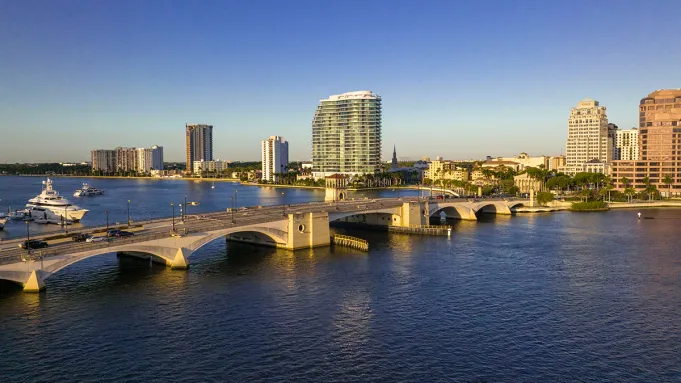
A new wave of luxury towers along the Intracoastal Waterway is reshaping West Palm Beach’s skyline and redefining price barriers.
Visions of America/Joseph Sohm/UCG/Universal Images Group via Getty Images
As wealth has followed work, residential demand has surged across every tier of the WPB luxury market, with waterfront condominiums marking the first visible wave. The Bristol, completed in 2019, helped reset pricing expectations, attracting buyers who historically would have defaulted to Palm Beach Island. “The Bristol was really a turning point,” Curry says. “It was the first true ultra-luxury building that showed West Palm Beach could command Miami- or New York-level pricing.”
It was followed by a flurry of swanky projects, including Olara, Forté on Flagler, Alba Palm Beach, and the Ritz-Carlton Residences, creating a towering skyline of premium-service, amenity-driven living. At the very top of the market, South Flagler House now stands as West Palm Beach’s most expensive new condominium, with prices starting near $8 million and climbing past $70 million. Former Apple CEO John Sculley recently went into contract for a roughly $40 million penthouse there after selling his oceanfront Palm Beach estate—a signal that even legacy Palm Beach buyers are now prioritizing turnkey luxury and modern infrastructure over custom builds.
“What we are seeing in West Palm Beach is demand that is rooted in long-term fundamentals,” says Isaac Toledano, CEO of BH Group, which is developing The Ritz-Carlton Residences, West Palm Beach with Related Group. He points to sustained in-migration from New York and other high-tax states, alongside corporate relocations, as evidence that buyers are making permanent moves and prioritizing long-term value.
As a result, pricing expectations have radically recalibrated. “Today high-net-worth individuals see $10 million to $20 million residences as a standard entry point,” adds Curry, noting that projects like South Flagler House and The Ritz-Carlton Residences are drawing unprecedented demand.
The changes, brokers say, are structural. “West Palm has completely transitioned from a secondary luxury market to a primary destination,” says Yvette Davis of ONE Sotheby’s International Realty. She adds that while tax advantages and lifestyle initially drew buyers, the market is now being shaped by the rapid concentration of wealth and finance, a reshuffling that has also broadened the buyer pool to include a growing pool of younger domestic buyers looking to raise families as well as international purchasers from across Latin America, the Middle East, and Europe.
West Palm Beach’s next chapter, however, is not limited to trophy assets along the waterfront. The downtown area has also become a focal point for growth, reflecting changing buyer preferences toward walkability, mixed-use neighborhoods, and proximity to offices and cultural offerings. Among the most prominent projects is Mr. C Residences West Palm Beach, now rising on Okeechobee Boulevard.

Mr. C Residences in West Palm Beach.
BINYAN Studios/Terra
“The city’s evolution was accelerated by the pandemic, when West Palm Beach stopped being viewed as a secondary market and started functioning as a full-time destination,” says David Martin, CEO of Terra. “With companies and residents now there full time, there’s a massive demand for high-quality residential living.”
Mr. C, which Terra is developing, introduces hospitality-driven living to the urban core. “The city center has evolved into a vibrant, mixed-use neighborhood,” Martin says. “It offers exactly the walkability and lifestyle today’s luxury buyers want, yet until now, the area has lacked new, high-end residential options.”
Back on the Intracoastal is Maison d’Or, a newly launched 19-story boutique tower with just 39 residences and pricing starting around $5.7 million. “Today’s luxury buyer is looking for something much more intentional,” says Ed Jahn, senior vice president at Kolter Urban. “Not just a home, but an experience that supports how they actually live.”
Single-family homes and estates are also part of the WPB upswing. Hedge fund billionaire Paul Tudor Jones is assembling a multi-acre waterfront compound along the Intracoastal, a practice once largely confined to Palm Beach Island. “When you concentrate this much wealth in a single area with a limited amount of inventory, there is a halo effect,” says Chad Carroll of Compass. “We are seeing a natural spillover of demand into neighborhoods that may have been overlooked in the past.”

Tree-lined streets in neighborhoods such as Northwood and SoSo are seeing rising values.
Jeffrey Greenberg/Universal Images Group via Getty Images
Despite the surge, West Palm Beach still retains much of its architectural character. Mediterranean Revival estates, midcentury modern homes, and Spanish-style bungalows still define neighborhoods such as Northwood and Southland Park, providing a counterweight to the glass towers rising downtown and along the water.
Looking ahead, brokers agree the market is becoming more selective, not weaker. “The top end is entering a more selective phase where only best-in-class properties will continue to command premium pricing,” Curry says. Others are more bullish. “West Palm Beach is no longer a trend,” Carroll adds. “It has become a staple in the global luxury real estate portfolio.”
If Palm Beach represents Florida’s storied past, West Palm Beach is shaping its future. With luxury price growth outpacing every major U.S. metro, billions still flowing into development, and a buyer pool that now spans hedge fund titans to next-generation entrepreneurs, the city’s ascent appears structural, not cyclical.
West Palm Beach is no longer emerging. It has arrived.
Authors
-

Abby Montanez
-
Coastal Coin Necklace
$34.00 -
Resort Palmtree Necklace
$64.00 -
Oceanside Sparkle Studs
$38.00 -
Coin Necklace
$34.00