This story is from an installment of The Oeno Files, our weekly insider newsletter to the world of fine wine. Sign up here.
Amid the surging popularity of non-alcoholic and low-ABV (alcohol by volume) beverages, oenophiles who’ve wanted to hop on the trend have run into a little problem: A lot of the wines haven’t been that good. Based on the several bottles we’ve tried, the de-alcoholization process used in booze-free and some low-ABV selections leaves us with wines that lack the body and flavor profile that we look for in a good glass. However, there is hope for afficionados looking to enjoy wine while still cutting back on the booze. There are talented winemakers crafting vintages with a naturally occurring low ABV, and we went of search of them to understand how they’re pulling off this feat.
Now, Germany and Austria have long been leaders in the sector, crafting Riesling and other aromatic whites whose complexity belies their ABV of around 11 percent or lower, and many styles of sparkling wine are naturally lighter than their dry counterparts. But to meet growing demand for low-ABV options, winemakers in regions across the globe are creating high-quality, full-flavored bottles with naturally lower alcohol and a softer profile. And their work to coax out maximum flavors from grapes with lighter alcohol potential begins well before any sort of de-alcoholization process would be employed.
It’s been said that great wine is made in the vineyard rather than the winery, and the same is true of lower-alcohol wine. Much of the work that is done involves canopy management, the art of encouraging or discouraging the proliferation of leaves around the grape bunches on the vine. The more sun and heat grapes are exposed to, the higher the sugar content, and the more sugar grapes have, the higher the potential alcohol content. At Barone Pizzini in Franciacorta, which produces a gorgeous range of the classified Italian sparkling that all have around 12 percent ABV, vineyard managers create an umbrella-shaped canopy to shield grapes from too much sunshine. “The distance between the pruning and the grape bunches keeps them covered and protected by the leaves,” explains general manager and CEO Silvano Brescianini. “We also increasingly raise the height of the wall to favor shading one row over another. We maintain a cap of leaves and increase protection.” Another technique used at Barone Pizzini is spraying kaolin, a white dust, on the leaves to improve photosynthesis and reflect solar rays. “This reduces sunburn and heat stress, leading to higher acidity, lower sugar accumulation, and reduced alcohol levels in our wines,” Brescianini says.

Growing more lush canopies can cultivate grapes that will yield lower-ABV wines.
Julien Fayard
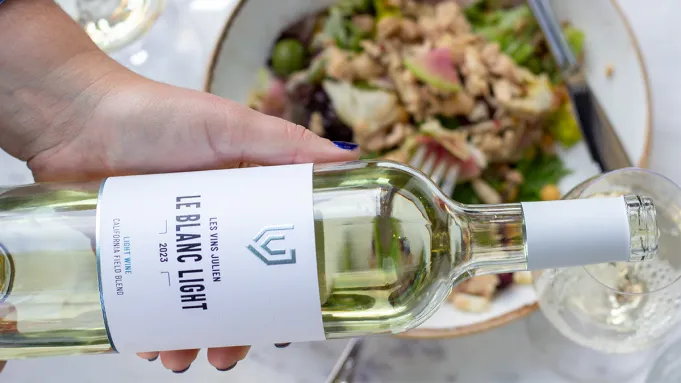
Winemaker Julien Fayard created a new naturally lower alcohol brand, Les Vins Julien, that offers California white and red blends and a Sonoma Coast Chardonnay that clock in at 10.5 and 11 percent ABV. He intentionally sought out older vineyards or challenged vines, ensuring the grapes encounter sufficient stress to allow proper sugar ripening and phenolic development while resulting in a lessened final alcohol content. Stating that wines that have had their alcohol decreased by processing are “lower quality,” Fayard tells Robb Report, “in wine, there is an aromatic component that will always be intrinsic to the product’s quality, and that is lost in dealcoholized products.” Working with older vines in cool areas that offer a lower ripening profile, he allows the plants to carry extra fruit and denser leaves to slow down sugar loading. “We always favor the low-intervention and technical mastery in the vineyard rather than during the winemaking process.”
While there is a clear definition of what constitutes a non-alcoholic wine—ABV less than 0.5 percent—there is no standard level that signifies a low-alcohol wine. “The no-alcohol category has a clear definition in both Europe and the U.S., so consumers know what they are buying,” says Liz Thach, president of the Wine Market Council. “By contrast, ‘low alcohol’ is fuzzy. Trade, regulators, and consumers all use different thresholds, such as less than 7.5 percent, 9 percent, 10 percent, or 11 percent ABV, and Wine Market Council research shows consumers themselves define ‘low alcohol’ across a wide range. Many say anything under 8 to 10 percent ABV” falls into the category, but the lack of a clear consensus may not be helping recognition or sales.
Thach believes if the TTB (Alcohol and Tobacco Tax and Trade Bureau, the government regulator of wine and spirits) defined the category using a percentage it would be helpful to the wine-buying public but not necessarily to wine producers. “I believe as long as producers clearly label the alcohol percentage on the front label in an easy-to-read font size, consumers will recognize and understand it as a low-alcohol wine.” For health-conscious consumers, Fayard takes labeling a step further; in addition to the legally required ABV, bottles of Les Vins Julien include a list of ingredients as well as the calories and carbohydrates per five-ounce serving.
When it comes to achieving lower alcohol, cool and wet regions have a strong advantage, but in hot, dry Roussillon, Domaine Lafage proprietor and winemaker Jean-Marc Lafage seems to have achieved the impossible with his Famille Lafage Miraflor Blanc Frisant, a delicious and refreshing sparkling wine with just 9 percent alcohol. He cites his organic and regenerative farming techniques coupled with a carbon-based water capture system as protagonists in achieving fresh aromas and flavors but also credits canopy management as an important method of maintaining low ABV. “When we go into the vineyard to pick grapes, we shouldn’t be able to see them,” he says. “We don’t want the grapes to see any sun, because a bad heatwave will damage the quality of the fruit.” While grapes with a lower sugar content that will lead to decreased alcohol may be hiding in plain sight, the final ABV is not: It’s right there on the back label. If, like many of us, you are trying to limit the amount of alcohol you ingest without completely giving up the pleasure that wine brings, seeking out well-made wines with lower ABV is a step in the right direction.
Do you want access to rare and outstanding reds from Napa Valley? Join the Robb Report 672 Wine Club today.
Authors
-
Mike DeSimone and Jeff Jenssen

-
Coastal Coin Necklace
$34.00 -
Resort Palmtree Necklace
$64.00 -
Oceanside Sparkle Studs
$38.00 -
Coin Necklace
$34.00