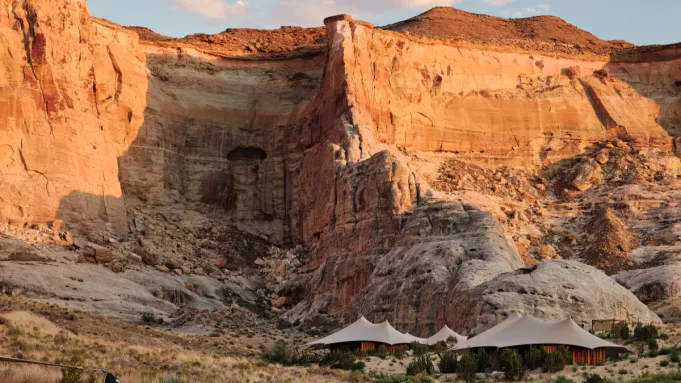
“It’s like coming into Fort Knox,” our driver declares as we wind our way through the cacti and sage brush surrounding Amangiri, a southern Utah resort considered to be the most exclusive (read: superlative, private, bucket-list-y) on the continent. Not that there are armed patrols or trip wires anywhere, but point taken: The sandstone mesas of Glen Canyon National Recreation Area hover over us at dusk, acting like sentries as we drive farther and farther into the desert canyons.
“Remote” doesn’t begin to describe our setting. We’re on a rare stretch of private land—900 acres acquired in a land swap with the federal government, which wanted a parcel near Lake Powell—amid a national-park bonanza in the American Southwest known as the “Golden Circle.” Within 2-3 hours’ drive (or a quick helicopter ride) are Zion, Bryce, Grand Canyon’s North Rim, and all the hoodoos, slot canyons, and epic views this region has to offer. At its intersection is a destination unto itself: the ultra-luxurious Camp Sarika at Amangiri.

Tented pavilion no. 8 is known on site as the “Private Canyon.”
Laura Dannen Redman
Being able to book one of the 10 tented pavilions at this resort within a resort is akin to winning the vacation lottery: that unrealistic yet perfect combination available to a lucky few who have the money to opt in. A beautiful, oversized one-bedroom pavilion—fully temperature controlled and enclosed, with a private patio outfitted with a pool, telescope, outdoor shower, fire pit, and personal golf cart—starts at $6,000 a night. It goes up from there to the new-in-’26 six-bedroom villa (from $45,000/night), an artfully designed compound with its own staff of eight that could host a small corporate retreat, a medium-sized royal family, or a big-deal celebrity and their entourage. Masastudio, one of the original architects behind Amangiri and the maker of these new residences, could lead a master class on working with the natural surroundings: The villa bedroom with the best sunset views has extra gold leaf on the walls to better reflect the light; an oculus skylight in the kitchen is meant to mimic the sky seen from inside the slot canyons.

Indoor-outdoor living is core to Camp Sarika.
Aman
It’s easy to feel verklempt amid all the man-made and natural beauty—just as I was when I visited Our Habitas and Banyan Tree tented camps in Alula, Utah’s doppelgänger desert in the Ashar Valley of Saudi Arabia, in 2022. Camp Sarika, Habitas, and Banyan Tree opened sequentially from 2020-2022 during the pandemic, as travelers around the world sought outdoor retreats that allowed for social distancing. Little did we know that a global movement toward safari-style tented camps had sparked, going beyond “glamping” to full immersion—physically, culturally—into some of the most beautiful, remote places on earth.
The standard, though, was set by Amangiri, and remains golden thanks to the careful attention to next-level service paid by its new general manager, Mario Bevilacqua von Gunderrode. “We need to keep exceeding expectations,” says von Gunderrode, especially given the high percentage of returning guests. The typical Amangiri visitor is American (80-90 percent of the market is from the U.S.), possibly a CEO with a deadly inbox who craves silence and stillness, or a multigen set celebrating a special occasion. It might be Kim Kardashian and Lewis Hamilton looking to relax away from prying paparazzi. Everyone is treated as a VIP, with individualized check-ins and room tours, and an on-call staff that will bring you a ginger shot and Tums if your stomach hurts and plug in your golf cart to charge overnight.

The six-bedroom villa has a 12,000-square-foot main house, with floor-to-ceiling sliding glass doors that open onto Canyon Country.
Laura Dannen Redman
File this under “exceeding expectations”: A spa writer I traveled with commented that Amangiri’s 25,000-square-foot spa was one of the best she had ever visited. I had to agree, putting Amangiri up there with my long-standing favorite, The Retreat at the Blue Lagoon in Iceland. In addition to its five treatment rooms, guests have access to a water pavilion with a steam room, sauna (also with a view), cold plunge pool, and heated step pool; a private jacuzzi big enough for just one (maybe two); and two outdoor treatment terraces overlooking the canyons. On-site trails and yoga atop a butte make for a complete wellness package—one that will spur an appetite. Camp Sarika does all-day dining at its restaurant, serving a very satisfying, protein, probiotic, and açai-filled breakfast (with just enough decadence—try the banana bread). Dinners rotate three times a week, switching between a Utah BBQ with ribs piled high, an authentic Mexican tasting menu, and Korean dishes.

In the Utah desert, we can see rockets by day and constellations at night.
Laura Dannen Redman
It would be easy enough to just stay on property for a few days—it is 900 acres, after all—but that’s not really why you’re there. Remember: location, location, location. Camp Sarika coordinates excursions with expert Arizona, Utah, and Navajo guides who have thousands of climbs and decades of experience under their belt. They’ll not only take you up the side of cliffs on via ferrata—they’re the ones who blazed the trail, hammering the metal rungs into the rockface. Guests can do dinosaur-fossil digs, go horseback riding, spend a day on nearby Lake Powell, hike the slot canyons, learn candle and pottery making, and watch a Navajo hoop dance performed by a world-championship contender. Many outings are included in the stay, though private bookings can scratch any itch, be it geological, cultural, or athletic.

Local guides lead us on via ferrata to the tops of mesas; a visitor enters Antelope Canyon.
Laura Dannen Redman
A trip here isn’t complete without a day spent in Navajo Nation among the slot canyons, those narrow, winding gorges 140 feet deep that formed over millions of years of water and wind carving rust-red dunes. “Welcome to Instagram Canyon,” our Navajo guide Eli jokes as we pause for a photo opp at the gaping entrance of the site made famous on Instagram. A student of photography, Eli knows how to take a mighty panoramic shot with an iPhone, but better still, he can point out the bear, eagle, heart, and desert moon shapes among the rocks and tell stories about how kids used to party in these canyons in the 1970s and ‘80s. He carries a hand-carved pipe in his back belt loop, seeking out a quiet place to play and tell the story of his clans, his heritage. In Rattlesnake and Owl Canyons—so named for their inhabitants, though we saw neither that day—the music echoes amid the twists, turns, and crevices of the petrified sand. “[The canyons] were forged of floods and destruction,” says Eli, “but became something beautiful. It is a metaphor for us all. You step in with your philosophy, your ethics, and you come out a better person.”
-

Coastal Coin Necklace
$34.00 -
Resort Palmtree Necklace
$64.00 -

Oceanside Sparkle Studs
$38.00 -

Coin Necklace
$34.00