For many collectors and cognoscenti of the world’s most important cars, the Bugatti Veyron is a favorite—and rightly so. Not only was the model instrumental in resurrecting the French marque, it was pivotal in positioning it once again at the apex of performance automobiles. The car, and its success, is thanks largely to Ferdinand Karl Piëch, then chairman of the parent Volkswagen Group, and his vision for the W16 engine.
To pay tribute to this contemporary Bugatti cornerstone, as well as to the father of its seminal power plant, the Molsheim-based team has just debuted the one-off Bugatti F.K.P. Hommage, or at least a representation of it. Created specifically for a highly valued client, the unique hypercar becomes the second example, following last year’s Brouillard, built as part of Bugatti’s return to the advancement of coachbuilding through its Programme Solitaire.

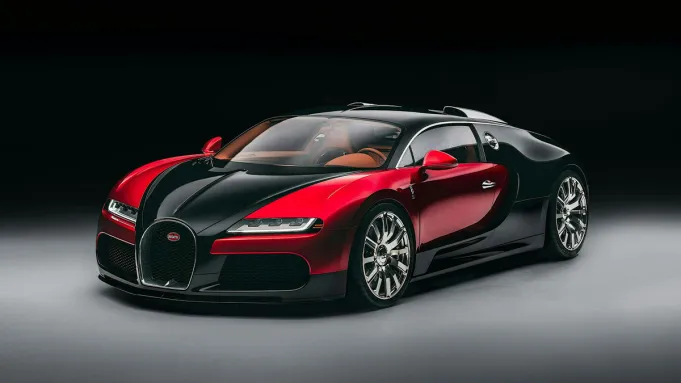
The 1,578 hp Bugatti F.K.P. Hommage is a tribute to both Ferdinand Karl Piëch, former chairman of the Volkswagen Group, and the 20th anniversary of the Bugatti Veyron‘s first delivery.
Bugatti Automobiles S.A.S.
“These Solitaire programs allow us to really deep dive into one particular subject,” stated Frank Heyl, Bugatti’s director of design, during an invitation-only virtual preview last week that included Robb Report. “The subject here is the celebration of the 20th anniversary of the Veyron . . . counting that backwards from the delivery of the first customer car in 2006.”
According to Heyl, “the direct underpinnings, technically, are a Chiron Super Sport.” That means the F.K.P. Hommage carries a 1,578 hp W16 engine—compared to the original Veyron’s 1,001 hp predecessor—though performance specs have not been announced. But it’s the bodywork that’s the real story, as it honors that of the stylistically pioneering Veyron.

“We are working with custom-woven fabrics here from Paris . . . woven especially for this car,” explained Frank Heyl, director of design, regarding the interior.
Bugatti Automobiles S.A.S.
“Before the Veyron, supercars were very much still perceived as this kind of wedge shaped, forward angled, surfacing architecture, much inspired still by the works of Marcello Gandini,” mentioned Heyl. “We recall the Lancia Stratus Zero, or the Ferrari Modulo, or even some of the first Countach proposals—all were forward-wedged body postures. The Veyron did exactly the opposite . . . leaning back, and this is the very unusual body posture that we wanted to certainly capture here.” As for the slight change found at the front, “it’s a more upright horseshoe [grille] . . . and all the surfaces originate from the horseshoe,” said Heyl. “It’s a little more modern interpretation of the Veyron theme; still with the color breakup along the bonnet shut lines, and then the two front wings are sort of docked on to that.” As for the back, the rear diffusor has been widened by two centimeters on each side.

A close-up of the bespoke 41 mm Audemars Piguet Royal Oak Tourbillon timepiece set in the dash.
Bugatti Automobiles S.A.S.
Adding authenticity are aesthetic elements that were initially conceived by the design team back in the day, of which Heyl was already a part. These were suggested in preparation for a refresh of the Veyron, though he notes that those plans were abandoned once it became clear that a new model, the Chiron, would replace it. Heyl has now been able to bring some of those bygone Veyron revisions to light. Specifically, he cites the L-shaped daytime running lights and the taillights. “These were the original proposals that we think make the selection of design themes for this car period correct,” he noted.

The F.K.P. Hommage carries a 1,578 hp W16 engine—compared to the original Veyron’s 1,001 hp predecessor—though performance specs have yet to be announced.
Bugatti Automobiles S.A.S.
As for the interior, it showcases the extent of customization that is Programme Solitaire’s raison d’etre. “In terms of the scope of this project, for a one of one, we’ve really gone to the greatest extent of complexity here. We do not only trim this in the original leather, but we are working with custom-woven fabrics here from Paris . . . woven especially for this car,” explained Heyl. The centerpiece is a 41 mm Audemars Piguet Royal Oak Tourbillon made exclusively for the F.K.P. Hommage. “It sits in a revolving gondola. There is no mechanical or electrical connection between the watch and the car, but the gondola has an axis of which it revolves about,” explained Heyl, adding that “the watch will rotate several times an hour to keep the power reserve wound.”

The F.K.P. Hommage is the second example built as part of Bugatti’s coachbuilt-focused Programme Solitaire.
Bugatti Automobiles S.A.S.
Another standout feature is the exterior’s dual-tone paint scheme, which comprises multiple layers that include a red clear coat atop a silver-aluminum one. Complementing this is black exposed carbon fiber bolstered in appearance by a black clear coat. The entire presentation rides on bigger wheels than the Veyron, now with the Chiron’s 20-inch and 21-inch setups in the front and rear, respectively. It also benefits from the Chiron’s brakes (420 mm rotors with eight-piston calipers).
The actual vehicle intended for the owner, a car Heyl summarizes as “a Veyron interpreted with 2026 technology,” has yet to be built, but is scheduled to be delivered next year. In the meantime, a show-car version will make a public appearance at the Rétromobile exhibition in Paris on January 29.
Click here for more photos of the Bugatti F.K.P. Hommage.

The one-off Bugatti F.K.P. Hommage.
Bugatti Automobiles S.A.S.
Authors
-

Viju Mathew
-
Coastal Coin Necklace
$34.00 -
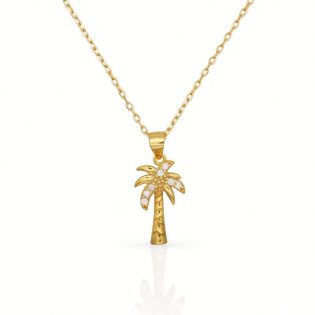
Resort Palmtree Necklace
$64.00 -
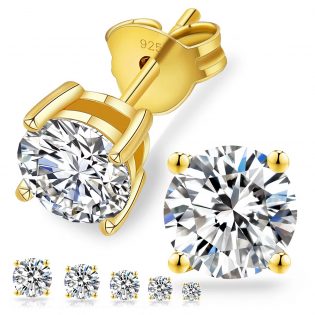
Oceanside Sparkle Studs
$38.00 -
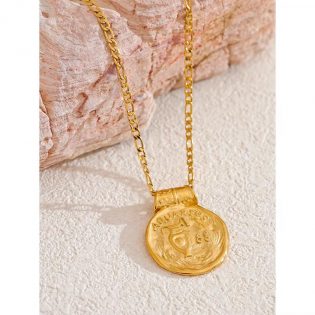
Coin Necklace
$34.00