
The race for electric aircraft supremacy is moving full-speed ahead, and a dark horse could emerge as one of the frontrunners.
Electric aircraft manufacturer Beta Technologies was listed yesterday on the New York Stock Exchange, joining Joby, Archer, Vertical Aerospace, EHang, Eve and Surf Air Mobility as publicly traded eVTOL makers. The company raised nearly $1 billion in its initial public offering through the sale of 29.85 million shares and a market valuation of about $7.44 billion. It plans to use the proceeds to speed up the manufacturing and certification of its two electric aircraft.

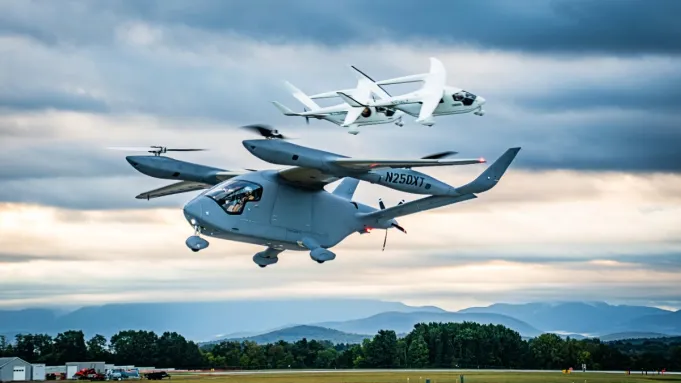
Beta’s CX300 is a conventional, fixed-wing electric aircraft that has several advantages over eVTOLs.
Beta is making two aircraft in its Alia series. The first, the CX300, is a conventional, fixed-wing takeoff and landing (CTOL), and the second, the Alia 250, an electric vertical takeoff and landing vehicle (eVTOL). The company was founded in 2017 by engineer, pilot, and former NHL hockey star Kyle Clark. It is headquartered in Burlington, Vermont, where it has a manufacturing facility.
The CX300 has a 50-foot wingspan, with space for a pilot and five passengers, a maximum speed of 176 mph, a 336-nautical mile range. It’s powered by a single H500A electric motor pushing a five-bladed pusher propeller. The aircraft completed the first coast-to-coast flight by an all-electric aircraft in March, and in June, it was the first passenger-carrying electric flight into JFK. During a three-month deployment with the U.S. Air Force, it had a 98 percent dispatch reliability. The aircraft recently won the Pulitzer Electric Aircraft Race in Springfield, Ohio.

Beta plans to move the CX300 through certification in 2026 or early 2027.
Unlike the other eVTOL makers, which went public in 2021 and 2023 by merging with a special purpose acquisition company, Beta waited until it had a “solid foundation,” according to Clark. “It was on brand for us to wait for the IPO until we are ready because these can create a lot of churn and noise,” Clark told Ainonline.com. “If you are chasing what people [i.e. investors] want to hear rather than what is needed you can get off kilter quickly and lose your footing.” The company decided to establish manufacturing facilities for serial production of its airframes, propulsion units, and flight controls. It has developed its own battery technology. Earlier this year, General Dynamics and GE made strategic investments in the company.
Like its competitors, Beta is on a similar timeline toward type certification. It projects FAA certification for the CX300 by late 2026 or early 2027, with the Alia 250 expected to achieve certification a year later. But the CX300 differs from its competitors since it’s more like a conventional aircraft than the helicopter-like eVTOL. The CX300’s range could give it an edge in regional passenger transport, along with other applications such as medical logistics, cargo deliveries, and military roles. Its electric power delivers a quieter, emissions-free flight with minimal costs than conventional aircraft. BETA plans to develop larger aircraft with the ability to carry between 19 and 150 passengers, according to Clark.

Archer says it is progressing with its FAA certification plans, though several news reports in October suggested it won’t be certified in the UAE in late 2025, as previously announced. On Monday, its share price dropped nearly 7 percent on the news.
Joby also saw its shares decline by 9 percent with similar reports that its certification will also be delayed in the UAE. But most analysts consider those speed bumps given their respective market valuations ($6.2 billion for Archer and $13.08 billion for Joby as of November 4) and head starts in manufacturing, infrastructure development, strategic acquisitions, and connections with automotive companies that provide technical assistance and investments. Archer also recently announced a 100-aircraft order from Korean Airlines for its Midnight eVTOL.

Eve, meanwhile ,reported that it is in the final stages of testing its engineering prototype before flight testing begins. It expects the prototype to get airborne by “the end of this year or early next year,” said CEO Johann Bordais in the brand’s November 4 earnings call. Eve, a spinoff of Embraer, which remains its major shareholder, said it has reached an agreement to test its aircraft in Bahrain. “The agreement also calls for Eve to possibly conduct test flights in the region in 2027,” said Bordais.
Authors

-

Coastal Coin Necklace
$34.00 -

Resort Palmtree Necklace
$64.00 -

Oceanside Sparkle Studs
$38.00 -

Coin Necklace
$34.00