
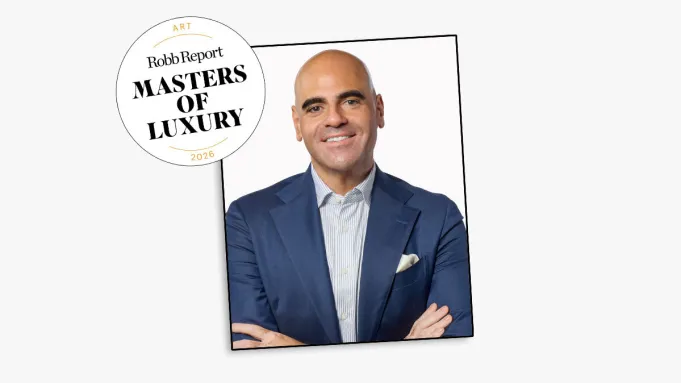
Sometimes, no matter how smart, connected, and well-resourced you are, you simply need an expert—and not just any expert, but the rarefied insider whom other specialists call when they need help. Luckily Robb Report has our own highly curated directory of heavy hitters across categories: the Masters of Luxury.
This month, it’s Ralph DeLuca, the tough-talking art adviser for everyone from Leonardo di Caprio to Steven Spielberg to Martin Scorsese. New Jersey–born DeLuca stands out—and apart—from many of his rivals for his openness around commercial pressures in this secretive, tightly guarded world. He also has a true passion for the works he tells clients to buy (and buys himself).
Have a conundrum you’d like to see solved? Email askrobb@robbreport.com.
The Expert
Name: Ralph DeLuca
Occupation: Art consultant and adviser
HQ: Las Vegas, Nev.
Specialty: Shredding red tape and pretensions in the art world
The Big Question
I’ve been dabbling in collecting for a few years, but I think I’m ready to ramp up and engage with an adviser to really turbocharge my gallery connections and access. What do I need to know?
First, don’t misunderstand the role of an adviser as some kind of wheel-greaser. “Ninety percent of the time, my job is to say no,” DeLuca says. “I’m a hired bad cop.” Galleries’ loyalties are first to their artists and then to their own bottom line, so they may not treat you like a priority unless you’re a known quantity. See, for example, the proliferation of BOGO deals, with bundled works offered as a package: one to keep and one to donate. It’s an arbitrage, not a testament to your connoisseurship. A great adviser might more likely reduce your spend, not increase it. Still, there’s combined clout working with someone like this. “A lot of that bullshit gets cut when clients are under a single shingle.”
Make sure to ask about fee structures—whether commission or retainer—and inquire about their own collections. “Does an adviser put their money where they’re telling you to put yours? I know so many who spend their money trying to pretend to live like their clients and not buying art,” he adds. Put another way: If they arrive in a Bentley but don’t collect, steer clear.
And even if you’re outsourcing some work to an expert, don’t disengage. He suggests thinking of in-demand contemporary art like a child and the gallery like an adoption agency screening new parents. “Will you be responsible? Will you be a patron? Show up at openings and ask questions even if you’re not interested in buying,” he says. “It’s the commitment level—like going to an orphanage to see the kids at Christmas and bringing toys for them.”
Speed Round
How do you gauge if a storage facility is truly top-tier? Get reports on the quality of build—the certifications of humidity, temperature, and air-quality control—and ask art conservators if it’s a safe place to keep art.
What should you do before splurging on a secondary-market piece? Inspect it out of the frame. Frames hide flaws, especially in older works, or on paper or photography. I’ve found fire damage, the signature, or edition numbers cut off.
Smartest shortcut you rely on? Download See Saw, an app where you can see every gallery show listed. They have New York, Los Angeles, Berlin, London, Paris, and Miami.
What is most overlooked about contemporary art? Living artists can have bad shows or make a faux pas on social media—they could totally Kanye themselves—or a dealer can mismanage their career. That can all affect their market.
What’s the difference between contemporary and other areas of the art and collectibles market? I started in collectibles, and I’m very interested in Hollywood memorabilia. In certain things like coins, comic books, sports cards—a third party like PSA grades them, so it’s much easier. In art, tastes could change, but Action Comics No. 1 will always be the first appearance of Superman.
How do you hack the secondary market? The total price includes a buyer’s premium of 27 percent that no one except the auction house gets. So if art is selling at auction, ask if they have anything in a private sale—works the consignor chose not to auction off to avoid saturating the market. If a gallery sells a new work by a living artist, typically the split is 50/50.
Either | Or

At high-profile sales, the provenance and pedigree of a piece trump the cash value of the market.

If you’re caught up in the medium, not the quality? Long-term, it will burn you in the ass.

In a show, people cover it and see it in an environment in concert with the rest of the artist’s body of work.

The social enrichment, the egotistical component? Both get filled much quicker.

You should have your collection. Your collection should not have you.

There is a price for everything—just don’t buy things with the mentality to trade them.

Ninety percent of the great things at art fairs are placed a month or more in advance.
-
Coastal Coin Necklace
$34.00 -

Resort Palmtree Necklace
$64.00 -

Oceanside Sparkle Studs
$38.00 -

Coin Necklace
$34.00