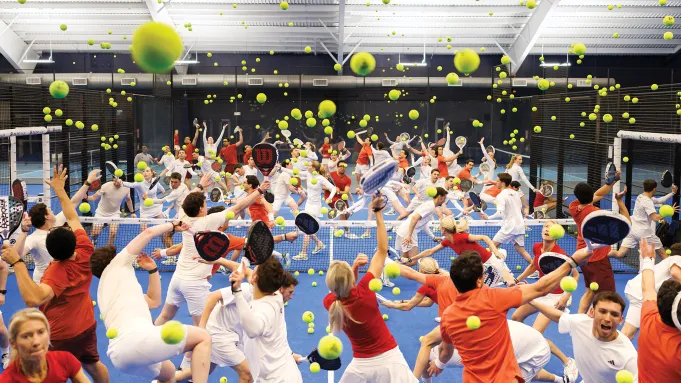
The world’s fastest growing sport has a problem: No one seems sure how to pronounce it. At least, no one in the Northeastern United States. Is it “PA-del” like “battle” or “pa-DEL” like “lapel”? Remarkable, given that it has become the new darling of the luxury world, with Rolex, Prada, and Lamborghini now vying for the attention of a rapidly expanding cohort of wealthy players and fans.
The confusion, it seems, traces back to the personal experiences of Marcos del Pilar, the self-styled “Godfather of Padel in the U.S.A.” Nearly a decade ago, the Spaniard arrived in the U.S. hoping to sell a sport that today is beloved by about 6 million of his countrymen. Originating in Mexico in the 1960s and hugely popular across the Spanish-speaking world, padel struck him as a compelling commercial proposition for racket-sport associations and American investors.

Fans gather in stadium seating to watch the 2025 Reserve Cup in Miami. Padel is played in a tempered-glass-walled cage.
Major Media
But as far as they were concerned, padel already had a U.S. footprint—and not a promising one. The game of platform tennis or simply paddle, had been played at closed-door country clubs since it was created as a winter sport in the 1920s. It was aloof. Unscalable. A bewildered del Pilar was turned away.
Bruised but not beaten, he came up with a simple solution: Change the pronunciation. Pa-DEL, with the pseudo-Spanish inflection, described the fast-paced mash up of squash and tennis played on a tempered-glass- and wire-mesh walled court far removed from cable knits and New England trust funds. It sounded much more appealing to the money men. The pronunciation stuck, and funds flowed.

Pro padel player Brittany Dubins chats with the C.E.O. of Pro Padel League (PPL) in Miami.
Bryan Bedder/Getty Images/Pro Padel League
Now, the variation in the name has become a bit of a pickle. (And then there’s pickleball—another game entirely, played in backyards and recreation centers with a perforated plastic ball.) As participation, investment, and sponsorship opportunities have surged, the sport’s U.S. pioneers are eager to retire del Pilar’s clever phonetic work-around for good.
“It’s padel,” confirms Wayne Boich, using the original pronunciation. The former competitive tennis player would know. In 2023, Boich founded Reserve, a Miami-based upmarket lifestyle brand that also operates members-only padel clubs on Manhattan’s Upper East Side and at Hudson Yards.
“Padel is proper,” echoes Michael Dorfman, C.E.O. of the Pro Padel League, now in its third season. “I’ve been constantly correcting folks.”

Reserve Miami Seaplane spans 50,000 square feet, and courts overlook the water.
Reserve Padel
Before long, the distinction may no longer matter. Padel—always played in pairs—is surging, with popularity and participation accelerating in the U.S. and around the world.
Some of the numbers are staggering. According to the International Padel Federation (FIP), in 2018 there were fewer than 8 million padel players globally. By November last year, that figure had risen to an estimated 35 million. Clubs and courts are proliferating just as quickly: Some 4,775 clubs opened between April 2024 and November 2025, a 24.1 percent increase, while the federation’s latest count put the number of courts worldwide at more than 77,000, up 23 percent over that same 18-month stretch. Five years ago, padel was played in 50 countries. Now it’s 150.

From left: Tom Holland gets in on the action at a one-day pro-am tournament at London’s Padel Social Club last year; Spanish Argentine pro player Claudia Jensen lunges for the ball at a PPL tournament.
Jeff Spicer/Getty Images/Bero/Pro Padel League
The professional game is exploding, too. In 2024, 36 countries hosted 182 FIP-licensed tournaments. Last year, there were 290 tournaments across 49 countries and more than 11,000 players with a professional FIP ranking. As in tennis, there are now four majors, a tiered tournament structure, year-end finals, and meaningful prize money. Dorfman estimates that the top handful of players—such as the world’s No. 1 pairing, Agustín Tapia and Arturo Coello—now earn close to seven figures annually once endorsements and appearance fees are factored in. Big money is rolling in as well: In 2023, Qatar Sports Investments added the Premier Padel Tour, the leading international pro tour, to a portfolio that includes French football giant Paris Saint-Germain.
What, exactly, is so bewitching about padel? Advocates say it’s easy to pick up and quick to master, inherently social because it’s played in pairs, and that once you’ve felt the mighty thwack of a sort of doughy, slightly smaller tennis ball against a carbon-fiber racket or paddle—or pala, in Spanish—there’s no going back.

Fans gather beneath striped umbrellas at a PPL event in the Hamptons.
Pro Padel League
Glenn Spiro, the London private jeweler who ditched tennis for padel a few years ago, talks about it as if it’s aerobic nirvana. “There’s a sexiness to it because it’s a very easy game to understand and to participate in,” he says. “It’s a revolution.”
Benji Markoff agrees. The 37-year-old serial investor cofounded Padel United Sports Club in late 2023, transforming a 36,000-square-foot warehouse in Creskill—an upscale New Jersey suburb—into a padel and wellness club. “It was love at first sight,” he says of the sport. Since opening in January last year, Padel United has added about 675 members, with numbers rising every month and expansion plans already underway as current capacity approaches its limit.
Boich, meanwhile, can’t build his clubs fast enough. The waiting list for Hudson Yards membership is now closed due to oversubscription, and he says developers have already offered to build resorts if he would license the Reserve name. “You feel like you’re part of an incredible community that lets you feel athletic and healthy,” he says of padel’s appeal.

Players during a PPL match in the Hamptons.
Pro Padel League
That community is wealthy. Markoff is targeting the “upper middle class and high net worths” with a $4,500 annual family membership. Boich says his top-tier memberships will reach six figures for some locations currently in planning, and that his clientele includes entrepreneurs, city power brokers, venture capitalists, and family-office managers—85 percent of whom are men—looking to network, strike big-money deals over a three-foot net, and then continue the conversation over lunch.
Does that make padel the new golf? It helps that a match takes two hours instead of four or five, Boich says. “The affluent community that belongs to golf clubs—we’ve found they’re really looking for this. Are they going to forgo their memberships? No. I’m not saying that. But they’re going to find time to put padel into their everyday lives, and we’ve seen it happen very quickly.”
With the sport scaling and a fan base that knows its way around Fifth Avenue, luxury brands are circling. Earlier this year, Rolex validated the sport’s fast-maturing structure and global, multigenerational audience by signing Coello as one of its Testimonees, or ambassadors. In February, fellow Swiss watchmaker Frederique Constant inked what it described as a long-term deal with Dorfman’s Pro Padel League.

Argentina’s Augustín Tapia and Spain’s Arthuro Coello celebrate winning the men’s final of the Paris Major Premier Padel tournament at Roland-Garros.
Thibaud Moritz/AFP/Getty Images
Others are doing equipment deals or even building upscale clubs of their own. Prada’s padel racket with a nylon case, currently out of stock, retails for $1,970. Lamborghini’s $600 Babolat racket is sold out, too. High-end streetwear brand Kith opened Kith Ivy, a private members’ club in New York’s West Village, last fall, charging a reported $36,000 initiation fee for access to padel, a Giorgio Armani–designed spa, and the city’s first Erewhon location. More recently, an ultra-luxe Swiss watchmaker is rumored to be in talks to join the tour.
“We’ve never seen something like this,” says Jeffrey Cohen, president of Citizen Watch America, which oversees Frederique Constant. “Padel is the fastest growing sport, and we’re one of the fastest growing brands in this country, so we thought it was natural to ride this wave together.” Co-branded watches will follow, he confirms.
For Dorfman, it’s vindication of a bet he and his fellow investors made three years ago, when he was handing out free tickets to brands he hoped might become partners. “What we’re seeing now is that we’re starting to convert per-event deals into annual deals, and annual deals into multi-season deals,” he says.

From left: Augustín Tapia of Argentina takes a shot during the 2025 OYSHO Milano Premier Padel P1 Semifinal; Arturo Coello catches air at the 2025 Reserve Cup in Miami.
Roberto Finizio/Getty Images/Major Media
Reserve’s Tony pro-am tournaments are drawing luxe sponsors, too. Boich says Aston Martin, Richard Mille, and UBS have all backed events that pull in leading players. In the U.K., London’s prestigious Hurlingham Club hosts the Alfred Dunhill Padel Classic, a star-studded pro-am garden party–style event held in aid of the Laureus Sport for Good, with past sponsors including a local Bentley dealership and Swiss watchmaker IWC.
There is also a gilded celebrity sheen to the sport. Jay-Z, Dwyane Wade, Lando Norris, DJ Khaled, David Beckham, and Leonardo DiCaprio have all been snapped with padel rackets in hand—most of them at Reserve. “[Brands] are coming because of what the sport is doing,” Boich notes.
Luxury-sports marketers are now steering clients in padel’s direction. “The opportunity is real,” says Merrick Haydon, founder of the global sports-marketing agency ThirtyThree18. “Padel gives luxury brands access not just to wealth, but to a very particular kind of wealthy consumer: socially active, image-conscious, and highly networked.”

Richard Mille ambassador and pro padel player Fernando Belasteguín wearing a RM 35-03 watch.
Hamish Brown
Scale may come, but Haydon argues that padel already offers the alignment upmarket brands are looking for. “Luxury brands tend to be less interested in scale alone than in cultural fit,” he says. “What makes padel stand out is not just growth but the fact that it sits so naturally alongside premium hospitality, fashion, travel, wellness, and real estate.”
Amanda Mille, Richard Mille’s daughter and the brand’s partnerships director, describes padel as a “high-touch ecosystem where performance meets conviviality” and claims it has provided “authentic connections between the brand and our clients.” The watchmaker counts former padel world No. 1 Fernando Belasteguín as an ambassador and has hosted client events at the Argentinean’s Barcelona facility.

Reserve NYC Hudson Yards holds prime real estate with courts surrounded by Manhattan’s high-rise skyscrapers.
Omar Vega
Padel may still be in its early growth phase in the U.S.—only 7.7 percent of the world’s players are in North and Central America, and the U.S. only offers about 800 courts nationwide—but those already invested are convinced of its potential. They point to the millions of Netflix subscribers introduced to the sport through the series Formula 1: Drive to Survive, who’ve watched drivers dabble in padel during their downtime. And to the current and former N.H.L. stars who have helped popularize it in North America. Hall of Famer Daniel Alfredsson and All-Star Henrik Zetterberg are among its prominent investors.
Dorfman estimates that the top handful of players—such as the world’s No.1 pairing, Augustín Tapia and Arthuro Coello—now earn close to seven figures annually once endorsements and appearance fees are factored in.
This summer, both Boich and Dorfman talk of leveraging the FIFA World Cup, with plans for high-profile events with top soccer players from padel strongholds such as Spain, Argentina, and Italy. “There’s a massive overlap of padel and soccer fans,” Dorfman says.

Left to right: a luxe indoor pool and lounge space at Padel United Sports Club in New Jersey; Kith Ivy’s private members’ club in the West Village carries high-end padel goods framed in marble decor accents.
Padel United Sports Club/Kith
Even so, for padel to fully level up, it will likely need TV and true mass exposure. For now, Dorfman’s Pro Padel League streams on YouTube, with a handful of deals with smaller broadcasters. He notes that the audience resembles that of tennis or golf, but skews nearly a full generation younger. “In the short term, we’ll see an expansion in legacy media companies distributing live padel tournaments,” Markoff predicts.
Some are nearly certain the sport’s rise is unstoppable. “I’d be amazed if it wasn’t an Olympic sport one day,” Spiro says, with something close to reverence.
-
Coastal Coin Necklace
$34.00 -
Resort Palmtree Necklace
$64.00 -
Oceanside Sparkle Studs
$38.00 -
Coin Necklace
$34.00