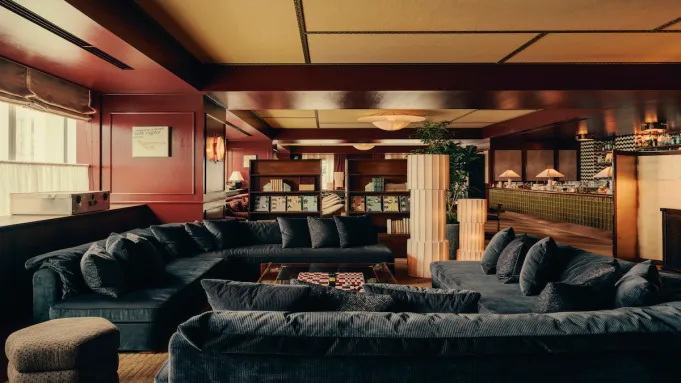
Soho House has made headlines of late with some dismayed members claiming the brand is no longer cool, that the pools feel overcrowded, that the fees to belong aren’t worth the entry. The debate goes on about whether the brand has lost its edge. But if the recent $2.7 billion sale to return Soho House to private ownership and the brand’s first House in Japan, Soho House Tokyo, have anything to do with it, fairer winds might be blowing for the private members’ club.
Private members clubs in Tokyo are nothing new. The Tokyo American Club in Azabudai, Ginza Sapphire Lounge, and Roppongi’s Le Club de Tokyo have found solid footing among Tokyo’s face-time-matters, business networking set. It’s a world where potential new members’ names get passed around with the two-handed business card transfer and personal recommendations come from the lips of established members at board meetings.
With Soho House Tokyo’s debut on April 8 inside the mixed-used Omotesando Grid Tower in Tokyo’s stylish Aoyama District, the London-born brand’s 50th House looks to chart its own course.

The entrance to Soho House Tokyo.
Edvinas Bruzas
Staff in bespoke denim uniforms by Japanese lifestyle brand Onitsuka Tiger welcome guests to Soho House Tokyo at a discreet side entrance on the ground floor of 38-story Omotesando Grid Tower. The hotel and membership club, accessible via a private elevator, occupy floors 11 to 14. The neighborhood is full of high design and high fashion: Kengo Kuma’s iconic, lattice-wrapped SunnyHills cake shop is around the corner; Comme des Garçons and the Prada and Miu Miu buildings (the latter two designed by Herzog & de Meuron) are within a short stroll.
Across the House’s upper two floors, connected by a gleaming wooden spiral staircase, club facilities merge business and pleasure. A mirrored fitness studio has pilates reformers and floor-to-ceiling windows with city views. Lounges beckon with long communal tables, plush banquettes, and modular sofas designed for meeting and working. Meals come via a sushi counter and the House Brasserie, where the menu mixes European comfort food with local influences, such as the prawn Scotch egg served “okonomiyaki style,” roast chicken with maitake sauce (mushrooms, mirin, soy sauce), and donburi rice bowls that change weekly. The club spaces’ deep burgundy color scheme, inspired by Japanese lacquer, pairs with British paneling and tatami-patterned ceilings for a polished, warm effect.
Near the restaurant on the 13th floor, an intimate bar decorated with reimagined Japanese roof tiles has a few comfortable bar seats for settling in. The 14th floor’s larger club bar, with its custom-made DJ booth, is a long onyx stone top covered with leather and illuminated with a mix of Murano chandeliers and Japanese washi paper lights. Nearby, the Cabaret Room stages conversations and intimate music sessions in its matcha-colored den, covered in moiré silk wallpaper and custom Japanese black and green lacquer (urushi).

A dizzying climb to the top, and the reward: a rooftop pool with a sweeping view of Tokyo.
Edvinas Bruzas
The hotel’s pièce de résistance awaits guests on the rooftop terrace: In lieu of an onsen, Soho House now has the city’s newest rooftop pool (of which there are surprisingly few in this city known for glittering views), which stays heated all winter. Individual sunloungers and daybeds—available on a first-come, first-served basis—surround the infinity pool, a soothing spot lined in indigo blue and white custom Tajimi tiles made in Gifu.
That sensibility shines where vintage European furnishings, like a 1960s sofa by Italian designer Luciano Frigerio, sit alongside antique Japanese screens and cabinetry; or when upcycled kimono fabrics hang alongside bespoke amber-glass wall sconces made in Murano, Italy. Works by more than 40 artists—most Japanese, or with life-long careers in the country—decorate the walls.
The hotel’s 42 guest rooms–all of which have balconies with city views, soft furnishings made from upcycled kimonos and sakiori weavings, parquet flooring inspired by tatami patterns and Nagoya tiles in the bathrooms–occupy two additional floors below the club spaces.

Guest rooms are rich with textiles and old-school touches like a rotary phone.
Sean Hazen
In Soho House Tokyo’s first week, founding members, guests, and those who’d flown in from their home Houses in New York and Mumbai gathered for activities that included an “In Conversation” series with celebrated British stylist and fashion designer Clare Waight Keller, the global director of Uniqlo whose past roles include artistic director at Chloé and Givenchy.
There was a vinyl-only session with iconic Tokyo DJ duo, Bib and Moe, one evening. On another, a shamisen and geisha performance by Asakusa Geisha segued to Japanese high-energy house sets by Tokyo music scene icons, TOWA TEI and Yuka Mizuhara (with a pop-up ramen bar to fuel the fun).
The feeling that something exciting had arrived was palpable as groups clustered together on couches and reunited with friends from distant cities.
“We’ve been intentionally building a diverse and interesting community of members for the past eight years, through our Cities Without Houses membership (CWH),” Yuji Okada, general manager of Soho House Tokyo, told Robb Report, adding that potential members can be invited by the existing community—a creatively diverse one in a city like Tokyo.
“Now that the House is open, members from across all creative industries—from fashion to design, music, architecture, as well as gaming, anime, and publishing—continue to shape what our programming and offering in their new home looks like,” Okada said.
Kelly Wardingham, regional director, Asia, of Soho House, said the brand’s Cities Without Houses membership in Tokyo helped form a local base for membership before Soho House Tokyo’s official opening. “We’re very much focused on that community building and the social side of things,” she said.

Imagine the deals that could be made in these booths at the House Brasserie.
Edvinas Bruzas
On the business side, things appear to be full-speed ahead for Soho House. The brand opened three new Houses in 2025—Soho Farmhouse Ibiza, Barcelona Pool House, and Soho House Manchester—and has plans for much more, including Soho House Los Cabos in Mexico (fall 2026) and Soho Desert House Palm Springs (2027). Outposts will open in several other destinations in Europe, Australia, India, and the U.S. in the coming years, too, including Soho Farmhouse Hudson Valley, Soho Ranch House Sonoma, Soho House in Flatiron (New York City’s largest), Soho House Milan, Soho House Madrid, Soho House Sydney, and Soho House New Delhi.
While only time will tell if Tokyo’s new House can carve out—and keep—its cool, the rooftop pool, with views of Tokyo Tower and even Mt. Fuji on a clear day, is all but certain to become a favorite hangout for those with access as another sizzling city summer approaches. And there’s no denying Soho House Tokyo’s overall inviting aesthetics are set to level up the city’s private club game.
Wardingham says she’s confident that since they built it, they’ll come.
“There are a tremendous amount of creatives in this city and there’s a lot of them on the global stage, so it’s really nice to see them want to be part of what we’re doing,” she said. “We have our model, and I think just knowing that the city is right for what we do, we just sort of went in for it.”
-
Coastal Coin Necklace
$34.00 -
Resort Palmtree Necklace
$64.00 -
Oceanside Sparkle Studs
$38.00 -
Coin Necklace
$34.00