This story is from an installment of The Oeno Files, our weekly insider newsletter to the world of fine wine. Sign up here.
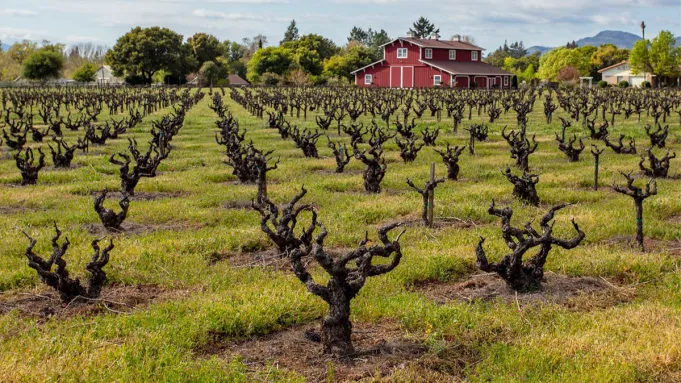
With land in Napa Valley among the priciest anywhere in the United States, vineyards planted more than 40 years ago are a truly limited luxury asset. As costs of both real estate and farming continue to rise, many parcels are vanishing without notice, making wine made from old vines increasingly scarce, especially in Napa. While it would seem like a storied region with more than 150 years of winemaking history that rose to international prominence 50 years ago would be teeming with older grapevines, a phylloxera outbreak there in the 1980s and ’90s that decimated upwards of 50,000 acres of vines—including significant amounts of Cabernet Sauvignon—led to a valley-wide replanting effort that has many plots falling shy of the 35-year mark.
While there isn’t an agreed-upon definition or age limit for vines to be considered old, it is known that complexity and concentration increase in direct proportion to vine age. These qualities create the type of wines that collectors actively seek, which offer greater equilibrium, structure, and age-worthiness. “I see old-vine character more as a mellowing of the tannins and a balance with the fruit,” says La Jota winemaker Chris Carpenter, whose Cabernet Franc is made mostly with grapes from the Winery Block in the La Jota Vineyard on Howell Mountain, which was planted in 1976. “The vines are 50 years old, which is a long time for grapevines,” he says. “As they have aged, the volume of fruit has decreased, and the quality has ratcheted up.”
Carpenter gets about half as many grapes from this plot as he would from a significantly younger one, but that’s all the more reason to keep making wine from here. “Working with these old vines has given me perspective as I’ve grown older myself,” he says. “No matter the age, there is the possibility to create excellence at high levels. Perhaps not at the same volumes once achieved, but with the wisdom and experience that come with time.” The Old Vines Registry, which is exactly what it sounds like, lists 82 Napa plots among more than 101,000 vineyards worldwide. The roster includes several farmed by Robert Biale Vineyards, which produces seven vineyard-designate Zinfandels, a Barbera, and a Petite Sirah from Napa Valley plots planted between 1905 and the 1960s, more than half of which are home to vines dating back over 100 years.
Robert Biale winemaker David Natali says while yields are between 40 and 60 percent lower than he would expect from younger plantings, the fact that all his vineyards are dry farmed throws off any direct comparisons. He believes advanced vine age significantly increases the sense of place evident in the wines, which he wants to keep intact through the winemaking process. “Making as many of them as we do, we work hard to make sure each of these vineyard’s characters comes through,” Natali says, so he relies on a softer touch in the cellar, such as gentle extraction on whole berry ferments, low number of daily punch downs, and moderate to low peak fermentation. While younger vines of Zinfandel have bold fruit character but less depth, causing him to increase extraction to maintain balance, older vines produce smaller berries with a higher skin-to-juice ratio, offering built-in concentration.

Winemaker Chris Carpenter says the tannins are milder in wines he makes with old vines.
La Jota
Red varieties aren’t the only ones that make it to old age. In Oakville, a portion of the famed To Kalon Vineyard was planted with Sauvignon Blanc in 1945, and more than 75 percent of those original vines remain productive today. Vineyard operations director Blake Wood says yields are less than a quarter of what is typical for the region, but that the resulting bottling, Robert Mondavi Winery Fumé Blanc I Block, offers “notable concentration, depth, and complexity.” Wood’s colleague and head winemaker Kurtis Ogasawara tells Robb Report this wine requires a couple of tweaks in the vineyard and winery that begin with walking the block prior to harvest and splitting it up into smaller sections based on flavor development. “We really focus on our work at the press to ensure we get the highest intensity juice prior to going down to barrel for fermentation,” he says. “We are very intentional with our use of new French oak barrels so that the personality of the old vines shows through in the glass.”
At the southern tip of Napa Valley in Carneros, Bouchaine specializes in Pinot Noir and Chardonnay from estate vineyards that were planted to those varieties on the advice of André Tchelistcheff, the Russian-born enologist who has been called the dean of American winemakers. Bouchaine Reserve Chardonnay is made exclusively from the blocks planted in 1984, shortly after owners Gerret and Tatiana Copeland purchased the winery. (Tatiana, being of Russian descent, called Tchelistcheff before purchasing the property because he was the only other Russian she had heard of in Napa Valley.) President and winemaker Chris Kajani says this old vine fruit imbues “intensity, nuance, and elegance, with a texture and depth of flavor that you don’t tend to see in young vines, such as aromatics, flavor components, and a sexy texture.” Wanting the site to show in the wine, she mainly uses larger, neutral foudres and puncheons and just a small amount of new French oak, and she purposely limits malolactic fermentation to “keep the palate energetic and distinctly Carneros.”
None of these wines is inexpensive, a fact that reflects the cost of farming in general and maintaining older vines in particular. “We make it because we love it. It does not make financial sense,” Kajani says. “When you tear out vineyards, you lose the history and heritage, and we’re committed to working with our old vines as long as we can.” Natali agrees it doesn’t always make the most financial sense to stick with old vines, but there’s something bigger at play. “The economics behind it are frequently clouded by a labor of love on both our part and the growers to share the heritage of these sites and shine a small window onto Napa as it was,” he says. It turns out that with enough care and attention—and a bit of love—you actually can put time in a bottle.
Do you want access to rare and outstanding reds from Napa Valley? Join the Robb Report 672 Wine Club today.
Authors
-
Mike DeSimone and Jeff Jenssen

-
Coastal Coin Necklace
$34.00 -
Resort Palmtree Necklace
$64.00 -

Oceanside Sparkle Studs
$38.00 -

Coin Necklace
$34.00