Until the early 21st century, the annals of horological history included relatively few conjurings.
Now, however, it seems like each day brings the magical resuscitation of a long-extinct watchmaker—some obscure, once-glorious (or not) Swiss marque whose fortunes declined beneath the weight of the Quartz Crisis until, poof! The brand was dead.
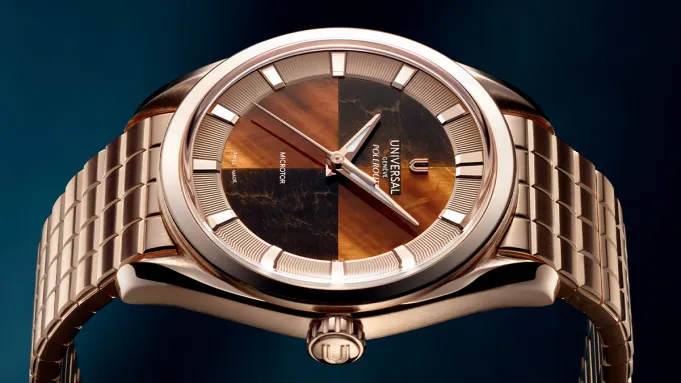
Once among the most lauded chronograph manufacturers in the world, Universal Genève has been awaiting a resuscitation for decades . . . but its rebirth was never going to so thoughtless as that of so many other long-deceased marques. Owned by Hong Kong-based Stelux Holdings since 1989, the trademark was finally sold to Partners Group, the majority owner of Breitling, in 2023. Long forgotten and relegated to the dusty back drawer of watch-dom, UG is finally being given a second lease on life—one that promises to be the most anticipated horological event of the century. (Although, fans of the recently relaunched Urban Jürgensen may quibble with this characterization.)

The new Cabriolet.
Universal Genève
“I think the challenge is really that Universal Genève was a very important brand partly during the ‘50s and the ’60s. And we have a huge responsibility to relaunch [it] because a lot of people have huge expectations linked to this company—the creativity and the quality of the product was incredible,” says Gregory Buttin, the managing director of Universal Genève. “When you have something that was sleeping for a long time . . . it’s very, very challenging because you want to continue the story, but it’s very important to start in the right place. And our objective was really to continue the story after the ’70s.”
The middle of the 20th century was indeed an incredibly fertile period: It saw the launch of the ref. 885103/02 “Nina Rindt,” a panda-dial chronograph famously worn by the famous Finnish fashion model and wife of race car driver Jochen Rindt; the “Big Eye” chronographs refs. 884100/01 and 884100/02; and the Tri-Compax “Eric Clapton” ref. 881101/01. This is to say nothing, of course, of the Polerouter—the famed three-hander famously made in celebration of Scandinavian Airlines System’s first flight over the North Pole. Together, this gaggle of timepieces helped cement the brand as a top-shelf tool watch manufacturer of the post-War era—and a favorite of vintage watch collectors in the early 21st century.

Universal Genève Signature Dioramic and Signature Disco Volante Watches
Universal Genève
All of this is reflected in the catalog being launched today—and celebrated next week in Switzerland—as UG reclaims its historical place on the Rue du Rhône in Geneva. Split into four collections, it comprises reinterpretations of some of the maison’s most beloved models as well as new imaginings of vintage UG tropes. Within the Prêt-à-Porter collection are permanent takes on important historic models, while the Capsule collection features limited seasonal riffs that play with colors, materials, and decorative techniques. The Couture collection, meanwhile, comprises special pieces developed with highly skilled artisans, emphasizing métiers d’art and craftsmanship, while the Signature collection consists of limited reinterpretations of archival icons. The idea is to make modern Universal Genève the “couturier” of watchmaking, placing it above Breitling with respect to pricing and segmentation and position it as a top luxury watchmaker. Pricing begins around 9,800 Swiss francs (about $10,900) for a stainless-steel Cabriolet with chronograph prices beginning around 15,500 Swiss francs ($19,450) and climbs up to 320,000 Swiss francs (about $401,000) for a Cabriolet Couture Edition.

Universal Genève Polerouter
Universal Genève
Core models in the new collections include reimaginings of the Polerouter—the famed Gérald Genta-designed watch from 1954; the Compax chronograph made famous by Eric Clapton, Nina Rindt, and others and launched in 1936; the reversible Cabriolet dress watch from 1933; and the Disco Mini ladies’ watch, based upon Disco Volante “flying saucer” designs of the 1950s. Beyond these models, there are numerous limited-edition Couture Creations as well as Signature Timepieces—limited-edition riffs on classic models from the brand’s archive. In short, no fewer than 36 different SKUs will be available at launch—quite the opening salvo from a brand that many thought would ever see the light of day again.

Universal Genève Disco Mini
Universal Genève
In speaking to the division of UG’s catalog between core models and limited editions, Buttin makes an important point about scarcity: “You have two types of scarcity,” he explains. “The first one is artificial scarcity, and you say, ‘I will produce this quantity because I want to maintain the price of my product.’ And [then] you have real scarcity—if someone asks you to double the production, that would be impossible because you don’t have the artisans to do that. With Universal Genève, it will not be possible to produce a lot of pieces during the two first years because the ramp-up of movements takes a lot of time. That is the first thing. And on top of that, for the limited editions, we work with very specific artisans. And for these people, it’s not possible to produce millions of pieces. It’s real scarcity.”

Universal Genève Couture Dioramic
Universal Genève
Movement production, as Buttin mentioned, is its own animal: One of the myriad reasons why modern collectors love vintage UG watches is due to their in-house movements. Though not necessarily beautifully finished, they were manufacture creations with numerous complications made for pilots, engineers, soldiers, and the like. But spinning up a complete manufacture right from the get-go wasn’t an option in the revival of Universal Genève—at least not yet.
“The movement creation was really key to the DNA of the brand,” says Buttin. “We have 70 years of history linked to the micro-rotor. And it’s also something very important for me because when I was a watchmaker, the first movement I bought was a [Universal Genève] micro-rotor. During my career, I developed a lot of micro-rotors because it was really great to use this complication to show the beauty of the movement. And it was really the vision of the brand [Universal Genève]—to optimize everything to create the perfect design.”
He stresses that at this iteration of the brand, the company really wanted its own movement following its own philosophy. “Today this was to have something very thin, very elegant, with high-quality finishing and very good performance—and we really target 72 hours [of power reserve] because it’s the duration of the weekend.” Of course, chronograph movements are perhaps even more important to a brand such as UG. “The automatic [movement] is very easy and everyone said to us, it’s a normal first step,” says Buttin. “The second one was the chronograph because Compax is really one of the most iconic products for the brand, and we had no choice but to develop this kind of movement. But today you want an automatic [chronograph]—you don’t want manual winding. Finally, it was not possible to put these two movements in the Cabriolet, and the only real choice was to develop a movement for this model.”

The Compax
Universal Genève
So how did UG manage multiple movements in the space of just two years? “When you want to develop your own manufacture, you need approximately 10 years,” Buttin continues. “And for us, it was not possible. This is the reason why we started with a company in Neuchâtel called LTM (Le Temps Manufactures), which supplies movements for a lot of companies in the watchmaking industry. We are very transparent about this. We worked together to develop our own movement with our own DNA, but we bought the reliability, the quality of the production. That is for the automatic movements and also the hand-winding. For the chronographs, it’s a bit different because one of the best movements on the market today is the Breitling B01, and we use the same platform, because reliability is key when you launch a new brand. So we take the same platform and we construct the movement from zero. Ninety percent of the components are specific to Universal Genève.”
So far, so good. But were the 1950s and 1960s really the golden age for UG? Aesthetics are, of course, subjective, but the brand was already well on its way to greatness back in the 1930s and 1940s. In fact, it was in 1933 that Universal created its Compur chronograph, while the Compax—the first wristwatch to feature a triple-register chronograph showing hours, minutes, and running seconds—followed in 1936. From here, all manner of innovative riffs on the common chronograph were developed: There was the Aero-Compax with its unique reference-time dial; the Tri-Compax with its full calendar display; the Medico Compax with its pulsations scale; and more. Surely the modern incarnation of UG will want to take advantage of these striking designs?
“It’s planned,” Buttin smiles. “We plan to develop these kinds of products in the next few years. There’s a reason why we created a collection with the name ‘Signature’—the objective is really to recreate this historical product, but with a modern interpretation.” Indeed, with die-hard vintage collectors eagerly awaiting the relaunch—plus millions of potential new customers who have never heard of Universal Genève before—satisfying everyone is a tall order. “I [received] a lot of questions about why we came with four collections,” says Buttini. “For us, it was very important to open the brand, to show the creativity of the brand, and to say, ‘We have strong legitimacy to do that.’ One of the key elements of UG was really the creativity and all the incredible product design. That was very important. And this is the reason why we came with four collections and three levels of segmentation. We are back. Universal Genève is back, and it was very important for us to come with something strong.”
Click here to see all the new Universal Genève watches in photos.

Universal Genève
Authors
-

Oren Hartov
[ad_2]
Source link
-
Coastal Coin Necklace
$34.00 -
Resort Palmtree Necklace
$64.00 -
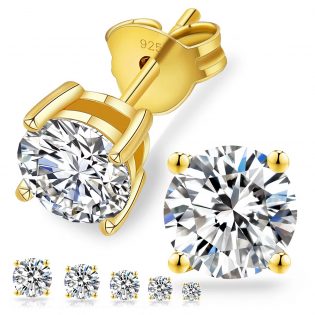
Oceanside Sparkle Studs
$38.00 -
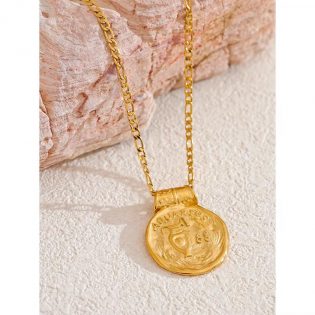
Coin Necklace
$34.00