Antarctica exists only in wide-screen. You turn around, trying to take it all in: Snow-covered quartzite mountains rise like 10,000-foot drifts. Crevasses slice through the ice like cracks in pavement. Then there are the eerie absences: of sound, smell, even darkness. On a clear day, the moon hangs in the same sky as the sun, which circles and never sets during summer. It’s cold, but not quite as cold as you imagine. A hearty Minnesotan would do just fine, plus there’s that old saying, “There’s no bad weather, only bad gear.” Beneath it all, naturally occurring glacial ice a mile deep sparkles like a cache of diamonds.
This idyll can change within hours. A westerly wind blows in fog off the peninsula. Temperatures climb just enough for snow to lift and swirl. Then conditions suddenly turn whiteout, disorienting at best and fatal at worst. Weather reigns supreme here.
Antarctica is the coldest, driest, least hospitable place on Earth—and I’m here on vacation. Not on a cruise ship, and not in search of penguins (although there are plenty) and polar bears (which are only in the Arctic). I’ve come for the White Continent’s interior, once the realm of explorers, scientists, and record-breakers, and now opening to what operators call nontechnical travelers.

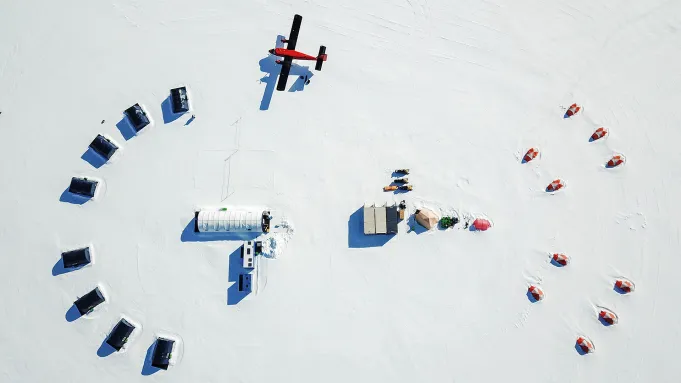
An aerial view of Three Glaciers Retreat, the luxury tented camp run by Antarctic Logistics and Expeditions (ALE) at the intersection of the Driscoll, Schanz, and Schneider glaciers.
Christopher Michel
Much of that shift traces back to Antarctic Logistics and Expeditions, or ALE. Founded in 1985 by Canadian mountaineers Pat Morrow and Martyn Williams and British pilot Giles Kershaw, the company began as Adventure Network International. The trio launched the venture after reaching the top of Mount Vinson, Antarctica’s highest peak. At 16,050 feet, it’s little more than half the height of Everest, but its unpredictable conditions make it formidable. Expect the unexpected, climbers are warned. And expect it to try to kill you. It was the final step in their quest to complete the Seven Summits, and, in 1985, they became the first to climb the highest peak on every continent.
Today, ALE is the longest-running tour operator on the continent. Acquired and renamed in the early 2000s, it has supported 95 percent of all modern Antarctic expeditions. Take, for instance, its first crossing on foot, or a group of filmmakers documenting a kite-skiing journey to the South Pole. There have also been skydivers, legendary mountaineers, renowned scientists, and heads of state. Even Will Smith has braved the elements. Whether clients are traversing by foot, vehicle, or plane, ALE provides the infrastructure for them. “We are the airport. We are the hospital. We are the weather station,” says Heather Bowers, communications manager for ALE. Each season, the company establishes a private base camp at Union Glacier in the southern Ellsworth Mountains, about 600 nautical miles from the South Pole. “We’re it—we have to make everything,” she explains. Here, from November through late January, a blue-ice runway receives a chartered Icelandair Boeing 757 that ferries expeditioners from Punta Arenas, Chile, across the infamous Drake Passage to the White Continent.

At the bottom of the world, all roads point north from base camp at Union Glacier.
Tre-C Dumais/ALE
It’s an instantly “iconic destination, unlike anywhere else in the world,” says Mike McDowell, an Australian geophysicist who founded Quark Expeditions and now focuses on travel to humanity’s farthest reaches: Antarctica, the Mariana Trench, and space travel for the general public. As one of four active partners at ALE, McDowell concentrates on logistics while making the inhospitable welcoming—even plush. But not too plush. “We want to keep the flavor of Antarctica without losing it to luxury,” he says. “It’s important to us that visitors still feel what makes Antarctica extraordinary and life‑changing when they travel with ALE.”
Almost bursting with anticipation, our group has the sense that we are about to embark on a singular experience from the jump. “I feel like we’re astronauts going to the launchpad,” says Ed Finger, 48, from Houston, as we walk the passageway to our Boeing 757. (Another member of our adventure‑ready entourage has already been to space on a Blue Origin flight.) There are 13 of us bound for Three Glaciers Retreat, or 3GR to those in the know: Finger, a solo traveler who has visited 90‑something countries; a family of four with college‑aged daughters; two brothers celebrating a 70th birthday; and an author working on multiple books about Antarctica. We are engineers, C.E.O.s, small‑business owners, retirees, students, artists, and writers, all eager to be “on the ice,” per the local lingo.

ALE uses Basler and Twin Otter aircraft for intercontinental travel.
Christopher Michel
At ALE’s newest and most luxurious camp, 3GR visitors are greeted with a Champagne toast and cheese board worthy of a five‑star resort, served alfresco in the freezing temperatures. Alejandro, the Chilean headwaiter with a gift for small talk, pours wine with a sommelier’s grace as we get to know our fellow travelers. “Traveler” isn’t the right word. If you made it this far, you’re an explorer, one who feels the spirit of adventure down to the marrow.
Antarctica is the coldest, driest, least hospitable place on Earth—and I’m here on vacation.
Staff members arrive two weeks ahead to set up camp at the convergence of the Driscoll, Schanz, and Schneider glaciers in the Ellsworth Mountains. The range was named for American explorer Lincoln Ellsworth, who discovered it on the first trans-Antarctic air crossing in 1935. Over the next seven days, we trade life stories over family-style meals and test our limits during boundary-pushing excursions.

Granite mountains rise as tall as 16,000 feet, and ALE supports the expeditioners hoping to summit them.
Christopher Michel
There’s an element of adult summer camp, too. Bathrooms are shared—a not-so-subtle feature that familiarizes everyone quickly. We sleep in heated huts that resemble yurts, with cloudlike beds layered in pillows, comforters, and thick knit blankets. Sheepskin rugs soften the elevated wooden floors. The communal tent serves as a dining room, living room, and briefing center. We sprawl on overstuffed couches and leather armchairs, charge our phones (yes, there’s Wi-Fi), watch movies, and play chess and cribbage. Beyond keeping us well-fed and, more importantly, alive, the staff—many with Ph.D.s—give nightly presentations on the prehistoric geology of the continent or the great 1911 race to the South Pole between Roald Amundsen and Robert Falcon Scott, a story so compelling it brings some to tears. If we’re lucky, we’ll hear about the more-modern adventures of our expert guides—professional mountaineers who need both hands (and soon, some toes) to count the number of times they’ve climbed Everest.
Though the setting is reminiscent of a safari camp, the comparison stops there. The interior of the continent holds no life to photograph beyond the humans at Union Glacier, 3GR, and the South Pole Camp. The emperor penguins are on the coast at Gould Bay Camp. But those mind-boggling landscapes? They’re begging to be traversed, climbed, skied, and studied. That’s where ALE really excels.

ALE sets up heated tents and breaks down camp each season, leaving no waste on the White Continent. Everything—yes, everything—gets flown back out to Chile.
Christopher Michel
With gentle encouragement from our guides—legends who were off to climb Mount Vinson shortly after our glamping party—we push our personal limits. I click into skis for the first time in more than a decade, strap on skins, and hike up a gentle slope on a bluebird day, risking sun-burned nostrils but not much else. Another afternoon, we ride snowmobiles to the upper reaches of Driscoll Glacier.
In the shadow of Mount Sporli, we drop into boot-deep polar powder and carve down a one-mile-long hill akin to a blue on a groomed mountain. It was off-piste perfection. But my favorite outing? Hiking with a nine-time Everest guide who outfits us with ice axes, ropes, harnesses, and crampons and leads us up a spur—where no other people have been this season—for our own bite-size moment of glory.
Guests can explore the region by scenic flight in a Twin Otter turboprop or a ride in a Tucker, which looks like a Sunkist orange snow tank. At a minimum, you must be able to climb in and out of those vehicles. Before arriving, all guests fill out a medical form addressing altitude tolerance, frostbite risk, and ability to walk without needing to pause.

Inside the tents, king-size beds make the inhospitable Antarctic interior very cozy.
Christopher Michel
We are not here to summit Vinson or ski unsupported to the South Pole in the spirit of Ernest Shackleton. But “tourist” doesn’t quite capture it either. We are coached by ALE to be Antarctic ambassadors, encouraging people to care about—and protect—a place far from daily life.
But its natural environment isn’t the only thing that sets it apart. Since 1959, when 12 countries signed the Antarctic Treaty declaring it a preserve for peaceful purposes and scientific inquiry, Antarctica has served as a rare model of international cooperation. It remains a protected continent with territorial claims made by Argentina, Australia, Chile, France, New Zealand, Norway, and the United Kingdom. As a result, visitors never technically leave the country from which they depart. We remain on Chilean time, even when visiting the Amundsen-Scott South Pole Station, a U.S. research base that runs on New Zealand time. Here, people live and work—about 150 per week in summer and up to 42 in winter—in an elevated two-story steel compound, studying astrophysics, neutrinos, glaciers, climate change, and some of the cleanest air on Earth. When shifts end, they play volleyball and pickleball, hold movie nights and T. Swift Tuesdays, and retreat to the greenhouse—the only soundproof room—for a little gossip.

Travelers can choose from a wide range of activities, including snowmobiling.
Adam Ungar/ALE
A trip to the South Pole has long been considered the holy grail for adventurers, who would pull sleds with hundreds of pounds of gear for months and thousands of miles. These days, we arrive via plane (it took me a total of six flights from New York), outfitted with parkas and well-insulated sleeping bags. It’s an exercise in impostor syndrome, enough to write off the moments of discomfort that come from being at the bottom of the world. At 9,000 feet, altitude sickness gets the better of some of us, while the temperatures—dipping to minus 40 degrees Fahrenheit—bite any exposed skin. Our toilets are fancy outhouses, with all waste being transported off the continent. Hot showers are available for a couple of minutes every two to three days. The commitment to “leave no trace” is core to the experience, and it’s worth it.
Our journey culminates in a gathering around the ceremonial South Pole, candy-cane striped and flanked by international flags—the symbolic marker of where all lines of longitude meet (the geographic South Pole is several feet away and must be moved every year due to geology). We hug it, dance around it, acting both the hero and the fool. We’ve come as comfortably close as anyone can get to the true expeditioner’s experience. I’m a middle-aged mom at the bottom of the world, and now I’m an explorer, too.
From $87,975 per person for seven days, including all meals, tented accommodations, and round-trip flights between Chile and Antarctica.
-

Coastal Coin Necklace
$34.00 -
Resort Palmtree Necklace
$64.00 -

Oceanside Sparkle Studs
$38.00 -

Coin Necklace
$34.00