If there is one supercar icon from the end of the 20th century, that car would have to be the Ferrari F40, the spiritual and technological heir of Maranello’s first supercar, the 288 GTO, a homologation special made from 1984 to 1987. The F40 program also began in 1984, and was initially conceived as Ferrari’s ultimate battle weapon for Group B rallying.
Sadly, the many fatalities suffered by Group B competitors ultimately shut down the series in 1986, which left Ferrari with a partially developed competition car that had no place to compete. Nonetheless, development continued, with the model’s debut in 1987 as Enzo’s ultimate road-going statement, coinciding that year with the company’s 40th anniversary.

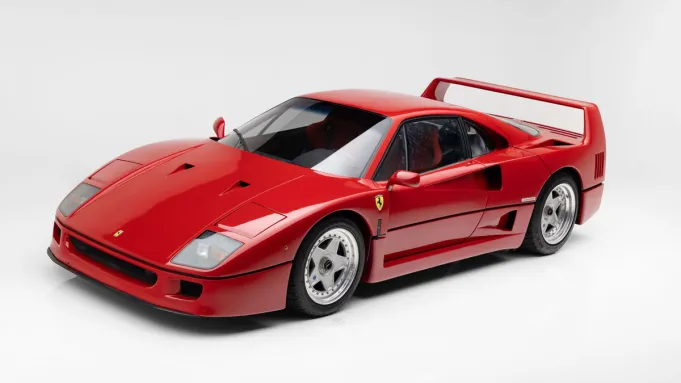
This 1990 Ferrari F40 sold through RM Sotheby’s for $3.855 million last year.
RM Sotheby’s
The design was by Pininfarina’s Leonardo Fioravanti, author of the Ferrari 308, from whose profile the 288 GTO was derived. There’s no denying that its successor, the F40, is a masterpiece in the Ferrari portfolio, with then-state-of-the-art design cues such as a basket-handle rear spoiler and plentiful NACA ducts that, together with other aero-details, give the F40 a slippery drag coefficient of 0.34.
The body, built by Scaglietti, is composed of Kevlar, carbon-fiber, and aluminum panels covering a tubular spaceframe chassis. The F40 is a featherweight in comparison to any supercar of the 21st century, with a curb weight well under 3,000 pounds, aided by the elimination of creature comforts such as interior door panels, a carpeted interior, and a radio, which would be inaudible anyway.

This example had approximately 224 miles on it when sold at auction in 2025, and had previously been in storage for 35 years.
RM Sotheby’s
Under its rear clamshell is a 2.9-liter, fuel-injected V-8 engine, mounted longitudinally, unlike the transversely mounted V-8 powering Ferrari’s 308 and later 328 models. Developing 478 hp at 7,000 rpm, the F40 also features twin turbocharging, the first implementation of that emerging technology for a Ferrari road car. And a five-speed transmission sends power to the rear wheels. Performance numbers for the day were truly impressive, including a zero-to-60 mph time of less than 4.0 seconds, and a factory-claimed top speed of 201 mph, making it Ferrari’s most powerful road car developed at the time.

The car’s 2.9-liter, fuel-injected V-8 engine makes 478 hp and 425 ft lbs of torque.
RM Sotheby’s
Although 400 examples were initially planned, demand far outstripped original projections. Despite an MSRP of approximately $400,000, about 1,315 examples of the F40 were ultimately produced by the time most production ended in 1992. (A few LM, Competizione, and GTE versions were built through 1996.)
Importantly, the F40 didn’t come to the United States until 1990, with just 213 finding their way stateside when new. Those production numbers crunch nicely, meaning that there are sufficient F40s on the market in any given year to stimulate collector interest, and yet the model will always remain a rare sight on concours fields, and rarer still on roads.

About 1,315 examples of the F40 were ultimately produced by the time most production ended in 1992.
RM Sotheby’s
Values usually hover at $3 million to $4 million today, jumping from well under $2 million in late 2021 to nearly double in late 2025. This year, the F40 is poised to break new records as new and seasoned collectors seeking an authentic “analog” driving experience continue to be drawn into its thrall. Case in point; a 1992 Ferrari F40 recently sold through the RM Sotheby’s Miami auction, in conjunction with the ModaMiami concours, for $5.23 million.
Click here for more photos of this 1990 Ferrari F40.

This time-capsule 1990 Ferrari F40 sold through RM Sotheby’s in 2025.
RM Sotheby’s
Authors
-

Robert Ross
-
Coastal Coin Necklace
$34.00 -
Resort Palmtree Necklace
$64.00 -
Oceanside Sparkle Studs
$38.00 -
Coin Necklace
$34.00