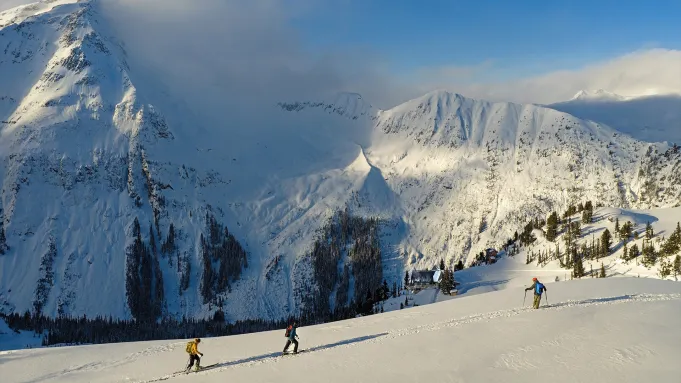
As I set out on my first morning from Battle Abbey, the storied ski-touring lodge set deep within British Columbia’s Selkirk Mountains, thick gray clouds quickly swallow the just-risen sun. Wind whips ferociously, kicking up gusts of powdery snow. I can hardly see the track in front of me, let alone the towering fangs of granite. With a windchill of minus 2 degrees Fahrenheit, the weather is downright inhospitable. But when our guide, Kenton Lambert, gathers our group of seven guests behind the shelter of a giant boulder and asks, “Who’s up for a little adventure?” he’s met with a unanimous show of gloved hands. And so, rather than backtrack and ski down into the protected trees behind the lodge, we strap our skis and splitboards to our packs, put our heads down, and begin a 15-minute bootpack up Foremast Ridge.
Barely visible below us is a conical pile of rocks. Lambert later tells me it’s a memorial to Hans Gmoser, the Austrian mountain guide and heli-skiing pioneer who, along with American alpinist Bill Putnam, founded Battle Abbey as a private ski haven in the 1970s. Gmoser would have approved of our decision to press on. “This mountain to us is not a sports arena,” says Gmoser in Bugaboo Dreams: A Story of Skiers, Helicopters & Mountains, a book about the history of heli-skiing. “To us it is a symbol of truth and a symbol of life as it should be. This mountain teaches us that we should endure hardships and not drift along the easy way…”

Battle Abbey, pictured at night against the backdrop of the Selkirk Mountains.
Nansen Weber
Our climb is definitely not the easy way, but it takes us to the south bowl of Schooner Pass, where the wind is more of a whisper than a roar, and the snow is unfathomably light and deep. Hints of blue sky peek through the clouds as we transition from our touring equipment to our ski gear and, one by one, follow Lambert’s track—ripping fresh lines some 3,600 feet from the high alpine into the spruce and white-bark pine. My snowboard floats over the waist-deep snow, replicating the feeling of surfing a glassy ocean wave.
“White room!” shouts our second guide, Troy “Sweet-lines” Grant, as my board sprays me with a plume of powder that whites out my view for what feels like a solid minute. At the bottom, he fist-bumps me and, with a wink, adds, “We only deliver five-star runs here.” We regroup, press our sticky nylon-and-mohair climbing skins to the bottom of our skis so we can glide forward without sliding back, and climb another 90 minutes to find our next five-star line, which proves even more thrilling than the last.
On our final push back to the lodge, the weather’s mood shifts again, and we’re battered by bone-chilling wind. The cold restricts blood flow to my fingers, triggering a tingling, nausea-inducing sensation known as the screaming barfies. My muscles ache from the effort. Yet as Grant zooms past me on his skis, enthusiastically yelling “Best day ever!” I can’t help but crack a frozen grin. Kitchen Envy—an epic 35-degree slope—deposits us straight at the door of Battle Abbey just after five p.m. The barrel sauna is piping hot, craft beer from Whitetooth Brewing Company and Mt. Begbie is on tap, and chef Jessica Walkden has laid out an après-ski spread of bubbling fondue and charcuterie. We toast to our day by the wood-burning fire of the high-ceilinged living room, marveling at the contrast of where we are and where we’ve been.

Skiers brave the elements on their uphill journey.
Jordan Drew/Alpine Media
As mountains become commodified by corporate ski resorts—crowded pistes, outrageously priced lift tickets—heading into the backcountry has become a way to rediscover the soul of skiing. “Many people wouldn’t think in terms of skiing unless they had a lift to carry them to the top of the slope,” muses Gmoser in Bugaboo Dreams. “To be bound to one slope, even to one mountain, by a lift may be convenient but it robs us of the greatest pleasure that skiing can give, that is, to travel through the wide, wintry country, to follow the lure of the peaks which tempt on the horizon and to get away from all the noises of our technological age and into some clean, mysterious surroundings.”
In an era of comfort, ease, and predictability, there is something deeply satisfying about braving the elements and earning your turns in untamed wilderness. Perhaps this helps explain why alpine touring—the oldest and purest form of skiing—is booming. Participation has almost doubled in the past five years, with over 2.15 million Americans choosing to skip the luxury of a heated lift and instead grind uphill on skis, according to Snowsports Industries America.
When we visited Battle Abbey, it felt like the last piece of paradise in B.C.
Gmoser’s trailblazing idea—to secure a car’s ski rack to the skids of a helicopter with a bungee cord and fly skiers to a glacier so they could carve virgin powder—is no longer novel. Today, you can heli-ski almost anywhere, from Iceland to Antarctica. In British Columbia alone there are more than 20 companies to choose from, including Canadian Mountain Holidays, founded by Gmoser in 1959 (with ski tours starting in 1965). CMH, as it’s known, is credited with laying the foundation for the commercial heli-skiing industry in North America and is now the largest heli-ski operation in the world.

The lodge’s living room and deck have panoramic views of 10 glaciers and 9,842-foot-tall peaks.
Matt Charland
As his business expanded in the 1970s, Gmoser became weary of the demands of growing a brand and the rushed pace of heli-skiing. He craved an escape where he could reconnect with the mountains, and after more than a decade of flying around British Columbia’s peaks, he had a good idea of where to find one: the Battle Range. He reportedly heli-dropped his friend Bill Putnam into this isolated subregion of the Selkirks and instructed him to find a dream location. The agreement was that they’d build a lodge that Putnam could use during the summer and Gmoser would use for his longtime ski-touring friends in winter.

Vintage photos and mountaineering equipment hang from hallway walls.
Nansen Weber
Putnam scouted a prize parcel perched just above tree line at 7,200 feet, far from roads, power lines, and any other signs of civilization. If terrain were terroir, this would be Burgundy, with both south-facing aspects and colder north faces that hold the snow later in spring. Located on the east side of the Selkirk watershed divide, this area receives big dumps of snow in the high peaks, and the geography also creates a lens of cold air in and around those peaks, keeping warm air fronts away from the Abbey. It’s a unicorn ski destination.
The duo, as well as a handful of friends, began construction in 1977. Putnam was known to jokingly refer to the lodge as a “geriatric home for alpinists.” Built from granite and timber cut from the hillside, the humble lodge was, and still is, a cathedral of sorts for mountain lovers. In fact, the site takes its name from the Benedictine monastery Battle Abbey, founded by William the Conqueror to commemorate the Battle of Hastings in 1066. It’s fitting for a location that asks its visitors to reach a sort of nirvana through trial, grit, and sheer force of will.
From its doorstep, you can access almost any fathomable type of topography, from endless glades and big mountains (like the 10,305-foot-tall Mount Butters) to couloirs and glaciers such as Typee. “I would say we grew into the terrain at Battle Abbey,” says Roger Laurilla, an alpinist who helped build the lodge as a teenager and worked alongside Putnam and Moser until they retired in the early 2000s. He and Gmoser’s son, Robson, acquired it from and CMH in 2004. “By the time Robson and I owned the hut, we had developed more lines and bigger runs, the ski-touring guests were more fit and adventurous.”

Perched at 7,217 feet, Battle Abbey gives guests every imaginable type of terrain, from glaciers and steep chutes to couloirs and trees.
Nansen Weber
Now, a new chapter is being written in Battle Abbey’s history. In 2024, Laurilla sold Battle Abbey to Nansen and Tessum Weber, two ski-obsessed brothers with a background in tourism and polar exploration. “I still chuckle that Roger warned us how remote the lodge is,” recalls Tessum, who made his first foray into the Arctic with his parents when he was just six weeks old. “Nansen and I spent most of our lives in the most remote parts of the world, 2,000-plus miles from the nearest city, dodging polar bears and filming narwhal. Battle Abbey is certainly isolated for B.C., but you can still reach a hardware store with a short heli flight.”
The Webers have a penchant for adventure woven into their genes. All the members of their immediate family were competitive Nordic ski racers, and their mother, father, and grandfather were vaunted polar explorers. Their father, Richard, was awarded the Order of Canada for his exploratory efforts. My friend Eric Larsen, the accomplished American polar explorer, described Richard’s unsupported expedition from Canada to the North Pole and back as “the hardest North Pole expedition in history, full stop.” Tessum, 36, tall, lean, and tanned, already has two world records for trips to the North Pole.
We only deliver five-star runs here.
When Nansen and Tessum weren’t helping their parents run Arctic Watch, a secluded fly-in camp in Nunavut that offered wildlife tours, they were leading largely word-of-mouth ski expeditions. They established the world’s northernmost heli-ski operation on Baffin Island, as well as superyacht-based heli-ski trips on Greenland. When Arctic Watch closed in 2025 after 25 years of operation, the brothers launched ski-focused Weber Powder and turned their attention to the mountains of British Columbia, where they’d spent most of their winters.
“We’d been to a handful of ski lodges in B.C. and saw an opportunity to do something different,” says Tessum. “When we visited Battle Abbey, it felt like the last piece of paradise in B.C.” Simon Dupéré, an entrepreneur from Montreal who booked three trips during Battle Abbey’s inaugural 2025 season and has another planned for 2026, tells me on the phone, “It’s my definition of heaven. You’re touring among the most beautiful nature I’ve ever seen.” I feel the same sentiment before I even strap into my splitboard.
Most ski-touring lodges are no-frills huts that cater to hardy mountaineers who’d balk at the idea of taking a gondola or a lift. But the Webers have reimagined Battle Abbey with all the comforts associated with a top-notch heli-lodge. Tessum has personally curated the 750-bottle wine cellar with small-batch wines from British Columbia, like Little Engine and Covert Farms Family Estate. Chef Walkden crafts Michelin-worthy cuisine from meticulously sourced products like bison procured from a local fifth-generation ranching family in Hudson Hope and Arctic scallops from a family-owned business in Vancouver. There’s also an espresso bar and a fully equipped boot room.

The newly imagined Battle Abbey’s farm-style dining table.
Nansen Weber
But the real luxury is the intimacy and hands-on attention guests receive, from sitting by the fire and gazing out at the glaciers to shredding powder in the alpine. The lodge has five rooms and can accommodate 10 guests who are paired with four ski guides—one of the highest guide-to-guest ratios in the industry—to ensure everyone has their perfect ski day, whether that’s a half-day of mellow touring or a full send-up into the big mountains.
I arrive in early January, during one of the snowiest seasons on record in the area since 2000. From Calgary airport, a shuttle whisks me three hours to the Weber Powder hangar in Golden—a blue-collar railroad and timber town and the gateway to Kicking Horse, one of the rowdiest ski resorts in North America. Nansen, tall, lanky, and sporting neon Vuarnet shades, greets me with a firm handshake. Our group represents every decade from 30s to a spry 70. I am joined by Rob Lane, a repeat guest from Nova Scotia, and his friend Howard Wightman; Nansen and Tessum’s cousin Bjorn Weber, who works in forestry and helped glade 190 additional acres of terrain at Battle Abbey last summer; and Warren Lever, Tom Harris, and Steven Davies, three friends who met working at Nav Canada’s Vancouver Area Control Centre (VACC).
An 18-minute flight in a Bell 212 deposits us into the high alpine. If weather permits, guests can do a heli-descent to the lodge, however the visibility isn’t in our favor. We waste no time getting into the mountains. After a thorough safety briefing and tutorial on how to use our transceivers, shovels, probes, and avalanche bags—all supplied by the lodge—we head up a ridge behind the lodge in search of long lines and deep snow. Chitchat quickly subsides as we find our rhythm. “Uphilling” is the ultimate longevity workout, while also being extremely meditative. “I find myself in this peaceful, Zen-like headspace,” 63-year-old Lane tells me over dinner that night. “I’ve heli-skied but you’re so rushed you don’t even have time to take a breath and appreciate the scenery. This is my preferred pace in the mountains.”

Hyperlocal multicourse meals are paired with small-batch B.C. wines.
Nansen Weber
Over the next four days, we explore just a sliver of the 12,500-acre parcel, stopping midday to lunch on sandwiches, miso soup, and homemade cookies beneath Seussian trees bent at cartoonish angles, limbs heavy with snow. Each day, we return to après snacks and multicourse meals featuring dishes like fennel-seared albacore tuna and caramelized pork tenderloin served over polenta. According to my Whoop, I’m burning an average of 2,500 calories a day, so I feel no guilt indulging in desserts, like sticky toffee pudding with Baileys ice cream.
Around the old-growth-fir dining table, Nansen regales us with tales of the rebuild. “The old lodge was literally sliding down the mountain, and there was a wall filled with squirrels and varmints,” he says. The brothers, along with some friends and local stonemasons, spent 135 straight days renovating the building, staying true to the original footprint while adding a big picture window in the living room as well as a sprawling deck. Walls are decorated with vintage mountaineering equipment including an ice ax their grandfather Hans Weber used on ascents of peaks in the Arctic. Like Gmoser, Hans Weber came to Canada from Europe after World War I and joined the Alpine Club of Canada. “According to family legend, they crossed paths in the mountains and competed for my grandma’s affections,” says Nansen.

The new barrel sauna with mountain views.
Matt Charland
There are plans to add an additional room or two, plus a houseboat for guests who want to stay on a nearby lake in summer, and within five years the brothers want to develop a network of wilderness lodges throughout B.C. “It’s a natural evolution of our family, and we’re lucky to see it come full circle,” says Nansen.
On our final day, the wind is quiet and the clouds break to reveal a cornflower-blue sky and a lingering half-moon. We have four hours before the heli arrives to transfer us back to civilization—enough time for one long powder run. After discussing the avalanche danger and snow conditions, the guides decide to take us up Omoo Glacier (all the surrounding peaks, such as Pequod and Moby Dick, take their names from Herman Melville novels). We skin across a frozen lake then climb slowly for 90 minutes, with Lambert heroically breaking trail in the seemingly bottomless powder.

A skier facing the mountain from the terrace.
Matt Charland
When we reach the top, I understand what Tessum meant when he said these mountains make you feel alive. One by one, we follow Lambert’s long, steep line through the featherlight, sparkling snow. Powder-drunk is the only way to describe the emotion I have when we reach the bottom. On the heli back to Golden, every guest has a far-off, wistful look in their eyes. This kind of mountain pilgrimage has a way of stripping away the noise—after the high-octane adrenaline rush, you’re left with a sense of ceremonial stillness, a kind of high that defies many of modern life’s high-tech pleasures.
Top: From the front door of Battle Abbey, lodge guests have exclusive access to 12,500 acres of ski-touring terrain.
A five-day trip to Battle Abbey starts at about $3,984 per person, including guiding, meals, safety equipment, and transfers from Calgary. A buyout of the lodge starts at about $39,134 for up to 10 guests.
-

Coastal Coin Necklace
$34.00 -
Resort Palmtree Necklace
$64.00 -

Oceanside Sparkle Studs
$38.00 -
Coin Necklace
$34.00