This story is from an installment of The Oeno Files, our weekly insider newsletter to the world of fine wine. Sign up here.
While the famed Médoc is known as the home of some of the world’s finest bottles of Cabernet Sauvignon, one producer is quietly bucking the trend. Acquired by Baron Edmond de Rothschild more than 50 years ago, Château Clarke (a historic estate dating back to the 12th century) not only crafts a Merlot-dominant Left Bank wine in the heart of Cabernet country but also makes a rare white in Listrac-Médoc, which traditionally produces only reds. Made using all four permitted white varieties rather than the usual Sauvignon Blanc and Sémillon, in 1995 Château Clarke revived this heritage bottling, which was first made in 1898. With the same vineyard and cellar team at the helm for almost 30 years, this pillar of the de Rothschild family’s winemaking expertise deserves the spotlight it has rarely received.
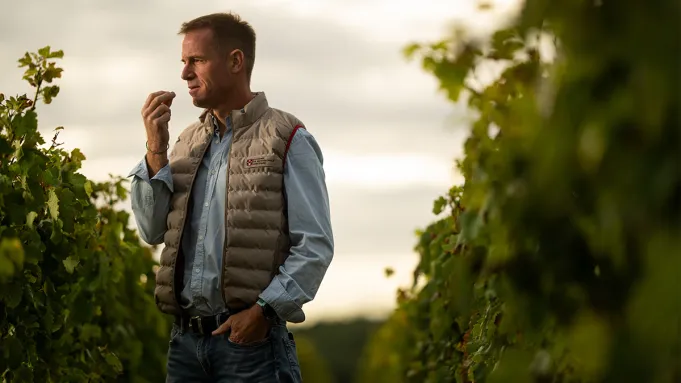
When de Rothschild visited Château Clarke for the first time, there were several prestigious estates on the market, including the likes of Château Margaux and Château Beychevelle, yet he chose this rundown, neglected property “precisely because everything remained to be done,” says Château Clarke winemaker Fabrice Darmaillacq. “Edmond de Rothschild was not looking for a name; he was seeking a place of expression. Clarke thus became the work of his life.” It was truly an audacious move: The de Rothschild name is associated with some of the most prestigious wine in the world, and it had been many years since Château Clarke’s bottles had been considered anything but ordinary at best.
Although conventional wisdom holds that Bordeaux’s Left Bank in general and the Médoc in particular are Cabernet Sauvignon territory, the Listrac-Médoc subregion is home to large plantings of its half-sibling Merlot, which today makes up 70 percent of the 136 acres at Château Clarke planted with red grapes. (An additional 13.5 acres are planted with white varieties.) The first several releases were based on Cabernet Sauvignon, but the Château Clarke red became a Merlot-driven blend starting with the 1986 vintage. “Surrounded by a team of experts, de Rothschild and his team came to the conclusion that Château Clarke’s terroir was more suited to growing Merlot,” explains Darmaillacq, who describes the estate as a “singular terroir,” with a vein of clay and limestone and deep, cool soils that “benefit the culture of Merlot.” He explains that the coolness of clay allows the Merlot to ripen slowly in warm conditions, helping to preserve its natural acidity.
“If we tell our customers that it is from the Left Bank, they immediately think it will have more Cabernet Sauvignon,” says Roxanne Langer, co-owner and sommelier of LadySomm, a wine bar and shop in Carmel, Calif. “The average consumer does not know that the Listrac-Médoc is primarily Merlot, so informing our customers makes the wine more interesting and helps them understand it.” Despite their genetic similarities, Merlot has naturally softer tannins than Cabernet Sauvignon, leading to a wine that is often lighter on the palate and easier to enjoy in its youth. “This distinction explains the wine’s softer texture, approachable fruit profile, and aromatic brightness,” Langer tells Robb Report.

Not your usual Bordeaux Blanc
Château Clarke
In Bordeaux, Merlot’s natural characteristics were masked for many years by heavy oak aging, Darmaillacq points out, resulting in a more rigid style of wine. However, the combination of the chateau’s unique terroir and the cool Bordeaux climate provide an ideal foundation for a Merlot that is fresh, refined, and balanced, “a wine that respects both flavor and structure, while revealing the true personality of the grape,” he says. Lying between the Pauillac and Margaux appellations, the Médoc is known for good rather than great wine, and de Rothschild set out to change that from day one. He replanted the vineyards rather rapidly, completing the project by 1978, just five years after his acquisition. With the goal of reviving the reputation that Château Clarke enjoyed throughout the 19th century and the early part of the 20th, he also resuscitated Le Merle Blanc, a rare white Bordeaux made with Sauvignon Blanc, Sémillon, Sauvignon Gris, and Muscadelle.
Considered an excellent businessman and a bit of a visionary, de Rothschild anticipated a growing demand for white wine long before the rest of the industry caught on; the re-release of Le Merle Blanc took place in 1995. In a playful nod to its rarity, its name means “the white black bird.” Whites abound throughout the larger Médoc, but Listrac-Médoc is a hard-core red wine zone, so it was considered daring to produce a white here. Darmaillacq explains that the addition of Sauvignon Gris and Muscadelle to the usual Sauvignon Blanc and Sémillon brings greater complexity to the wine. “By blending four varieties, we created a limited-production wine with a harmonious profile; rich and textured, yet simultaneously fresh, vibrant, and fruit-forward,” he says.
“Explaining the blend and that it brings aromatic lift, textural richness, and freshness provides guests a deeper understanding of how Bordeaux’s sub-regions and varietal diversity shape style beyond expectation,” Langer explains. She loves to pair the white with oysters on the half shell topped with citrus mignonette; while she prefers oysters from Bordeaux’s Bay of Arcachon for a true local marriage, she says oysters from anywhere will do. Regardless of origin, Langer sees this as what she calls a “mirrored pairing,” because the wine’s acidity and minerality pair perfectly with the same qualities in the oysters.
Made with 70 percent Sauvignon Blanc and 10 percent each of Sauvignon Gris, Sémillon, and Muscadelle, Le Merle Blanc could be labeled Médoc Blanc—a new appellation, permitted from the 2025 vintage onwards—in the future rather than the more widely recognized Bordeaux Blanc. Despite Darmaillacq’s belief that this may allow Château Clarke and its neighbors to establish a category defined by very high quality, small-production wines, thus setting it apart from large-volume, generic Bordeaux Blancs, he is aware of the challenges an unknown AOP presents, which could potentially confuse wine lovers. “Our aim is always to make the world of wine clearer, more accessible, and more approachable,” he says. de Rothschild may have been a rule-breaker, but it seems that there are limits to what the market will bear.
Do you want access to rare and outstanding reds from Napa Valley? Join the Robb Report 672 Wine Club today.
Authors
-
Mike DeSimone and Jeff Jenssen

-
Coastal Coin Necklace
$34.00 -
Resort Palmtree Necklace
$64.00 -
Oceanside Sparkle Studs
$38.00 -
Coin Necklace
$34.00