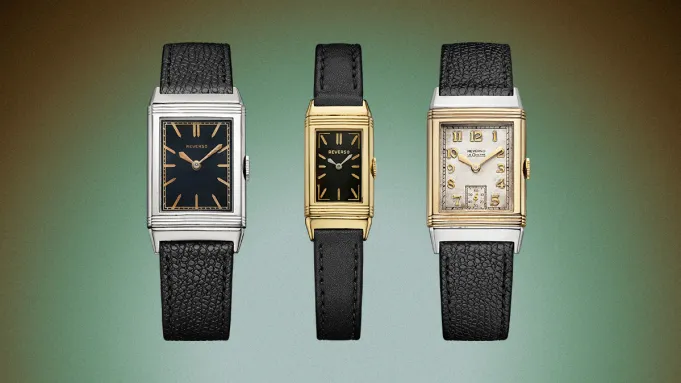
Catch them if you can. Jaeger-LeCoultre is back with another round of The Collectibles, it’s highly-anticipated capsule collection of rare vintage timepieces meticulously sourced and repaired by the brand. The fifth series launched last night to a packed house at the Swiss watchmaker’s Madison Avenue boutique, where heritage director Matthieu Sauret was on hand to show off eight extremely rare and early Reversos. Most of the pieces date to the earliest years of production for the model and, while some have already been spoken for and most, if not all, will go to VIPs, these museum-status pieces are still worth checking out and will be on view at the New York City flagship store now through February 23.
Tracking down Reversos dating back to the models origin years isn’t easy, even for the company that made them, which is why there are so few available. “It was a big of a challenge,” Sauret tells Robb Report. “They’re hard to find. They’re the oldest pieces that we have and the production was very limited.” The first Reversos were only in production from 1931 to 1942 and in small numbers, so they remain scarce. Adding to the difficulty in the hunt for the model is the fact that at the dawn of its creation, it was intended for the polo-playing British army officers stationed in India during the ’30s. “It was a watch that was advertised to be worn for tough times or sports, so sometimes they’re not in as perfect of a condition as we would hope,” says Sauret. In fact, it took his team of five in the heritage department one and a half years to source and then restore eight perfect examples. Restoration, in this case, means finding already pristine examples and bringing them back to working order using period-correct, authentic parts.

A rare two-tone LeCoultre Reverso
Jaeger-LeCoultre
Every piece is a unicorn of sorts, and as the popularity of the Reverso continues to see a resurgence, will probably continue to increase in value. But a few examples standout. Sauret points to a two-tone Reverso, which he says is likely the first two-tone watch ever made by the company. He has never seen a model earlier than this one in this dual-metal casing. Adding to its interest is its execution in yellow gold paired with Staybrite, rather than stainless steel. Early versions of stainless steel were hard to machine and polish, so Staybrite—an alloy composed of iron, chromium, and nickel—was often used during the era. Another is a black-dial Reverso with tan-hued indices and hands, that Sauret says is one of the earliest Reverso’s ever made. “This is about as close to a museum piece as you can get, because it is an original Reverso,” he says. In the first year of production, he estimates that probably less than 200 were made. The $45,000 piece has no engraving on the backside, which means it’s ready to be transformed into a personal family heirloom.

One of the first Reverso models ever made from The Collectibles
Jaeger-LeCoultre
Marking another historical milestone is a 1937 example (pictured below), which Sauret says is the earliest “Jaeger-LeCoultre” branded Reversos he has ever seen. It heralded the partnership between the Paris-based watchmaker Edmond Jaeger and the Swiss manufacture LeCoultre & Cie when they formally became one name that same year. What is also particularly noticeable about this example is the unusual quality to the dial and numerals. The hour markers were created by punching a plate of metal from behind with the outline of the numerals so they are raised on the dial. “You see the numerals are actually three-dimensional, but then they have to paint it, but they cannot paint the numerals,” says Sauret. “They likely used wax to cover them and then painted the rest of the dial. When you look at it you can see that the guy that painted the dial actually made up for the mistake of the guy that did the metal part so he was painting a little thicker on some parts to have something very flat.” The amount of precision required to do this work is hard to quantify, but Saret says if they were to do a dial in this same way today it would likely cost $10,000 to make. “The sophistication of the craft they were using is out of this world.”

One of the earliest examples of a Jaeger-LeCoultre-branded Reverso from The Collectibles
Jaeger-LeCoultre
But, of course, there are important vintage Reversos for women in The Collectibles as well. Take for instance the petite Reverso on a chrome cord bracelet and a Staybrite case from roughly 1932 or 1933. “Every time I see it, I’m like ‘Are we ok to sell this?’” says Sauret. “Because I’ve never seen one like this before.” The blued hands are also particularly bright for a vintage model.

A 1932 or 1933 women’s Reverso on a chrome cord bracelet
Jaeger-LeCoultre
Many of the timepieces come to the brand either via dealers or small auction houses. Sauret says some of the best finds are at small, relatively unknown auction houses or estate sales in France or the U.K. Of course, the joy is always in the hunt. “There is someone very important that has taught me many valuable lessons and one day he said to me, ‘There is never a good road to a good fishing spot,’” says Sauret of locating these ultra-rare pieces. “This is very true.” With so few available, you can expect these will go only to VIPs and, indeed, some have already sold but if you have even a cursory interest in one of the most defining eras of the brand, they are not to be missed.
Authors

-
Coastal Coin Necklace
$34.00 -
Resort Palmtree Necklace
$64.00 -
Oceanside Sparkle Studs
$38.00 -
Coin Necklace
$34.00