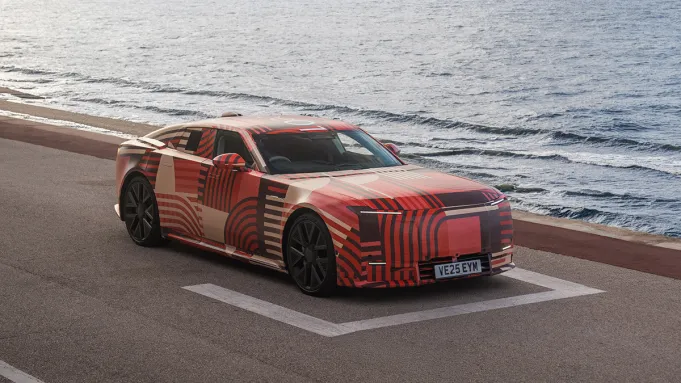
Mazda defines itself as an upstart “challenger” brand amongst its core Japanese peers—Honda, Toyota, and Nissan. This is based not only upon its name recognition and sales, both of which are dwarfed by its competitors, but also by its location in its home market. While those brands are headquartered in a cluster around Tokyo, Mazda is located further south, in Hiroshima.
Yet while growth amongst these brands has been somewhat uneven in the American market recently—Honda and Toyota have seen their market share stagnate over the past decade, while Nissan’s has plummeted—Mazda set a new sales record in the United States in 2024, moving nearly 425,000 vehicles, an almost 17% increase over 2023, a year that compounded gains of more than 23% over 2022. In fact, the brand was one of the few automakers to consistently increase sales throughout the 2020s, including during the COVID-19 pandemic, which decimated the global supply chain.
According to Brian Moody, executive editor for Kelley Blue Book at Cox Automotive, since 2012, Mazda’s long-term average share of the American new car market has increased by 35%. Of course, according to Moody, the brand remains “stuck” at just under 3% of the market overall, but that is a significant improvement over its historic 2% share. And garnering this smallish corner of the market is intrinsic to the brand’s identity. It does not want to be a high-volume player. It wants to emulate Mercedes and BMW, which both have an American market share between 2% and 3%.

The Mazda Museum
Dan Froude
Intriguingly, all of this growth took place despite the fact that the brand does not offer a pure battery electric vehicle (BEV) in the US. More intriguingly, it has taken place as the marque has aggressively pushed into a higher price point; according to Kelley Blue Book, as recently as last month, in March 2025, Mazda’s transaction prices had increased more than just about any other brand.
“The way we work and think is to take a challenge positively and utilize an event as something that makes us stronger,” says Jeff Guyton, Mazda’s global chief financial officer, of the brand’s march upmarket following the manufacturing vagaries of the pandemic. “As I marry product up to pricing, my hope is that we can connect that increase to the experience that customers hope for.”
Mazda’s enhanced pricing structure is organized around enhancing two core brand equities. The first is engineering. “High-quality, precision engineering came about in Hiroshima because it was chosen as a safe port for the Japanese military because it was in a cove and thus easier to defend with a navy,” says Ryuichi Umeshita, the brand’s global chief technical officer. “An iron industry was developed in Hiroshima from 1000 years ago, and pre-World War Two, the biggest industry was shipbuilding. When Mazda was founded in 1920, many engineers came from the shipbuilding industry.”

Mazda Cosmo Sport
Mazda
Mazda thus staked its survival on mechanical innovation and the differentiation it offered in contrast to the competition. For decades, this has revolved around its unique promotion and utilization of the Wankel rotary, a gasoline-powered motor that is distinct from the basic internal combustion engine. This design is more compact, lightweight, and free-revving, and has fewer moving parts than a traditional piston engine, though it also frequently suffers from diminished reliability and increased oil usage and tailpipe emissions. For decades, it powered the brand’s iconic RX- line of sports coupes.
While Mazda has not yet given up on the Wankel, it has recently promoted another iconic engine, the inline-six-cylinder. Long preferred by German luxury brands such as BMW and Mercedes for its smooth, even power delivery, the I-6’s notable length also requires a long hood. And it’s typical coupling with rear-wheel (or all-wheel) drive, dictates proportions long associated with more exclusive vehicles: a cabin that is pushed back from the front wheels, providing a sense of potency and occasion.
The contemporary Mazda CX70 and CX90 SUVs offer just such a powertrain, and their correlative form suggests the brand’s other focus as it attempts to move upmarket: design, by pushing the cabin back from the long hood, the three-row CX90 sacrifices a bit of rear cargo room. Yet, instead of this being registered as a liability, Mazda sees this distinction as a benefit. “We might lose some customers; otherwise, we cannot move upmarket,” says Masashi Nakayama, the brand’s chief designer. “Otherwise, we are no different from Honda or Toyota.”

Mazda concept
Dan Froude
Experts agree with this assessment. “In terms of the strategy of moving upscale, it has been working. Mazda has gradually put the brand’s previous ‘zoom-zoom’ tagline behind them and made tangible improvements and updates to their vehicles over the years,” says Moody. “The new CX-90 is a perfect example. It’s not just the same old car with extra features added. It has a turbocharged inline 6-cylinder engine, just like many European brands. The interior colors, textures, and tech are all excellent. And the vehicles simply look and feel like they’re engineered to a high standard. I would put Mazda on par with Acura and Lexus.”
Mazda’s movement upmarket began in 2010 with its so-called Kodo Design sensibility, which Nakayama describes as a “rhythm of form,” imagining the “car as art.” Foundational to this style is the traditional use of hand modeling in clay, creating life-size models of the shapes and surfaces of the vehicles Mazda produces.
“Mazda is a small brand, but it is the number one user of clay,” says Nakayama. This, he says, imbues its vehicles with a desirable and premium sensibility, one that surpasses automakers that rely on computer assisted design. “It is difficult to make handmade design by mass production. So we create value through cultivating human creativity. If we rely only on digital technology, we will be no different from other automakers. Digital design they use eyes. Clay design, we use hands. There are many things you don’t know until you touch them. We incorporate tactile feel into design. If we don’t have that sense of wanting to touch, we just have clean design.”

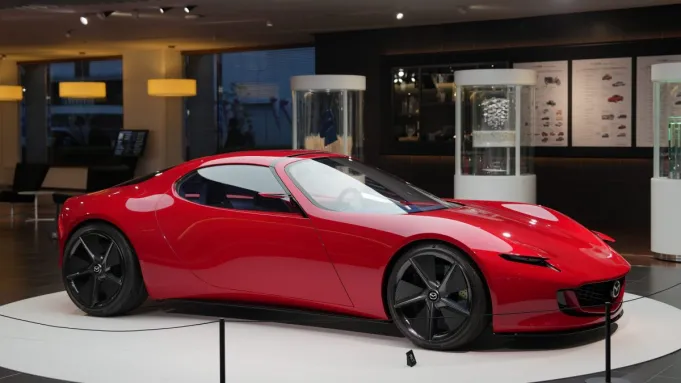
Mazda Iconic SP
Mazda
Mazda has combined these design features with an extremely consistent aesthetic that is reflected in and permeated throughout its whole family of vehicles, like Audi or BMW. It also uses a proprietary paint process that echoes the sensibility of liquid metal, especially in its signature “Soul Red” color. “The brand wanted to create a premium brand value, and used surfacing and rich surface color to stand out,” says Keichi Okamoto, a creative design expert at the brand. “This yielded colors that are both more vivid and deeper, a seeming contradiction, as gaining depth typically reduces vividness. Our Soul Red looks like both rubies and fine wine.”
Mazda produces its best-selling CX-50 midsize SUV at a domestic plant in Alabama, but all of its other vehicles are made overseas, and thus subject to the current administration’s misguided import tariffs. The brand’s decision on how to handle these significant increases in the price of doing business in America may, coincidentally, enhance just the effect Mazda is intentionally pursuing: increasing price.
Though this aligns with certain aspects of the brand’s goals, it may not align with all of them. “We have to provide an experience and product that makes people say, ‘Yeah, I want to pay that,” Guyton says. “Tariffs or not.”
-

Coastal Coin Necklace
$34.00 -

Resort Palmtree Necklace
$64.00 -
Oceanside Sparkle Studs
$38.00 -

Coin Necklace
$34.00